


Page 784 - Cardiac Nursing
P. 784
1
                                             2:0
                                               4 A
                                        009
                                        009
                                            1
                                                 A
                                                 A
                                                 A
                                                 A
                                                 A
                                                 A
                               d
                                 3
                                  0
                        3-7
                          68.
                             qx
                                    0
                                     6
                                       2
                     p7
                                  0
                                   /
                                                               ara
         LWB K34 0-c 32_ p7 5 3-7 68. qx d  3 0 / 0 6 / / 2 009   1 2:0 4 A M  Pa g g e 7 60  Apt ara
                                                            Apt
                                                               ara
         L L LWB
                0-c
            K34
         LWBK340-c32_32_p7553-768.qxd  30/06/2009  12:04 AM  Page 760 Aptara
                  32_
                                                 A
                                                  M
                                                 A
                                                 A
                                                 A
                                                    Pa
                                                       e 7
                                                         60
                                                         60
                  760    PA R T  V / Health Promotion and Disease Prevention
                     9
                     8
                     7
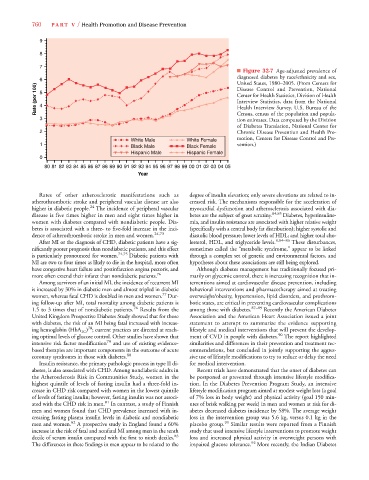
                                                                                     ■ Figure 32-7 Age-adjusted prevalence of
                                                                                     diagnosed diabetes by race/ethnicity and sex,
                     6                                                               United States, 1980–2005. (From Centers for
                    Rate (per 100)  5 4                                              Disease Control and Prevention, National
                                                                                     Center for Health Statistics, Division of Health
                                                                                     Interview Statistics, data from the National
                                                                                     Health Interview Survey. U.S. Bureau of the
                     3                                                               Census, census of the population and popula-
                                                                                     tion estimates. Data computed by the Division
                                                                                     of Diabetes Translation, National Center for
                     2                                                               Chronic Disease Prevention and Health Pro-
                                                   White Male        White Female    motion, Centers for Disease Control and Pre-
                     1                             Black Male        Black Female    vention.)
                                                   Hispanic Male     Hispanic Female
                     0
                       80 81828384858687888990919293 949596979899000102030405
                                                     Year
                     Rates of other atherosclerotic manifestations such as  degree of insulin elevation; only severe elevations are related to in-
                  atherothrombotic stroke and peripheral vascular disease are also  creased risk. The mechanisms responsible for the acceleration of
                  higher in diabetic people. 24  The incidence of peripheral vascular  myocardial dysfunction and atherosclerosis associated with dia-
                  disease is five times higher in men and eight times higher in  betes are the subject of great scrutiny. 84,85  Diabetes, hyperinsuline-
                  women with diabetes compared with nondiabetic people. Dia-  mia, and insulin resistance are associated with higher relative weight
                  betes is associated with a three- to five-fold increase in the inci-  (specifically with a central body fat distribution); higher systolic and
                  dence of atherothrombotic stroke in men and women. 24,73  diastolic blood pressure; lower levels of HDL; and higher total cho-
                     After MI or the diagnosis of CHD, diabetic patients have a sig-  lesterol, HDL, and triglyceride levels. 8,84–86  These disturbances,
                  nificantly poorer prognosis than nondiabetic patients, and this effect  sometimes called the “metabolic syndrome,” appear to be linked
                  is particularly pronounced for women. 74,75  Diabetic patients with  through a complex set of genetic and environmental factors, and
                  MI are two to four times as likely to die in the hospital, more often  hypotheses about these associations are still being explored.
                  have congestive heart failure and postinfarction angina pectoris, and  Although diabetes management has traditionally focused pri-
                  more often extend their infarct than nondiabetic patients. 76  marily on glycemic control, there is increasing recognition that in-
                     Among survivors of an initial MI, the incidence of recurrent MI  terventions aimed at cardiovascular disease prevention, including
                  is increased by 30% in diabetic men and almost tripled in diabetic  behavioral interventions and pharmacotherapy aimed at treating
                                                             77
                  women, whereas fatal CHD is doubled in men and women. Dur-  overweight/obesity, hypertension, lipid disorders, and prothrom-
                  ing follow-up after MI, total mortality among diabetic patients is  botic states, are critical in preventing cardiovascular complications
                  1.5 to 3 times that of nondiabetic patients. 76  Results from the  among those with diabetes. 87–89  Recently the American Diabetes
                  United Kingdom Prospective Diabetes Study showed that for those  Association and the American Heart Association issued a joint
                  with diabetes, the risk of an MI being fatal increased with increas-  statement to attempt to summarize the evidence supporting
                                     78
                  ing hemoglobin (HbA 1C ) ; current practices are directed at reach-  lifestyle and medical interventions that will prevent the develop-
                  ing optimal levels of glucose control. Other studies have shown that  ment of CVD in people with diabetes. 90  The report highlighted
                  intensive risk factor modification 79  and use of existing evidence-  similarities and differences in their prevention and treatment rec-
                  based therapies are important components in the outcome of acute  ommendations, but concluded in jointly supporting the aggres-
                  coronary syndromes in those with diabetes. 80       sive use of lifestyle modifications to try to reduce or delay the need
                     Insulin resistance, the primary pathologic process in type II di-  for medical intervention.
                  abetes, is also associated with CHD. Among nondiabetic adults in  Recent trials have demonstrated that the onset of diabetes can
                  the Atherosclerosis Risk in Communities Study, women in the  be postponed or prevented through intensive lifestyle modifica-
                  highest quintile of levels of fasting insulin had a three-fold in-  tion. In the Diabetes Prevention Program Study, an intensive
                  crease in CHD risk compared with women in the lowest quintile  lifestyle modification program aimed at modest weight loss (a goal
                  of levels of fasting insulin; however, fasting insulin was not associ-  of 7% loss in body weight) and physical activity (goal 150 min-
                  ated with the CHD risk in men. 81  In contrast, a study of Finnish  utes of brisk walking per week) in men and women at risk for di-
                  men and women found that CHD prevalence increased with in-  abetes decreased diabetes incidence by 58%. The average weight
                  creasing fasting plasma insulin levels in diabetic and nondiabetic  loss in the intervention group was 5.6 kg, versus 0.1 kg in the
                  men and women. 82  A prospective study in England found a 60%  placebo group. 91  Similar results were reported from a Finnish
                  increase in the risk of fatal and nonfatal MI among men in the tenth  study that used intensive lifestyle interventions to promote weight
                  decile of serum insulin compared with the first to ninth deciles. 83  loss and increased physical activity in overweight persons with
                                                                                          92
                  The differences in these findings in men appear to be related to the  impaired glucose tolerance. More recently, the Indian Diabetes

