


Page 800 - Cardiac Nursing
P. 800
8:3
                                        8:3
                                           5 A
                                        0
                                    009
                                    009
                                        0
                                               P
                                               P
                                                a
                                               P
                                           5 A
                                             M
                                             M
                                  9/2
                         82.
                         82.
                         82.
                           qxd
                               0
                               0
                           qxd
                    p76
                    p76
                                  9/2
                                9/0
                       9-7
                       9-7
                                9/0
         L L LWB
            K34
         LWB
                                                         ara
         LWBK340-c33_33_p769-782.qxd  09/09/2009  08:35 AM  Page 776 Aptara
                 33_
               0-c
            K34
            K34
                 33_
               0-c
                                                         ara
                                                  e 7
                                                a
                                                  e 7
                                                 g
                                                 g
                                                    76
                                                       Apt
                                                       Apt
                                                    76
                                                    76
                  776    PA R T  V / Health Promotion and Disease Prevention
                                    Fatigue Related to Recovery from CABG
                  Thoughts: “ I am useless or worthless, I will never be able to work like before, I will have to
                                                 quit”
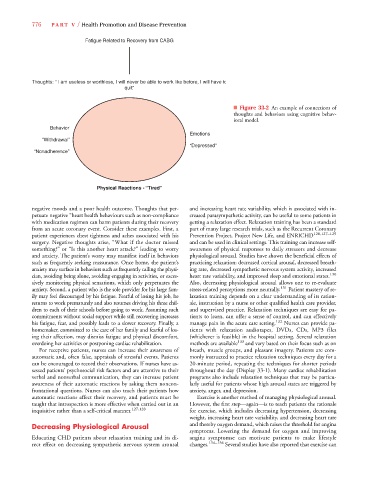
                                                                                    ■ Figure 33-2 An example of connections of
                                                                                    thoughts and behaviors using cognitive behav-
                                                                                    ioral model.
                        Behavior
                                                                      Emotions
                      “Withdrawal”
                                                                      “Depressed”
                   “Nonadherence”
                                        Physical Reactions - “Tired”
                  negative moods and a poor health outcome. Thoughts that per-  and increasing heart rate variability, which is associated with in-
                  petuate negative “heart health behaviours such as non-compliance  creased parasympathetic activity, can be useful to some patients in
                  with medication regimen can harm patients during their recovery  getting a relaxation effect. Relaxation training has been a standard
                  from an acute coronary event. Consider these examples. First, a  part of many large research trials, such as the Recurrent Coronary
                  patient experiences chest tightness and aches associated with his  Prevention Project, Project New Life, and ENRICHD 120,127–129
                  surgery. Negative thoughts arise, “What if the doctor missed  and can be used in clinical settings. This training can increase self-
                  something?” or “Is this another heart attack?” leading to worry  awareness of physical responses to daily stressors and decrease
                  and anxiety. The patient’s worry may manifest itself in behaviors  physiological arousal. Studies have shown the beneficial effects of
                  such as frequently seeking reassurance. Once home, the patient’s  practicing relaxation: decreased cortical arousal, decreased breath-
                  anxiety may surface in behaviors such as frequently calling the physi-  ing rate, decreased sympathetic nervous system activity, increased
                  cian, avoiding being alone, avoiding engaging in activities, or exces-  heart rate variability, and improved sleep and emotional states. 130
                  sively monitoring physical sensations, which only perpetuates the  Also, decreasing physiological arousal allows one to re-evaluate
                  anxiety. Second, a patient who is the sole provider for his large fam-  stress-related perceptions more neutrally. 131  Patient mastery of re-
                  ily may feel discouraged by his fatigue. Fearful of losing his job, he  laxation training depends on a clear understanding of its ration-
                  returns to work prematurely and also resumes driving his three chil-  ale, instruction by a nurse or other qualified health care provider,
                  dren to each of their schools before going to work. Assuming such  and supervised practice. Relaxation techniques are easy for pa-
                  commitments without social support while still recovering increases  tients to learn, can offer a sense of control, and can effectively
                  his fatigue, fear, and possibly leads to a slower recovery. Finally, a  manage pain in the acute care setting. 132  Nurses can provide pa-
                  homemaker, committed to the care of her family and fearful of los-  tients with relaxation audiotapes, DVDs, CDs, MP3  files
                  ing their affection, may dismiss fatigue and physical discomfort,  (whichever is feasible) in the hospital setting. Several relaxation
                  overdoing her activities or postponing cardiac rehabilitation.  methods are available 133  and vary based on their focus such as on
                     For receptive patients, nurses can increase their awareness of  breath, muscle groups, and pleasant imagery. Patients are com-
                  automatic and, often false, appraisals of stressful events. Patients  monly instructed to practice relaxation techniques every day for a
                  can be encouraged to record their observations. If nurses have as-  20-minute period, repeating the techniques for shorter periods
                  sessed patients’ psychosocial risk factors and are attentive to their  throughout the day (Display 33-1). Many cardiac rehabilitation
                  verbal and nonverbal communication, they can increase patient  programs also include relaxation techniques that may be particu-
                  awareness of their automatic reactions by asking them noncon-  larly useful for patients whose high arousal states are triggered by
                  frontational questions. Nurses can also teach their patients how  anxiety, anger, and depression.
                  automatic reactions affect their recovery, and patients must be  Exercise is another method of managing physiological arousal.
                  taught that introspection is more effective when carried out in an  However, the first step—again—is to teach patients the rationale
                  inquisitive rather than a self-critical manner. 127,128  for exercise, which includes decreasing hypertension, decreasing
                                                                      weight, increasing heart rate variability, and decreasing heart rate
                  Decreasing Physiological Arousal                    and thereby oxygen demand, which raises the threshold for angina
                                                                      symptoms. Lowering the demand for oxygen and improving
                  Educating CHD patients about relaxation training and its di-  angina symptomse can motivate patients to make lifestyle
                  rect effect on decreasing sympathetic nervous system arousal  changes. 134–136  Several studies have also reported that exercise can

