


Page 801 - Cardiac Nursing
P. 801
8:3
                                    009
                                  9/2
                                           5 A
                                               P
                                               P
                                             M
                         82.
                       9-7
                    p76
                         82.
                                9/0
                               0
                           qxd
                                                 g
            K34
               0-c
                 33_
            K34
         L L LWB K34 0-c 33_ p76 9-7 82. qxd  0 9/0 9/2 009  0 0 8:3 5 A M  P a a g e 7 77  Apt ara
         LWB
         LWBK340-c33_33_p769-782.qxd  09/09/2009  08:35 AM  Page 777 Aptara
                                                    77
                                                       Apt
                                                  e 7
                                                    77
                                                         ara
                                       C HAPTER  33 / Psychosocial Risk Factors: Assessment and Management Interventions  777
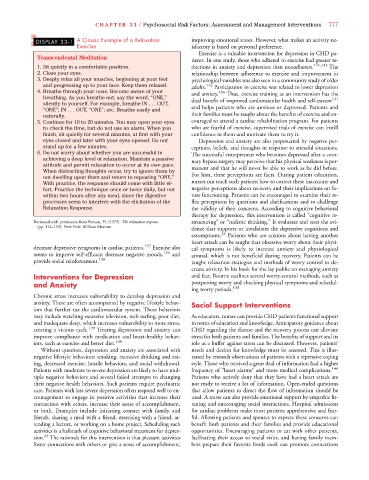
                    DISPLAY 33-1  A Classic Example of a Relaxation    improving emotional states. However, what makes an activity sat-
                                 Exercise                              isfactory is based on personal preference.
                                                                         Exercise is a valuable intervention for depression in CHD pa-
                    Transcendental Meditation
                                                                       tients. In one study, those who adhered to exercise had greater re-
                    1. Sit quietly in a comfortable position.          ductions in anxiety and depression than nonadherers. 141,142  The
                    2. Close your eyes.                                relationship between adherence to exercise and improvement in
                    3. Deeply relax all your muscles, beginning at your feet  psychological variables was also seen in a community study of older
                      and progressing up to your face. Keep them relaxed.  adults. 143  Participation in exercise was related to lower depression
                    4. Breathe through your nose. Become aware of your  and anxiety. 136  Thus, exercise training as an intervention has the
                      breathing. As you breathe out, say the word, “ONE,”  dual benefit of improved cardiovascular health and self-esteem 131
                      silently to yourself. For example, breathe IN . . . OUT,
                      “ONE”; IN . . . OUT, “ONE”; etc. Breathe easily and  and helps patients who are anxious or depressed. Patients and
                      naturally.                                       their families must be taught about the benefits of exercise and en-
                    5. Continue for 10 to 20 minutes. You may open your eyes  couraged to attend a cardiac rehabilitation program. For patients
                      to check the time, but do not use an alarm. When you  who are fearful of exercise, supervised trials of exercise can instill
                      finish, sit quietly for several minutes, at first with your  confidence in them and motivate them to try it.
                      eyes closed and later with your eyes opened. Do not  Depression and anxiety are also perpetuated by negative per-
                      stand up for a few minutes.                      ceptions, beliefs, and thoughts in response to stressful situations.
                    6. Do not worry about whether you are successful in  The successful entrepreneur who becomes depressed after a coro-
                      achieving a deep level of relaxation. Maintain a passive  nary bypass surgery may perceive that his physical weakness is per-
                      attitude and permit relaxation to occur at its own pace.  manent and that he will never be able to work as he did before.
                      When distracting thoughts occur, try to ignore them by
                      not dwelling upon them and return to repeating “ONE.”  For him, these perceptions are facts. During patient education,
                      With practice, the response should come with little ef-  nurses can teach such patients how to correct these inaccurate and
                      fort. Practice the technique once or twice daily, but not  negative perceptions about recovery and their implications on fu-
                      within two hours after any meal, since the digestive  ture functioning. Patients can be encouraged to examine their re-
                      processes seem to interfere with the elicitation of the  flex perceptions by questions and clarifications and to challenge
                      Relaxation Response.                             the validity of their concerns. According to cognitive behavioral
                                                                       therapy for depression, this intervention is called “cognitive re-
                   Borrowed with permission from Benson, H. (1975). The relaxation response  structuring” or “realistic thinking.” It evaluates and tests the evi-
                    (pp. 114–115). New York: William Morrow.
                                                                       dence that supports or invalidates the depressive cognitions and
                                                                       assumptions. 23  Patients who are anxious about having another
                                                                       heart attack can be taught that obsessive worry about their physi-
                   decrease depressive symptoms in cardiac patients. 137  Exercise also  cal symptoms is  likely to increase anxiety and physiological
                   seems to improve self-efficacy, decrease negative moods, 136  and  arousal, which is not beneficial during recovery. Patients can be
                   provide social reinforcement. 138                   taught relaxation strategies and methods of worry control to de-
                                                                       crease anxiety. In his book for the lay public on managing anxiety
                   Interventions for Depression                        and fear, Bourne outlines several worry-control methods, such as
                   and Anxiety                                         postponing worry and checking physical symptoms and schedul-
                                                                       ing worry periods. 133
                   Chronic stress increases vulnerability to develop depression and
                   anxiety. These are often accompanied by negative lifestyle behav-  Social Support Interventions
                   iors that further tax the cardiovascular system. These behaviors
                   may include watching excessive television, web surfing, poor diet,  As educators, nurses can provide CHD patients functional support
                   and inadequate sleep, which increases vulnerability to more stress,  in terms of education and knowledge. Anticipatory guidance about
                   creating a vicious cycle. 139  Treating depression and anxiety can  CHD regarding the disease and the recovery process can alleviate
                   improve compliance with medication and heart-healthy behav-  stress for both patients and families. The benefits of support and its
                   iors, such as exercise and better diet. 140         role as a buffer against stress can be discussed. However, patients’
                     Without question, depression and anxiety are associated with  needs and desires for knowledge must be assessed. This is illus-
                   negative lifestyle behaviors: smoking, excessive drinking and eat-  trated by research observations of patients with a repressive coping
                   ing, decreased exercise, hostile behaviors, and social withdrawal.  style. Those who received a great deal of information had a higher
                   Patients with moderate to severe depression are likely to have mul-  frequency of “heart alarms” and more medical complications. 144
                   tiple negative behaviors and several failed attempts to changing  Patients who actively deny that they have had a heart attack are
                   their negative health behaviors. Such patients require psychiatric  not ready to receive a lot of information. Open-ended questions
                   care. Patients with less severe depression often respond well to en-  that allow patients to direct the flow of information should be
                   couragement to engage in positive activities that increase their  used. A nurse can also provide emotional support by empathic lis-
                   connection with others, increase their sense of accomplishment,  tening and encouraging social interactions. Hospital admissions
                   or  both. Examples include initiating contact with  family and  for cardiac problems make most patients apprehensive and fear-
                   friends, sharing a meal with a friend, exercising with a friend, at-  ful. Allowing patients and spouses to express these concerns can
                   tending a lecture, or working on a home project. Scheduling such  benefit both patients and their families and provide educational
                   activities is a hallmark of cognitive behavioral treatment for depres-  opportunities. Encouraging patients to eat with other patients,
                      23
                   sion. The rationale for this intervention is that pleasant activities  facilitating their access to social visits, and having family mem-
                   foster connections with others or give a sense of accomplishment,  bers prepare their favorite foods cook can promote connections

