


Page 867 - Cardiac Nursing
P. 867
LWBK340-c37_p842-860.qxd  29/06/2009  09:40 PM  Page 843 Aptara


                                                                               C HAP TE R  37 / Exercise and Activity  843


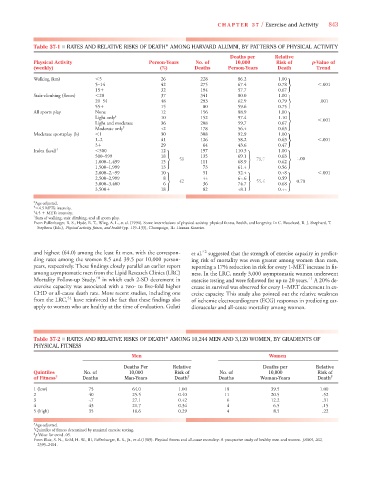
                   Table 37-1 ■ RATES AND RELATIVE RISKS OF DEATH* AMONG HARVARD ALUMNI, BY PATTERNS OF PHYSICAL ACTIVITY
                                                                                   Deaths per     Relative
                   Physical Activity                     Person-Years   No. of       10,000       Risk of     p-Value of
                   (weekly)                                 (%)         Deaths     Person-Years    Death        Trend
                   Walking (km)         5                    26           228         86.2         1.00
                                       5–14                  42           275         67.4         0.78  r       .001
                                       15
                   32           194         57.7         0.67
                   Stair-climbing (floors)   20               37           341         80.0         1.00
                                       20–54                 48           293         62.9         0.79  r       .001
                                       55
                   15           80          59.6         0.75
                   All sports play     None                  12           156         88.9         1.00
                                       Light only †          10           152         97.4         1.10          .001
                                       Light and moderate    36           208         59.7         0.67  s
                                       Moderate only ‡       42           178         56.4         0.63
                   Moderate sportsplay (h)   1               30           308         92.9         1.00
                                       1–2                   41           126         58.2         0.63  r       .001
                                       3
                    29           64          43.6         0.47
                   Index (kcal) §       500                  12           197        110.3         1.00
                                       500–999               18           135         69.1         0.63  1.00
                                       1,000–1,499           15  s  58    111         68.9  s  78.9  0.62  s
                                       1,500–1,999           13           73          61.4         0.56
                                       2,000–2,499           10           51          52.4         0.48          .001
                                       2,500–2,999           8            44          64.6         0.59
                                       3,000–3,400           6  s  42     36          74.7  s  55.4  0.68  s  0.70
                                       3,500
                18           82          48.1         0.44

                   *Age-adjusted.
                   †  4.5 METs intensity.
                   ‡ 4.5
 METs intensity.
                   § Sum of walking, stair climbing, and all sports play.
                   From Paffenbarger, R. S., Hyde, R. T., Wing, A. L., et al. (1994). Some interrelations of physical activity, physical fitness, health, and longevity. In C. Bouchard, R. J. Shephard, T.
                    Stephens (Eds.), Physical activity, fitness, and health (pp. 119–133), Champaign, IL: Human Kinetics.


                   and highest (64.0) among the least fit men, with the correspon-  et al. 52  suggested that the strength of exercise capacity in predict-
                   ding rates among the women 8.5 and 39.5 per 10,000 person-  ing risk of mortality was even greater among women than men,
                   years, respectively. These findings closely parallel an earlier report  reporting a 17% reduction in risk for every 1-MET increase in fit-
                   among asymptomatic men from the Lipid Research Clinics (LRC)  ness. In the LRC, nearly 3,000 asymptomatic women underwent
                   Mortality Follow-up Study, 50  in which each 2-SD decrement in  exercise testing and were followed for up to 20 years. A 20% de-
                                                                                                             51
                   exercise capacity was associated with a two- to five-fold higher  crease in survival was observed for every 1–MET decrement in ex-
                   CHD or all-cause death rate. More recent studies, including one  ercise capacity. This study also pointed out the relative weakness
                   from the LRC, 51  have reinforced the fact that these findings also  of ischemic electrocardiogram (ECG) responses in predicting car-
                   apply to women who are healthy at the time of evaluation. Gulati  diovascular and all-cause mortality among women.


                   Table 37-2 ■ RATES AND RELATIVE RISKS OF DEATH* AMONG 10,244 MEN AND 3,120 WOMEN, BY GRADIENTS OF
                   PHYSICAL FITNESS

                                                   Men                                          Women
                                                Deaths Per       Relative                     Deaths per       Relative
                   Quintiles       No. of         10,000         Risk of        No. of          10,000          Risk of
                   of Fitness †    Deaths        Man-Years       Death ‡       Deaths        Woman-Years        Death ‡
                   1 (low)           75            64.0           1.00           18              39.5            1.00
                   2                 40            25.5           0.40           11              20.5            .52
                   3                 47            27.1           0.42            6              12.2            .31
                   4                 43            21.7           0.34            4              6.5             .15
                   5 (high)          35            18.6           0.29            4              8.5             .22

                   *Age-adjusted.
                   †
                    Quintiles of fitness determined by maximal exercise testing.
                   ‡ ‡
                    p Value for trend .05.
                                                                                                                2
                                                                                                                2
                   From Blair, S. N., Kohl, H. W., III, Paffenbarger, R. S., Jr., et al.(1989). Physical fitness and all-cause mortality: A prospective study of healthy men and women. JAMA, 262,
                    2395–2401.

