


Page 869 - Cardiac Nursing
P. 869
LWBK340-c37_p842-860.qxd  29/06/2009  09:40 PM  Page 845 Aptara


                                                                               C HAP TE R  37 / Exercise and Activity  845

                   lack of physical activity, 28  the nurse or other health care  ple, the National Exercise and Heart Disease Project was a con-
                   provider’s role is more critical than ever in terms of encouraging  trolled randomized trial in the United States on the effects of pre-
                   patients to become more physically active, and to develop strate-  scribed supervised exercise involving 651 men with acute MI. 57
                   gies that promote the adoption of physically active lifestyles in all  The cumulative 3-year total mortality rates in this study were
                   their patients.                                     7.3% and 4.6% for the control and exercise groups, respectively,
                                                                       whereas the rates for recurrent MI were 7.0% and 5.4%, respec-
                                                                       tively. Although this represented 37% and 24% reductions in
                   “Health” Versus “Fitness”                           mortality and reinfarction rates, respectively, for the exercise
                   Benefits of Exercise                                 groups, more than twice as many patients would have been nec-
                                                                       essary in the study for these differences to be statistically signifi-
                   A noteworthy theme that is consistent in each of the aforemen-
                                                                       cant. The lack of adequate sample size in this study is typical of
                   tioned documents is that considerable health benefits are derived
                                                                       the secondary prevention trials that have assessed mortality; al-
                   from moderate levels of activity; it is generally not necessary to en-
                                                                       though the trends are generally favorable, few have independently
                   gage in vigorous, sustained activity to derive many of these bene-
                                                                       demonstrated that patients randomized to an exercise program
                   fits. Before the release of these reports in the mid 1990s, consen-
                                                                       have a significantly lower mortality compared with control sub-
                   sus documents generally promoted the concept that exercise was
                                                                       jects. However, two cardiac rehabilitation trials in Europe were
                   thought to be effective only if an improvement in some measure
                                                                       noteworthy for their favorable morbidity and mortality outcomes.
                   of cardiopulmonary function was observed. In recent years, the
                                                                       Vermuelen et al., 58  in a study involving fewer than 100 patients,
                   philosophy on exercise as a means to this end (“fitness” measured
                                                                       found that a 6-week rehabilitation program including compre-
                   by exercise capacity) has changed significantly. It is now appreci-
                                                                       hensive risk factor reduction and exercise resulted in a 50% lower
                   ated that substantial health benefits can be achieved through rela-
                                                                       rate of combined CHD morbidity and mortality in the rehabili-
                   tively modest amounts of regular exercise, regardless of whether
                                                                       tation compared with the control patients over a 5-year follow-up
                   exercise results in a measurable improvement in exercise capacity.
                                                                       period. In the second of these multiple risk factor intervention tri-
                   Epidemiologic studies have shown that death rates from cardio-
                                                                       als, Kallio et al. 59  studied 375 consecutive male and female post-
                   vascular and all causes are considerably lower even among people
                                                                       MI patients younger than 65 years in two clinical centers in Fin-
                   who engage in modest amounts of exercise, less than the thresh-
                                                                       land. After 3 years of follow-up, the cumulative CHD mortality
                   old that was generally thought necessary to increase exercise ca-
                   pacity. 1–5,7,55,56  It is important for health professionals to be  rate was significantly lower in the intervention group compared
                                                                       with the control group (18.6% vs. 29.4%). This difference pri-
                   aware of the distinction between “health” and “fitness” when mak-
                                                                       marily reflected a reduction in sudden death in the intervention
                   ing activity recommendations to patients with cardiovascular dis-
                                                                       group during the first 6 months after MI. A favorable trend to-
                   ease, those at high risk for its development, and healthy adults. In
                                                                       ward reduction in nonfatal reinfarctions also was observed in the
                   addition to cardiopulmonary fitness, measures of fat and lean
                                                                       intervention group.
                   weight, bone density, glucose and insulin metabolism, blood lipid
                                                                         An alternative but less rigorous scientific approach, in the ab-
                   and lipoprotein metabolism, and quality of life should be in-
                                                                       sence of a definitive clinical trial, is to pool data from existing
                   cluded under the category of “health.” A favorable profile for
                                                                       long-term, randomized, secondary prevention trials in which ex-
                   these variables represents a clear advantage in terms of health out-
                                                                       ercise training was a component. Several noteworthy meta-analy-
                   comes as assessed by morbidity and mortality statistics.
                                                                       ses have been published in which data from randomized clinical
                                                                       trials were pooled using the intention-to-treat principle. 9,10,60  In
                   Role of Exercise in                                 the trials included in these meta-analyses, intervention consisted
                   Secondary Prevention                                of either a formal exercise program or exercise advice, generally in
                                                                       combination with multiple risk factor management, making it
                   During the 1970s and 1980s, numerous controlled trials ad-  impossible to determine the independent contribution of exercise
                   dressed whether participation in a rehabilitation program influ-  to subsequent morbidity and mortality. Nevertheless, patients
                   enced morbidity or mortality in patients with CHD. Although  randomized to active cardiac rehabilitation programs after an MI
                   the results of these trials were inconclusive independently, most  had statistically significant reductions of approximately 25% in
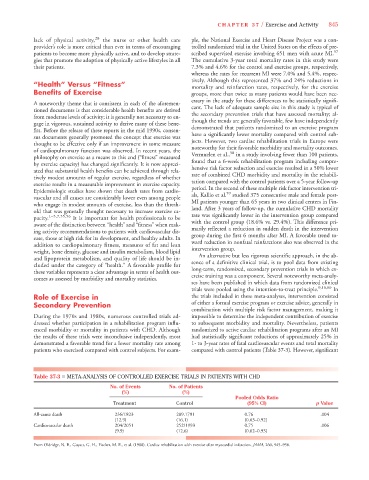
                   demonstrated a favorable trend for a lower mortality rate among  1- to 3-year rates of fatal cardiovascular events and total mortality
                   patients who exercised compared with control subjects. For exam-  compared with control patients (Table 37-3). However, significant
                   Table 37-3 ■ META-ANALYSIS OF CONTROLLED EXERCISE TRIALS IN PATIENTS WITH CHD
                                            No. of Events      No. of Patients
                                                (%)                 (%)
                                                                                     Pooled Odds Ratio
                                             Treatment            Control                (95% CI)              p Value
                   All-cause death            236/1823            289.1791              0.76                     .004
                                              (12.9)              (16.1)                (0.63–0.92)
                   Cardiovascular death       204/2051            252/1993              0.75                     .006
                                              (9.9)               (12.6)                (0.62–0.93)
                   From Oldridge, N. B., Guyatt, G. H., Fischer, M. E., et al. (1988). Cardiac rehabilitation with exercise after myocardial infarction. JAMA, 260, 945–950.

