


Page 870 - Cardiac Nursing
P. 870
qx
                          60.
                          60.
                               d
                                  9
                                  9
                                 2
                                                                a
                                                            Apt
                                                         46
                                                              ar
                        2-8
                        2-8
                     p84
                                               0 P
                                             9:4
                                             9:4
                                                  M
                                                       e 8
                                                      g
                                                    Pa
                                     6
                                    0
                                   /
                                       2
                                            0
                                        009
                                        009
            K34
                0-c
                  37_
            K34
         LWB K34 0-c 37_ p84 2-8 60. qx d  2 9 / 0 6 / / 2 009  0 9:4 0 P M  Pa g e 8 46  Apt ar a
         LWBK340-c37_p842-860.qxd  29/06/2009  09:40 PM  Page 846 Aptara
         LWB
                  846    PA R T  V / Health Promotion and Disease Prevention
                  differences in general were not found in the rate of nonfatal re-  improved myocardial function, increases in coronary artery size,
                  current reinfarctions in patients undergoing intervention com-  and increases in the myocardial capillary-to-fiber ratio. However,
                  pared with control patients.                        such changes have been difficult to demonstrate in humans. 61
                                    12
                     Recently, Taylor et al. performed an updated meta-analysis of  The major morphologic outcome of a training program in humans
                  rehabilitation trials among patients with CHD. While the afore-  is probably an increase in cardiac size; however, this adaptation
                  mentioned studies focused on research performed during the  also appears to occur mainly in younger healthy people and is an
                  1970s and 1980s, the  latter study included trials performed  unlikely outcome among individuals older than 40 years or in pa-
                  through 2003. A total of 48 trials met the inclusion criteria, in-  tients with  heart  disease. However, significant hemodynamic
                  cluding 8,940 patients. Compared with usual care, cardiac reha-  changes have been well documented among patients with heart
                  bilitation was associated with reduced all-cause mortality (odds  disease after training. These include reductions in heart rate
                  ratio   0.80) and cardiac mortality (odds ratio   0.74). In addition,  (HR) at rest and any matched submaximal workload, which is
                  participation in cardiac rehabilitation was associated with greater  beneficial in that it results in a reduction in myocardial oxygen
                  reductions in cholesterol, triglycerides, and systolic blood pres-  demand during activities of daily living (ADLs). Other hemody-
                  sure. However, there were no differences between rehabilitation  namic changes that have been demonstrated after training in-
                  and usual care groups in nonfatal reinfarctions or revascularization  clude reductions in blood pressure, increases in blood volume,
                  rates. Importantly, the effect of rehabilitation on mortality was in-  and increases in maximal oxygen uptake. The most important
                  dependent of chronic heart failure (CHF) diagnosis, type of reha-  physiologic benefits of training among patients with heart disease
                  bilitation, dose of exercise intervention, length of follow-up, trial  occur in the skeletal muscle. The metabolic capacity of the skele-
                  quality, or trial publication data.                 tal muscle is enhanced through increases in mitochondrial vol-
                                                                      ume and number, capillary density, and oxidative enzyme con-
                  Physiologic Benefits of                              tent. These adaptations enhance perfusion and the efficiency of
                                                                                     43,61,62
                  Exercise Training                                   oxygen extraction.   Finally, an important influence of
                                                                      training is a favorable effect on the risk profile in patients recov-
                  Regular exercise increases work capacity. Hundreds of studies have  ering from MI (Display 37-2). Although this may include such
                  been performed cross sectionally that document higher maximum  things as reductions in blood pressure, reductions in markers of
                                   .
                                   V
                                   V
                  oxygen consumption (VO 2 max) values among active versus seden-  inflammation (such as C-reactive protein), reductions in body
                  tary individuals or between groups after a period of training. The  weight, reductions in total cholesterol and low-density lipopro-
                                            .
                                            V
                                            V
                  magnitude of improvement in  VO 2 max with training varies  tein, and an increase in high-density lipoprotein, recent studies
                  widely, usually ranging from 5% to 25%, but increases as large as  suggest that the most powerful influence of regular exercise may
                  50% have been reported. The degree of change in exercise capac-  be an improvement in insulin sensitivity. It is also important to
                  ity depends primarily on initial state of fitness and intensity of  note that although the effect of exercise on any single risk factor
                  training. Training increases exercise capacity by increasing maxi-  may generally be small, the effect of continued regular exercise on
                  mal cardiac output and the ability to extract oxygen from the  overall cardiovascular risk, when combined with other lifestyle
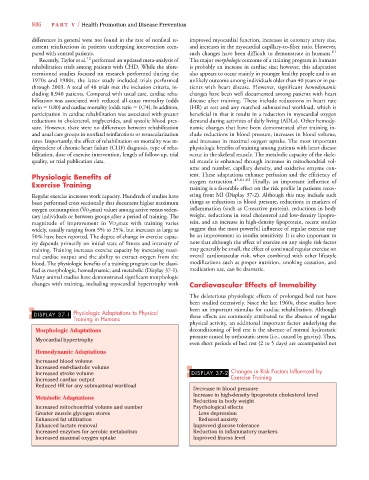
                  blood. The physiologic benefits of a training program can be classi-  modifications such as proper nutrition, smoking cessation, and
                  fied as morphologic, hemodynamic, and metabolic (Display 37-1).  medication use, can be dramatic.
                  Many animal studies have demonstrated significant morphologic
                  changes with training, including myocardial hypertrophy with  Cardiovascular Effects of Immobility
                                                                      The deleterious physiologic effects of prolonged bed rest have
                                                                      been studied extensively. Since the late 1960s, these studies have
                                                                      been an important stimulus for cardiac rehabilitation. Although
                   DISPLAY 37-1  Physiologic Adaptations to Physical  these effects are commonly attributed to the absence of regular
                                Training in Humans
                                                                      physical activity, an additional important factor underlying the
                    Morphologic Adaptations                           deconditioning of bed rest is the absence of normal hydrostatic
                                                                      pressure caused by orthostatic stress (i.e., caused by gravity). Thus,
                    Myocardial hypertrophy
                                                                      even short periods of bed rest (2 to 5 days) are accompanied not
                    Hemodynamic Adaptations
                    Increased blood volume
                    Increased end-diastolic volume
                    Increased stroke volume                            DISPLAY 37-2  Changes in Risk Factors Influenced by
                    Increased cardiac output                                        Exercise Training
                    Reduced HR for any submaximal workload
                                                                       Decrease in blood pressure
                                                                       Increase in high-density lipoprotein cholesterol level
                    Metabolic Adaptations
                                                                       Reduction in body weight
                    Increased mitochondrial volume and number          Psychological effects
                    Greater muscle glycogen stores                       Less depression
                    Enhanced fat utilization                             Reduced anxiety
                    Enhanced lactate removal                           Improved glucose tolerance
                    Increased enzymes for aerobic metabolism           Reduction in inflammatory markers
                    Increased maximal oxygen uptake                    Improved fitness level

