


Page 149 - untitled
P. 149
AAAC67  21/5/05  11:01 AM  Page 148
           67 The face and scalp

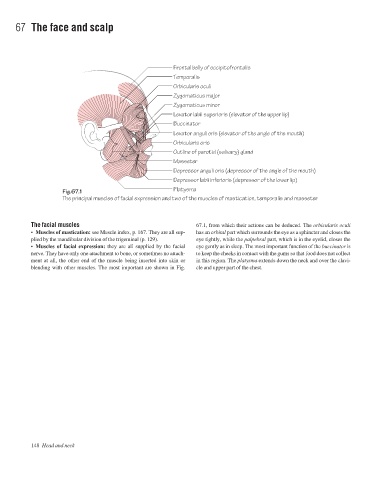
                                                              Frontal belly of occipitofrontalis
                                                              Temporalis
                                                              Orbicularis oculi
                                                              Zygomaticus major
                                                              Zygomaticus minor
                                                              Levator labii superioris (elevator of the upper lip)
                                                              Buccinator
                                                              Levator anguli oris (elevator of the angle of the mouth)
                                                              Orbicularis oris
                                                              Outline of parotid (salivary) gland
                                                              Masseter
                                                              Depressor anguli oris (depressor of the angle of the mouth)
                                                              Depressor labii inferioris (depressor of the lower lip)
                          Fig.67.1                            Platysma
                          The principal muscles of facial expression and two of the muscles of mastication, temporalis and masseter


                The facial muscles                                    67.1, from which their actions can be deduced. The orbicularis oculi
                • Muscles of mastication: see Muscle index, p. 167. They are all sup-  has an orbital part which surrounds the eye as a sphincter and closes the
                plied by the mandibular division of the trigeminal (p. 129).  eye tightly, while the palpebral part, which is in the eyelid, closes the
                • Muscles of facial expression: they are all supplied by the facial  eye gently as in sleep. The most important function of the buccinator is
                nerve. They have only one attachment to bone, or sometimes no attach-  to keep the cheeks in contact with the gums so that food does not collect
                ment at all, the other end of the muscle being inserted into skin or  in this region. The platysma extends down the neck and over the clavi-
                blending with other muscles. The most important are shown in Fig.  cle and upper part of the chest.


                148 Head and neck

