


Page 151 - untitled
P. 151
AAAC67  21/5/05  11:01 AM  Page 150
                                                                                      Supraorbital artery and nerve
                          Temporal branch
                                                                                      Supratrochlear artery
                          Zygomatic branch
                                                                                      Facial artery
                          Superficial                                                 Infraorbital nerve
                          temporal artery                                             Facial vein
                          Parotid duct
                                                                                      Labial branches
                          Lesser occipital nerve
                                                                                      Buccal branch
                          Greater auricular nerve
                                                                                      Mental nerve
                          Posterior auricular vein
                                                                                      Marginal mandibular branch
                          Retromandibular vein
                                                                                      Cervical branch
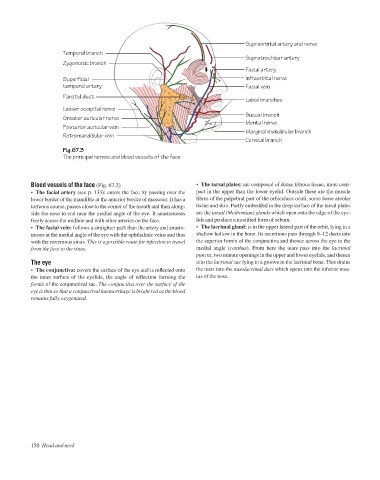
                          Fig.67.3
                          The principal nerves and blood vessels of the face


                Blood vessels of the face (Fig. 67.3)                 • The tarsal plates: are composed of dense fibrous tissue, more com-
                • The facial artery (see p. 133): enters the face by passing over the  pact in the upper than the lower eyelid. Outside these are the muscle
                lower border of the mandible at the anterior border of masseter. It has a  fibres of the palpebral part of the orbicularis oculi, some loose areolar
                tortuous course, passes close to the corner of the mouth and then along-  tissue and skin. Partly embedded in the deep surface of the tarsal plates
                side the nose to end near the medial angle of the eye. It anastomoses  are the tarsal (Meibomian) glands which open onto the edge of the eye-
                freely across the midline and with other arteries on the face.  lids and produce a modified form of sebum.
                • The facial vein: follows a straighter path than the artery and anasto-  • The lacrimal gland: is in the upper lateral part of the orbit, lying in a
                moses at the medial angle of the eye with the ophthalmic veins and thus  shallow hollow in the bone. Its secretions pass through 9–12 ducts into
                with the cavernous sinus. This is a possible route for infection to travel  the superior fornix of the conjunctiva and thence across the eye to the
                from the face to the sinus.                           medial angle (canthus). From here the tears pass into the  lacrimal
                                                                      puncta, two minute openings in the upper and lower eyelids, and thence
                The eye                                               into the lacrimal sac lying in a groove in the lacrimal bone. This drains
                • The conjunctiva: covers the surface of the eye and is reflected onto  the tears into the nasolacrimal duct which opens into the inferior mea-
                the inner surface of the eyelids, the angle of reflection forming the  tus of the nose.
                fornix of the conjunctival sac. The conjunctiva over the surface of the
                eye is thin so that a conjunctival haemorrhage is bright red as the blood
                remains fully oxygenated.


                150 Head and neck

