


Page 152 - untitled
P. 152
AAAC67  21/5/05  11:01 AM  Page 151
                                                      Nerves
                                                                          Arteries
                                                                               Supratrochear
                                        Supratrochear
                                                                               Supraorbital
                                        Supraorbital
                                        Auriculotemporal                       Superficial temporal
                                        Lesser occipital                       Posterior auricular
                                        Greater occipital
                                                                               Occipital
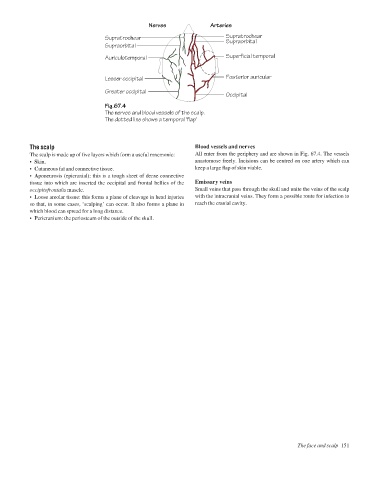
                                        Fig.67.4
                                        The nerves and blood vessels of the scalp.
                                        The dotted line shows a temporal 'flap'


               The scalp                                             Blood vessels and nerves
               The scalp is made up of five layers which form a useful mnemonic:  All enter from the periphery and are shown in Fig. 67.4. The vessels
               • Skin.                                               anastomose freely. Incisions can be centred on one artery which can
               • Cutaneous fat and connective tissue.                keep a large flap of skin viable.
               • Aponeurosis (epicranial): this is a tough sheet of dense connective
               tissue into which are inserted the occipital and frontal bellies of the  Emissary veins
               occipitofrontalis muscle.                             Small veins that pass through the skull and unite the veins of the scalp
               • Loose areolar tissue: this forms a plane of cleavage in head injuries  with the intracranial veins. They form a possible route for infection to
               so that, in some cases, ‘scalping’ can occur. It also forms a plane in  reach the cranial cavity.
               which blood can spread for a long distance.
               • Pericranium: the periosteum of the outside of the skull.


                                                                                                       The face and scalp 151

