


Page 153 - untitled
P. 153
AAAC68  21/5/05  11:01 AM  Page 152
           68 The cranial cavity


                                                       Cerebral veins

                                                       Falx cerebri


                                                       Tentorium cerebelli          Endothelium of superior
                                                                                    sagittal sinus
                                                       Diaphragma sellae                                   Emissary vein
                                                                                                           Fibrous dura
                                                                                                           Serous dura
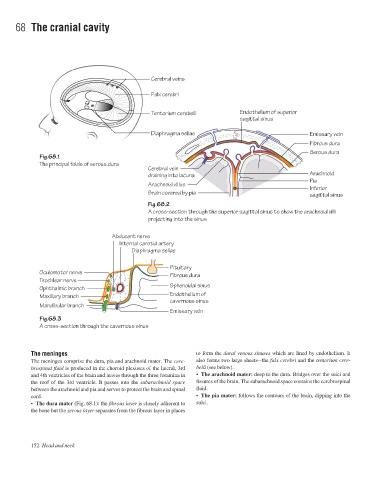
                   Fig.68.1
                   The principal folds of serous dura
                                                      Cerebral vein
                                                      draining into lacuna                                 Arachnoid
                                                                                                           Pia
                                                      Arachnoid villus
                                                                                                           Inferior
                                                      Brain covered by pia                                 sagittal sinus
                                                      Fig.68.2
                                                      A cross-section through the superior sagittal sinus to show the arachnoid villi
                                                      projecting into the sinus

                                          Abducent nerve
                                             Internal carotid artery
                                                 Diaphragma sellae


                                                             Pituitary
                   Oculomotor nerve
                                                             Fibrous dura
                   Trochlear nerve
                                                             Sphenoidal sinus
                   Ophthalmic branch
                                                             Endothelium of
                   Maxillary branch
                                                             cavernous sinus
                   Mandibular branch
                                                             Emissary vein
                   Fig.68.3
                   A cross-section through the cavernous sinus


                The meninges                                          to form the dural venous sinuses which are lined by endothelium. It
                The meninges comprise the dura, pia and arachnoid mater. The cere-  also forms two large sheetsathe falx cerebri and the tentorium cere-
                brospinal fluid is produced in the choroid plexuses of the lateral, 3rd  belli (see below).
                and 4th ventricles of the brain and leaves through the three foramina in  • The arachnoid mater: deep to the dura. Bridges over the sulci and
                the roof of the 3rd ventricle. It passes into the subarachnoid space  fissures of the brain. The subarachnoid space contains the cerebrospinal
                between the arachnoid and pia and serves to protect the brain and spinal  fluid.
                cord.                                                 • The pia mater: follows the contours of the brain, dipping into the
                • The dura mater (Fig. 68.1): the fibrous layer is closely adherent to  sulci.
                the bone but the serous layer separates from the fibrous layer in places


                152 Head and neck

