


Page 137 - ACCCN's Critical Care Nursing
P. 137
114  P R I N C I P L E S   A N D   P R A C T I C E   O F   C R I T I C A L   C A R E

                                                              around 10% of hospital deaths in Australia. 80,82  Patients
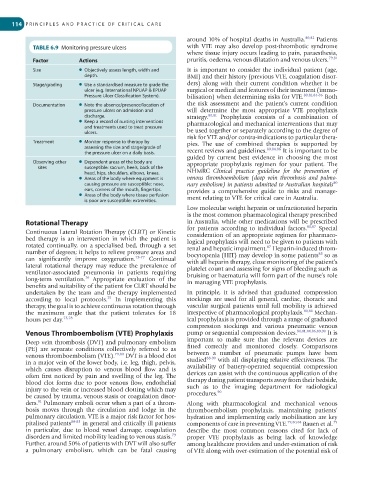
            TABLE 6.9  Monitoring pressure ulcers             with  VTE  may  also  develop  post-thrombotic  syndrome
                                                              where tissue injury occurs leading to pain, paraesthesia,
            Factor         Actions                            pruritis, oedema, venous dilatation and venous ulcers. 79,81
            Size           ●  Objectively assess length, width and   It  is  important  to  consider  the  individual  patient  (age,
                             depth.                           BMI) and their history (previous VTE, coagulation disor-
            Stage/grading  ●  Use a standardised measure to grade the   ders)  along  with  their  current  condition  whether  it  be
                             ulcer (e.g. International NPUAP & EPUAP   surgical or medical and features of their treatment (immo-
                             Pressure Ulcer Classification System).  bilisation) when determining risks for VTE. 80,81,84-86  Both
            Documentation  ●  Note the absence/presence/location of   the  risk  assessment  and  the  patient’s  current  condition
                             pressure ulcers on admission and   will  determine  the  most  appropriate  VTE  prophylaxis
                             discharge.                       strategy. 80,81   Prophylaxis  consists  of  a  combination  of
                           ●  Keep a record of nursing interventions   pharmacological and mechanical interventions that may
                             and treatments used to treat pressure
                             ulcers.                          be used together or separately according to the degree of
                                                              risk for VTE and/or contra-indications to particular thera-
            Treatment      ●  Monitor response to therapy by   pies.  The  use  of  combined  therapies  is  supported  by
                             assessing the size and stage/grade of                      80,84,86
                             the pressure ulcer on a daily basis.  recent reviews and guidelines.   It is important to be
                                                              guided  by  current  best  evidence  in  choosing  the  most
            Observing other   ●  Dependent areas of the body are   appropriate  prophylaxis  regimen  for  your  patient.  The
             sites           susceptible: sacrum, heels, back of the
                             head, hips, shoulders, elbows, knees.  NHMRC  Clinical  practice  guideline  for  the  prevention  of
                           ●  Areas of the body where equipment is   venous thromboembolism (deep vein thrombosis and pulmo-
                             causing pressure are susceptible: nose,   nary embolism) in patients admitted to Australian hospitals
                                                                                                              80
                             ears, corners of the mouth, fingertips.  provides  a  comprehensive  guide  to  risks  and  manage-
                           ●  Areas of the body where tissue perfusion   ment relating to VTE for critical care in Australia.
                             is poor are susceptible: extremities.
                                                              Low molecular weight heparin or unfractionated heparin
                                                              is the most common pharmacological therapy prescribed
         Rotational Therapy                                   in Australia, while other medications will be prescribed
                                                              for  patients  according  to  individual  factors. 80,87   Special
         Continuous Lateral Rotation Therapy (CLRT) or Kinetic   consideration of an appropriate regimen for pharmaco-
         bed  therapy  is  an  intervention  in  which  the  patient  is   logical prophylaxis will need to be given to patients with
         rotated continually, on a specialised bed, through a set   renal and hepatic impairment.  Heparin-induced throm-
                                                                                        87
         number of degrees; it helps to relieve pressure areas and   bocytopenia (HIT) may develop in some patients  so as
                                                                                                         88
         can  significantly  improve  oxygenation. 75-77   Continual   with all heparin therapy, close monitoring of the patient’s
         lateral  rotational  therapy  may  reduce  the  prevalence  of   platelet count and assessing for signs of bleeding such as
         ventilator-associated  pneumonia  in  patients  requiring   bruising or haematuria will form part of the nurse’s role
                             76
         long-term  ventilation.   Appropriate  evaluation  of  the   in managing VTE prophylaxis.
         benefits and suitability of the patient for CLRT should be
         undertaken  by  the  team  and  the  therapy  implemented   In  principle,  it  is  advised  that  graduated  compression
                                    75
         according  to  local  protocols.   In  implementing  this   stockings are used for all general, cardiac, thoracic and
         therapy, the goal is to achieve continuous rotation through   vascular surgical patients until full mobility is achieved
         the  maximum  angle  that  the  patient  tolerates  for  18   irrespective of pharmacological prophylaxis. 80,86  Mechan-
         hours per day. 75,78                                 ical prophylaxis is provided through a range of graduated
                                                              compression  stockings  and  various  pneumatic  venous
         Venous Thromboembolism (VTE) Prophylaxis             pump or sequential compression devices. 80,81,84,86,89,90  It is
                                                              important  to  make  sure  that  the  relevant  devices  are
         Deep vein thrombosis (DVT) and pulmonary embolism
         (PE)  are  separate  conditions  collectively  referred  to  as   fitted  correctly  and  monitored  closely.  Comparisons
         venous thromboembolism (VTE). 79,80  DVT is a blood clot   between  a  number  of  pneumatic  pumps  have  been
                                                                     88-90
         in a major vein of the lower body, i.e. leg, thigh, pelvis,   studied   with all displaying relative effectiveness. The
         which  causes  disruption  to  venous  blood  flow  and  is   availability  of  battery-operated  sequential  compression
         often first noticed by pain and swelling of the leg. The   devices can assist with the continuous application of the
         blood clot forms due to poor venous flow, endothelial   therapy during patient transports away from their bedside,
         injury to the vein or increased blood clotting which may   such  as  to  the  imaging  department  for  radiological
                                                                        90
         be caused by trauma, venous stasis or coagulation disor-  procedures.
             81
         ders.  Pulmonary emboli occur when a part of a throm-  Along  with  pharmacological  and  mechanical  venous
         bosis  moves  through  the  circulation  and  lodge  in  the   thromboembolism  prophylaxis,  maintaining  patients’
         pulmonary circulation. VTE is a major risk factor for hos-  hydration and implementing early mobilisation are key
         pitalised patients 80-83  in general and critically ill patients   components of care in preventing VTE. 79,80,84  Rauen et al.
                                                                                                              79
         in  particular,  due  to  blood  vessel  damage,  coagulation   describe  the  most  common  reasons  cited  for  lack  of
                                                         79
         disorders and limited mobility leading to venous stasis.    proper  VTE  prophylaxis  as  being  lack  of  knowledge
         Further, around 50% of patients with DVT will also suffer   among healthcare providers and under-estimation of risk
         a  pulmonary  embolism,  which  can  be  fatal  causing   of VTE along with over-estimation of the potential risk of

