


Page 142 - ACCCN's Critical Care Nursing
P. 142
Essential Nursing Care of the Critically Ill Patient  119


               BOX 6.3  Infection-control guidelines for the        TABLE 6.12  Transmission-based precautions and
               prevention of transmission of infectious             infectious conditions
               diseases in the healthcare setting 119
                                                                    Transmission-     Examples of infectious
               ●  Healthcare-associated infections are those acquired in care   based precautions  conditions
                  establishments (‘nosocomial’ infections) and infections that   Contact  MROs : MRSA, MRGN, VRE, ESBL
                  occur  as  a  result  of  healthcare  interventions  (‘iatrogenic’   Gastro-intestinal Pathogens: C. difficile,
                  infections). The infection may manifest after people leave            norovirus
                  the healthcare establishment.                                       Highly contagious skin infections
               ●  A  healthcare  establishment  is  any  facility  that  delivers   Droplet  Influenza
                  healthcare services.                                                RSV, Pertussis
               ●  Healthcare workers (HCWs) are all people delivering health-         Meningococcal
                  care  services,  including  students,  trainees  and  mortuary   Airborne  Pulmonary TB
                  attendants, who have contact with patients or with blood            Chickenpox (varicella), Measles (rubella)
                  and body substances.                                                SARS
               ●  Standard  precautions  are  standard  operating  procedures   Adapted from NHMRC Guidelines. NB: Standard Precautions apply for all
                  that apply to the care and treatment of all patients, regard-  patients at all times
                  less of their perceived infection risk. They are work practices
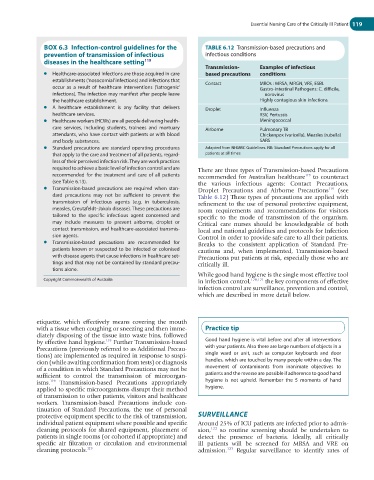
                  required to achieve a basic level of infection control and are   There are three types of Transmission-based Precautions
                  recommended  for  the  treatment  and  care  of  all  patients   recommended for Australian healthcare  to counteract
                                                                                                     119
                  (see Table 6.13).                               the  various  infectious  agents:  Contact  Precautions,
               ●  Transmission-based  precautions  are  required  when  stan-  Droplet  Precautions  and  Airborne  Precautions   (see
                                                                                                             119
                  dard  precautions  may  not  be  sufficient  to  prevent  the     Table 6.12) These types of precautions are applied with
                  transmission  of  infectious  agents  (e.g.  in  tuberculosis,   refinement to the use of personal protective equipment,
                  measles, Creutzfeldt–Jakob disease). These precautions are     room  requirements  and  recommendations  for  visitors
                  tailored  to  the  specific  infectious  agent  concerned  and    specific  to  the  mode  of  transmission  of  the  organism.
                  may  include  measures  to  prevent  airborne,  droplet  or   Critical  care  nurses  should  be  knowledgeable  of  both
                  contact transmission, and healthcare-associated transmis-  local and national guidelines and protocols for Infection
                  sion agents.                                    Control in order to provide safe care to all their patients.
               ●  Transmission-based  precautions  are  recommended  for   Breaks  to  the  consistent  application  of  Standard  Pre-
                  patients known or suspected to be infected or colonised   cautions  and,  when  implemented,  Transmission-based
                  with disease agents that cause infections in healthcare set-  Precautions put patients at risk, especially those who are
                  tings and that may not be contained by standard precau-  critically ill.
                  tions alone.
                                                                  While good hand hygiene is the single most effective tool
               Copyright Commonwealth of Australia                in infection control, 120,121  the key components of effective
                                                                  infection control are surveillance, prevention and control,
                                                                  which are described in more detail below.


             etiquette,  which  effectively  means  covering  the  mouth
             with a tissue when coughing or sneezing and then imme-  Practice tip
             diately disposing of the tissue into waste bins, followed
             by effective hand hygiene.  Further Transmission-based   Good hand hygiene is vital before and after all interventions
                                    119
             Precautions (previously referred to as Additional Precau-  with your patients. Also there are large numbers of objects in a
             tions) are implemented as required in response to suspi-  single  ward  or  unit,  such  as  computer  keyboards  and  door
             cion (while awaiting confirmation from tests) or diagnosis   handles, which are touched by many people within a day. The
             of a condition in which Standard Precautions may not be   movement  of  contaminants  from  inanimate  objectives  to
             sufficient  to  control  the  transmission  of  microorgan-  patients and the reverse are possible if adherence to good hand
                 119
             isms.   Transmission-based  Precautions  appropriately   hygiene  is  not  upheld.  Remember  the  5  moments  of  hand
             applied to specific microorganisms disrupt their method   hygiene.
             of transmission to other patients, visitors and healthcare
             workers.  Transmission-based  Precautions  include  con-
             tinuation  of  Standard  Precautions,  the  use  of  personal
             protective equipment specific to the risk of transmission,   SURVEILLANCE
             individual patient equipment where possible and specific   Around 25% of ICU patients are infected prior to admis-
             cleaning protocols for shared equipment, placement of   sion, 122   so  routine  screening  should  be  undertaken  to
             patients in single rooms (or cohorted if appropriate) and   detect  the  presence  of  bacteria.  Ideally,  all  critically
             specific  air  filtration  or  circulation  and  environmental   ill  patients  will  be  screened  for  MRSA  and  VRE  on
             cleaning protocols. 119                              admission. 123   Regular  surveillance  to  identify  rates  of

