


Page 138 - ACCCN's Critical Care Nursing
P. 138
Essential Nursing Care of the Critically Ill Patient  115

             bleeding  from  prophylaxis.  Given  the  risks  of  VTE  for   of  a  protocol  improves  bowel  care.  Rectal  examination
                                                                                                        91
             critically  ill  patients,  it  is  clearly  important  that  nurses   should be performed within 24 hours of ICU  admission
             contribute to lowering risks for their patients by knowing   and it should also be undertaken if the patient has not
                                                                                                             92
             the range of risk factors for their patients, along with the   had their bowels open for three consecutive days.  If the
             appropriate  pharmacological  prophylaxis  that  may  be   bowels have not been opened during this period, action
                                                                                96
             prescribed, how to appropriately implement and manage   should be taken.  For some patients in whom defecation
             the  mechanical  prophylaxis  devices  and  most  impor-  is problematic, it may be appropriate to objectively assess
             tantly facilitate the early mobilisation of the patient.  the quality of faecal stools using a tool such as the Bristol
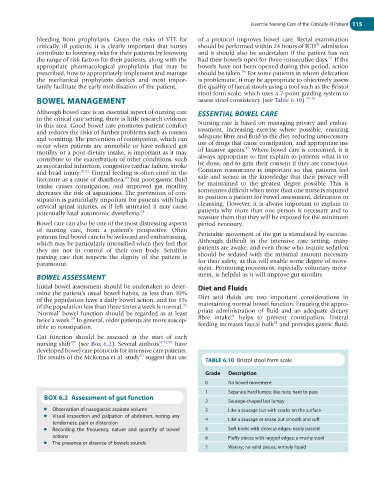
                                                                  stool form scale, which uses a 7-point grading system to
             BOWEL MANAGEMENT                                     assess stool consistency (see Table 6.10). 97,98
             Although bowel care is an essential aspect of nursing care   ESSENTIAL BOWEL CARE
             in the critical care setting, there is little research evidence
             in this area. Good bowel care promotes patient comfort   Nursing care is based on managing privacy and embar-
             and reduces the risks of further problems such as nausea   rassment,  increasing  exercise  where  possible,  ensuring
             and vomiting. The prevention of constipation, which can   adequate fibre and fluid in the diet, reducing unnecessary
             occur when patients are immobile or have reduced gut   use of drugs that cause constipation, and appropriate use
                                                                                 93
             motility or a poor dietary intake, is important as it may   of laxative agents.  Where bowel care is concerned, it is
             contribute to the exacerbation of other conditions, such   always appropriate to first explain to patients what is to
             as myocardial infarction, congestive cardiac failure, stroke   be done, and to gain their consent if they are conscious.
             and head injury. 91,92  Enteral feeding is often cited in the   Constant  reassurance  is  important  so  that  patients  feel
             literature as a cause of diarrhoea,  but poor gastric fluid   safe and secure in the knowledge that their privacy will
                                          93
             intake  causes  constipation,  and  improved  gut  motility   be  maintained  to  the  greatest  degree  possible.  This  is
             decreases the risk of aspirations. The prevention of con-  sometimes difficult when more than one nurse is required
             stipation is particularly important for patients with high   to position a patient for bowel assessment, defecation or
             cervical spinal injuries, as if left untreated it may cause   cleansing. However, it is always important to explain to
             potentially fatal autonomic dysreflexia. 94          patients why more than one person is necessary and to
                                                                  reassure them that they will be exposed for the minimum
             Bowel care can also be one of the most distressing aspects   period necessary.
             of  nursing  care,  from  a  patient’s  perspective.  Often
             patients find bowel care to be awkward and embarrassing,   Peristaltic movement of the gut is stimulated by exercise.
             which may be particularly intensified when they feel that   Although  difficult  in  the  intensive  care  setting,  many
             they  are  not  in  control  of  their  own  body.  Sensitive   patients are awake, and even those who require sedation
             nursing  care  that  respects  the  dignity  of  the  patient  is   should be sedated with the minimal amount necessary
             paramount.                                           for their safety, as this will enable some degree of move-
                                                                  ment. Promoting movement, especially voluntary move-
             BOWEL ASSESSMENT                                     ment, is helpful as it will improve gut motility.
             Initial bowel assessment should be undertaken to deter-  Diet and Fluids
             mine the patient’s usual bowel habits, as less than 10%
             of the population have a daily bowel action, and for 1%   Diet  and  fluids  are  two  important  considerations  in
                                                             92
             of the population less than three times a week is normal.    maintaining normal bowel function. Ensuring the appro-
             ‘Normal’ bowel function should be regarded as at least   priate  administration  of  fluid  and  an  adequate  dietary
                                                                            96
                        95
             twice a week.  In general, older patients are more suscep-  fibre  intake   helps  to  prevent  constipation.  Enteral
                                                                                           91
             tible to constipation.                               feeding increases faecal bulk  and provides gastric fluid,
             Gut  function  should  be  assessed  at  the  start  of  each
             nursing shift  (see Box 6.2). Several authors 91,92,96  have
                        101
             developed bowel care protocols for intensive care patients.
                                               93
             The results of the McKenna et al. study  suggest that use
                                                                    TABLE 6.10  Bristol stool form scale
                                                                    Grade   Description
                                                                    0       No bowel movement
                                                                    1       Separate hard lumps; like nuts; hard to pass
               BOX 6.2  Assessment of gut function
                                                                    2       Sausage-shaped but lumpy
               ●  Observation of nasogastric aspirate volume        3       Like a sausage but with cracks on the surface
               ●  Visual  inspection  and  palpation  of  abdomen,  noting  any
                  tenderness, pain or distension                    4       Like a sausage or snake but smooth and soft
               ●  Recording  the  frequency,  nature  and  quantity  of  bowel   5  Soft blobs with clearcut edges; easily passed
                  actions                                           6       Fluffy pieces with ragged edges; a mushy stool
               ●  The presence or absence of bowels sounds
                                                                    7       Watery; no solid pieces; entirely liquid

