


Page 140 - ACCCN's Critical Care Nursing
P. 140
Essential Nursing Care of the Critically Ill Patient  117

             ESSENTIAL NURSING CARE: URINARY                      solution  should  be  kept  minimal,  as  it  is  a  potentially
             CATHETERISATION                                      irritant chemical that can cause tissue damage: 50 mL is
             Catheter  insertion  and  maintenance  should  be  under-  as effective as 100 mL, and two sequential 50 mL wash-
             taken  by  people  adequately  trained  in  the  procedures.   outs are more effective at removing encrustation than one
                                                                                 109
             Aseptic technique should be observed, and hands should   100 mL washout.
             be washed immediately before and after catheter inser-  Critically ill patients should be provided with appropriate
             tion  and  any  manipulation  of  the  catheter  or  drainage   information  about  their  catheters  and  drainage  system,
             system. Protective clothing should be used in accordance   according to their needs and ability to understand. The
             with Standard Precautions guidelines (see Infection control   drainage  system  should  be  simple  to  operate  with  one
             later this chapter).                                 hand, easy to position, and the tap should have an open–
                                                                  close device. Contamination of the outlet must be avoided
             The urine drainage system should be sterile and continu-  and alcohol-based sprays may be used to decontaminate
             ously closed with an outlet designed to avoid contamina-  the outlet (inside and outside) before and after emptying.
             tion.  It  should  have  a  sample  port  for  taking  urine   An aseptic technique and sterile equipment must be used
             samples. If possible and appropriate, patients should be   when  taking  a  urine  sample  via  the  sample  port.  The
             given a choice of system appropriate to their needs: for   sample port should be cleaned with an alcohol wipe for
             example, a shorter drainage tube with a leg-bag may be   30  seconds  before  and  after  sampling.  Urine  samples
             more comfortable for a patient who is mobile.
                                                                  should be taken on clinical need and must be refrigerated
             Catheter Maintenance                                 if more than 1 hour is expected to elapse before the speci-
                                                                  men reaches the laboratory.
             The  continued  need  for  a  urinary  catheter  should  be
             assessed on a daily basis. Daily reminders by nursing staff   The whole drainage system should be maintained with
             to doctors results in shorter duration of catheter insertion,   patient  comfort  in  mind,  and  care  should  be  taken  to
                                             103
             with a lower associated infection rate.  The introduction   ensure that the patient is not lying on the drainage tube,
             of criteria that enable registered nurses to remove cathe-  which  can  cause  pressure  sores  and  blockage.  Further-
             ters without a doctor’s order may result in a significant   more, the catheter itself should be positioned so that it
             reduction  in  catheter-related  infections.  Penile  meatal   is not pulling on the urethra or kinked. The drainage bag
             care  with  soap  and  water 104,106   should  be  performed  at   should be kept below the level of the bladder at all times
             appropriate intervals for patient comfort and to keep the   to maintain an unobstructed flow of urine, and it should
             meatus free of encrustation and contamination. Cleans-  be emptied into a disinfected or single-use container. The
             ing with antiseptic solution is not recommended and can   drainage bag should be changed according to the manu-
             lead to multi-resistant organism infection.          facturer’s  instructions,  which  is  usually  in  the  range  of
                                                                  5–7 days. In addition, it should be replaced if it is leaking
             Urinary catheters should be changed according to clinical   or whenever the catheter is changed.
             need  and  with  regard  to  the  manufacturer’s  guidelines,
             and the closed drainage system should be broken only
             for  limited,  clearly  defined  clinical  reasons.  Bladder
             washout  or  irrigation  should  be  performed  only  for  a   Practice tip
             specific clinical reason, for example catheter blockage or
             high  risk  of  blood  clot  formation,  and  should  not  be   Using  a  catheter  support  bandage  on  the  leg  to  secure  the
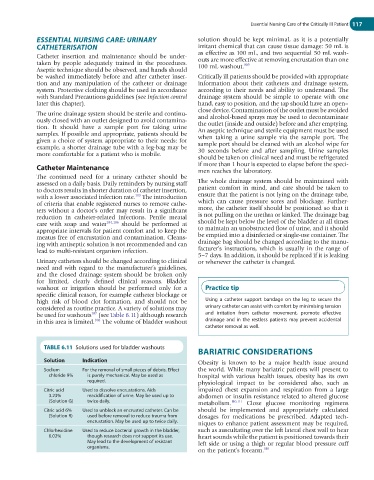
             considered as routine practice. A variety of solutions may   urinary catheter can assist with comfort by minimising tension
             be used for washouts  (see Table 6.11) although research   and  irritation  from  catheter  movement,  promote  effective
                               107
             in this area is limited.  The volume of bladder washout   drainage and in the restless patients may prevent accidental
                                108
                                                                    catheter removal as well.
               TABLE 6.11  Solutions used for bladder washouts
                                                                  BARIATRIC CONSIDERATIONS
               Solution     Indication                            Obesity  is  known  to  be  a  major  health  issue  around
               Sodium       For the removal of small pieces of debris. Effect   the world. While many bariatric patients will present to
                 chloride 9%  is purely mechanical. May be used as   hospital with various health issues, obesity has its own
                              required.                           physiological  impact  to  be  considered  also,  such  as
               Citric acid   Used to dissolve encrustations. Aids   impaired  chest  expansion  and  respiration  from  a  large
                 3.23%        reacidification of urine. May be used up to   abdomen or insulin resistance related to altered glucose
                 (Solution G)  twice daily.                       metabolism. 110,111   Close  glucose  monitoring  regimens
               Citric acid 6%   Used to unblock an encrusted catheter. Can be   should  be  implemented  and  appropriately  calculated
                 (Solution R)  used before removal to reduce trauma from   dosages  for  medications  be  prescribed.  Adapted  tech-
                              encrustation. May be used up to twice daily.  niques to enhance patient assessment may be required,
               Chlorhexidine   Used to reduce bacterial growth in the bladder,   such as auscultating over the left lateral chest wall to hear
                 0.02%        though research does not support its use.   heart sounds while the patient is positioned towards their
                              May lead to the development of resistant   left side or using a thigh or regular blood pressure cuff
                              organisms.
                                                                  on the patient’s forearm. 110

