


Page 163 - ACCCN's Critical Care Nursing
P. 163
140  P R I N C I P L E S   A N D   P R A C T I C E   O F   C R I T I C A L   C A R E


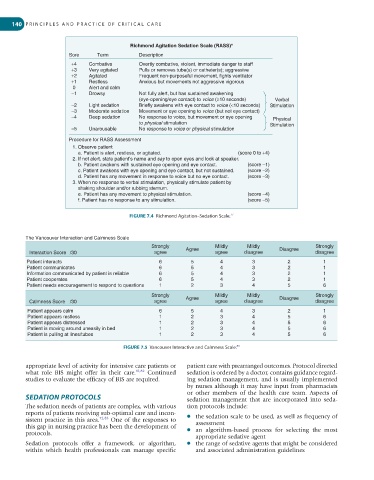
                                            Richmond Agitation Sedation Scale (RASS)*
                        Sore     Term         Description
                        +4    Combative       Overtly combative, violent, immediate danger to staff
                        +3    Very agitated   Pulls or removes tube(s) or catheter(s); aggressive
                        +2    Agitated        Frequent non-purposeful movement, fights ventilator
                        +1    Restless        Anxious but movements not aggressive vigorous
                         0    Alert and calm
                        −1    Drowsy          Not fully alert, but has sustained awakening
                                              (eye-opening/eye contact) to voice (≥10 seconds)  Verbal
                        −2    Light sedation  Briefly awakens with eye contact to voice (<10 seconds)  Stimulation
                        −3    Moderate sedation  Movement or eye opening to voice (but not eye contact)
                        −4    Deep sedation   No response to voice, but movement or eye opening  Physical
                                              to physical stimulation                    Stimulation
                        −5    Unarousable     No response to voice or physical stimulation
                        Procedure for RASS Assessment
                         1. Observe patient
                             a. Patient is alert, restless, or agitated.       (score 0 to +4)
                         2. If not alert, state patient’s name and say to open eyes and look at speaker.
                             b. Patient awakens with sustained eye opening and eye contact.  (score −1)
                             c. Patient awakens with eye opening and eye contact, but not sustained.  (score −2)
                             d. Patient has any movement in response to voice but no eye contact.  (score −3)
                         3. When no response to verbal stimulation, physically stimulate patient by
                             shaking shoulder and/or rubbing sternum.
                             e. Patient has any movement to physical stimulation.  (score −4)
                             f. Patient has no response to any stimulation.       (score −5)

                                                                            77
                                           FIGURE 7.4  Richmond Agitation–Sedation Scale.


         The Vancouver Interaction and Calmness Scale
                                                   Strongly            Mildly     Mildly                Strongly
           Interaction Score /30                   agree      Agree    agree     disagree   Disagree    disagree
          Patient interacts                          6         5         4          3          2           1
          Patient communicates                       6         5         4          3          2           1
          Information communicated by patient is reliable  6   5         4          3          2           1
          Patient cooperates                         6         5         4          3          2           1
          Patient needs encouragement to respond to questions  1  2      3          4          5           6
                                                   Strongly            Mildly     Mildly                Strongly
           Calmness Score  /30                     agree      Agree    agree     disagree   Disagree    disagree
          Patient appears calm                       6         5         4          3          2           1
          Patient appears restless                   1         2         3          4          5           6
          Patient appears distressed                 1         2         3          4          5           6
          Patient is moving around uneasily in bed   1         2         3          4          5           6
          Patient is pulling at lines/tubes          1         2         3          4          5           6
                                                                              80
                                         FIGURE 7.5  Vancouver Interactive and Calmness Scale.

         appropriate level of activity for intensive care patients or   patient care with prearranged outcomes. Protocol directed
         what  role  BIS  might  offer  in  their  care. 81,82   Continued   sedation is ordered by a doctor, contains guidance regard-
         studies to evaluate the efficacy of BIS are required.  ing sedation management, and is usually implemented
                                                              by nurses although it may have input from pharmacists
                                                              or  other  members  of  the  health  care  team.  Aspects  of
         SEDATION PROTOCOLS                                   sedation  management  that  are  incorporated  into  seda-
         The sedation needs of patients are complex, with various   tion protocols include:
         reports of patients receiving sub-optimal care and incon-  ●  the sedation scale to be used, as well as frequency of
         sistent practice in this area. 72,83  One of the responses to   assessment
         this gap in nursing practice has been the development of   ●  an  algorithm-based  process  for  selecting  the  most
         protocols.
                                                                 appropriate sedative agent
         Sedation  protocols  offer  a  framework,  or  algorithm,   ●  the range of sedative agents that might be considered
         within  which  health  professionals  can  manage  specific   and associated administration guidelines

