


Page 169 - ACCCN's Critical Care Nursing
P. 169
146  P R I N C I P L E S   A N D   P R A C T I C E   O F   C R I T I C A L   C A R E

         sleep, that lasts 60–90 minutes. Time spent awake during   critical care. Actigraphy is another method of recording
         the sleep period is less than 5% of TST. 123  All sleep stages   sleep that has been attempted in the critically ill. Modern
         are  important  to  health  and  unfortunately  critically    actigraphs are small wristwatch devices (they may also be
         ill  patients  commonly  experience  very  little  deep  or     located  on  the  trunk  or  leg)  containing  accelerometers
         REM sleep.                                           that detect motion in a single axis or multiple axes. 127,128
                                                              Data  obtained  from  actigraphy  provides  an  over-
         There  are  changes  in  sleep  architecture  over  the  adult
         lifespan  which  require  consideration  in  the  context  of   estimation of sleep time (critically patients are typically
         critical care nursing. TST and percentage of SWS decline   immobile for long periods regardless of sleep state). The
         (TST by 10 minutes and SWS by 2% per decade) and light   other  objective  method  which  has  been  attempted  in
                                                                                         129,130
         sleep increases slightly (only by 5% between 20 and 70   critical care is BIS monitoring.   At present, consider-
         years) with age. 124  REM sleep remains fairly constant with   able  algorithm  development  using  comparisons  with
         an  approximate  0.6%  decline  per  decade  until  age  70   PSG  data  are  required  before  it  is  a  viable  option  to
         when  REM  increases  with  a  simultaneous  decrease  in   measure sleep accurately in any setting.
         TST. 125  Time spent awake after sleep onset increases with   The most reliable option for the critical care clinician to
         age by 10 minutes per decade after age 30. 124       assess sleep is a patient self-report (in any case the patient
                                                              is  best  placed  to  judge  the  quantity  and  quality  of
                                                              their sleep if they are able). Two instruments have been
         SLEEP ASSESSMENT/MONITORING                          specifically developed for use in critical care; the Richards-
                                                                                                 131
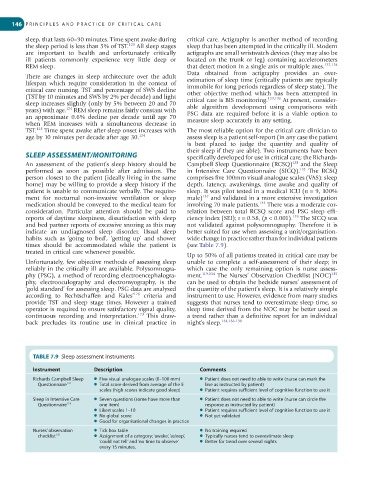
         An  assessment  of  the  patient’s  sleep  history  should  be   Campbell Sleep Questionnaire (RCSQ)  and the Sleep
                                                                                                   118
         performed  as  soon  as  possible  after  admission.  The   in  Intensive  Care  Questionnaire  (SICQ).   The  RCSQ
         person closest to the patient (ideally living in the same   comprises five 100mm visual analogue scales (VAS): sleep
         home) may be willing to provide a sleep history if the   depth,  latency,  awakenings,  time  awake  and  quality  of
         patient is unable to communicate verbally. The require-  sleep. It was pilot tested in a medical ICU (n = 9, 100%
         ment  for  nocturnal  non-invasive  ventilation  or  sleep   male) 132  and validated in a more extensive investigation
         medication should be conveyed to the medical team for   involving 70 male patients.  There was a moderate cor-
                                                                                      133
         consideration.  Particular  attention  should  be  paid  to   relation  between  total  RCSQ  score  and  PSG  sleep  effi-
         reports of daytime sleepiness, dissatisfaction with sleep   ciency index (SEI); r = 0.58, (p < 0.001). 133  The SICQ was
         and bed partner reports of excessive snoring as this may   not  validated  against  polysomnography.  Therefore  it  is
         indicate  an  undiagnosed  sleep  disorder.  Usual  sleep   better suited for use when assessing a unit/organisation-
         habits  such  as  ‘going  to  bed’,  ‘getting  up’  and  shower   wide change in practice rather than for individual patients
         times  should  be  accommodated  while  the  patient  is   (see Table 7.9).
         treated in critical care whenever possible.
                                                              Up to 50% of all patients treated in critical care may be
         Unfortunately, few objective methods of assessing sleep   unable  to  complete  a  self-assessment  of  their  sleep;  in
         reliably in the critically ill are available. Polysomnogra-  which  case  the  only  remaining  option  is  nurse  assess-
         phy (PSG), a method of recording electroencephalogra-  ment. 119,134  The Nurses’ Observation Checklist (NOC) 135
         phy,  electrooculography  and  electromyography,  is  the   can be used to obtain the bedside nurses’ assessment of
         ‘gold standard’ for assessing sleep. PSG data are analysed   the quantity of the patient’s sleep. It is a relatively simple
                                             126
         according  to  Rechtschaffen  and  Kales’   criteria  and   instrument to use. However, evidence from many studies
         provide  TST  and  sleep  stage  times.  However  a  trained   suggests that nurses tend to overestimate sleep time, so
         operator is required to ensure satisfactory signal quality,   sleep time derived from the NOC may be better used as
         continuous  recording  and  interpretation. 123   This  draw-  a trend rather than a definitive report for an individual
         back  precludes  its  routine  use  in  clinical  practice  in   night’s sleep. 134,136-138


            TABLE 7.9  Sleep assessment instruments

            Instrument          Description                       Comments
            Richards Campbell Sleep   ●  Five visual analogue scales (0–100 mm)  ●  Patient does not need to able to write (nurse can mark the
             Questionnaire 131  ●  Total score derived from average of the 5   line as instructed by patient)
                                  scales (high scores indicate good sleep)  ●  Patient requires sufficient level of cognitive function to use it
            Sleep in Intensive Care   ●  Seven questions (some have more than   ●  Patient does not need to able to write (nurse can circle the
             Questionnaire 118    one item)                         response as instructed by patient)
                                ●  Likert scales 1–10             ●  Patient requires sufficient level of cognitive function to use it
                                ●  No global score                ●  Not yet validated
                                ●  Good for organisational changes in practice
            Nurses’ observation   ●  Tick box table               ●  No training required
             checklist 135      ●  Assignment of a category; ‘awake’, ‘asleep’,   ●  Typically nurses tend to overestimate sleep
                                  ‘could not tell’ and ‘no time to observe’   ●  Better for trend over several nights
                                  every 15 minutes.

