


Page 167 - ACCCN's Critical Care Nursing
P. 167
144  P R I N C I P L E S   A N D   P R A C T I C E   O F   C R I T I C A L   C A R E

         pharmacological treatment of pain, non-pharmacological
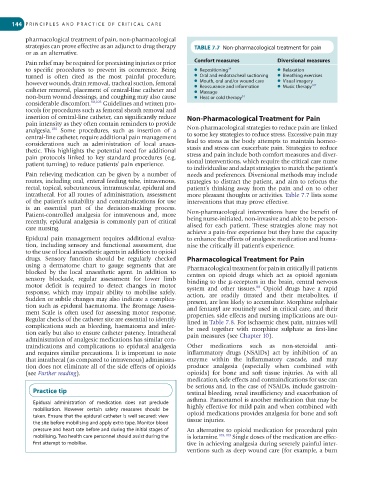
         strategies can prove effective as an adjunct to drug therapy   TABLE 7.7  Non-pharmacological treatment for pain
         or as an alternative.
         Pain relief may be required for preexisting injuries or prior   Comfort measures   Diversional measures
         to  specific  procedures  to  prevent  its  occurrence.  Being   ●  Repositioning 34  ●  Relaxation
         turned  is  often  cited  as  the  most  painful  procedure,   ●  Oral and endotracheal suctioning  ●  Breathing exercises
         however wounds, drain removal, tracheal suction, femoral   ●  Mouth, oral and/or wound care  ●  Visual imagery 107
         catheter removal, placement of central-line catheter and   ●  Reassurance and information  ●  Music therapy
                                                                 ●  Massage
         non-burn wound dressings, and coughing may also cause   ●  Heat or cold therapy 34
         considerable discomfort. 90,103  Guidelines and written pro-
         tocols for procedures such as femoral sheath removal and
         insertion of central-line catheter, can significantly reduce   Non-Pharmacological Treatment for Pain
         pain intensity as they often contain reminders to provide
                  106
         analgesia.   Some  procedures,  such  as  insertion  of  a   Non-pharmacological strategies to reduce pain are linked
         central-line catheter, require additional pain management   to some key strategies to reduce stress. Excessive pain may
         considerations  such  as  administration  of  local  anaes-  lead to stress as the body attempts to maintain homeo-
         thetic. This highlights the potential need for additional   stasis and stress can exacerbate pain. Strategies to reduce
         pain  protocols  linked  to  key  standard  procedures  (e.g.   stress and pain include both comfort measures and diver-
         patient turning) to reduce patients’ pain experience.  sional interventions, which require the critical care nurse
                                                              to individualise and adapt strategies to match the patient’s
         Pain relieving medication can be given by a number of   needs and preferences. Diversional methods may include
         routes, including oral, enteral feeding tube, intravenous,   strategies to distract the patient, and aim to refocus the
         rectal, topical, subcutaneous, intramuscular, epidural and   patient’s  thinking  away  from  the  pain  and  on  to  other
         intrathecal. For all routes of administration, assessment   more pleasant thoughts or activities. Table 7.7 lists some
         of the patient’s suitability and contraindications for use   interventions that may prove effective.
         is  an  essential  part  of  the  decision-making  process.
         Patient-controlled  analgesia  for  intravenous  and,  more   Non-pharmacological  interventions  have  the  benefit  of
         recently, epidural analgesia is commonly part of critical   being nurse-initiated, non-invasive and able to be person-
         care nursing.                                        alised  for  each  patient.  These  strategies  alone  may  not
                                                              achieve a pain-free experience but they have the capacity
         Epidural  pain  management  requires  additional  evalua-  to enhance the effects of analgesic medication and huma-
         tion,  including  sensory  and  functional  assessment,  due   nise the critically ill patient’s experience.
         to the use of local anaesthetic agents in addition to opioid
         drugs.  Sensory  function  should  be  regularly  checked   Pharmacological Treatment for Pain
         using  a  dermatome  chart  to  gauge  segments  that  are   Pharmacological treatment for pain in critically ill patients
         blocked  by  the  local  anaesthetic  agent.  In  addition  to   centres  on  opioid  drugs  which  act  as  opioid  agonists
         sensory  blockade,  regular  assessment  for  lower  limb   binding to the µ-receptors in the brain, central nervous
         motor  deficit  is  required  to  detect  changes  in  motor   system  and  other  tissues.   Opioid  drugs  have  a  rapid
                                                                                     88
         response,  which  may  impair  ability  to  mobilise  safely.   action,  are  readily  titrated  and  their  metabolites,  if
         Sudden or subtle changes may also indicate a complica-  present, are less likely to accumulate. Morphine sulphate
         tion such as epidural haematoma. The Bromage Assess-  and fentanyl are routinely used in critical care, and their
         ment  Scale  is  often  used  for  assessing  motor  response.   properties, side effects and nursing implications are out-
         Regular checks of the catheter site are essential to identify   lined in Table 7.8. For ischaemic chest pain, nitrates will
         complications such as bleeding, haematoma and infec-  be  used  together  with  morphine  sulphate  as  first-line
         tion early but also to ensure catheter patency. Intrathecal   pain measures (see Chapter 10).
         administration of analgesic medications has similar con-
         traindications  and  complications  to  epidural  analgesia   Other  medications  such  as  non-steroidal  anti-
         and requires similar precautions. It is important to note   inflammatory  drugs  (NSAIDs)  act  by  inhibition  of  an
         that intrathecal (as compared to intravenous) administra-  enzyme  within  the  inflammatory  cascade,  and  may
         tion does not eliminate all of the side effects of opioids   produce  analgesia  (especially  when  combined  with
         (see Further reading).                               opioids)  for  bone  and  soft  tissue  injuries.  As  with  all
                                                              medication, side effects and contraindications for use can
                                                              be serious and, in the case of NSAIDs, include gastroin-
            Practice tip                                      testinal bleeding, renal insufficiency and exacerbation of
                                                              asthma. Paracetamol is another medication that may be
            Epidural  administration  of  medication  does  not  preclude
            mobilisation.  However  certain  safety  measures  should  be   highly effective for mild pain and when combined with
            taken. Ensure that the epidural catheter is well secured: view   opioid medications provides analgesia for bone and soft
            the site before mobilising and apply extra tape. Monitor blood   tissue injuries.
            pressure and heart rate before and during the initial stages of   An alternative to opioid medication for procedural pain
            mobilising. Two health care personnel should assist during the   is ketamine. 108,109  Single doses of the medication are effec-
            first attempt to mobilise.                        tive in achieving analgesia during severely painful inter-
                                                              ventions such as deep wound care (for example, a burn

