


Page 168 - ACCCN's Critical Care Nursing
P. 168
Psychological Care 145


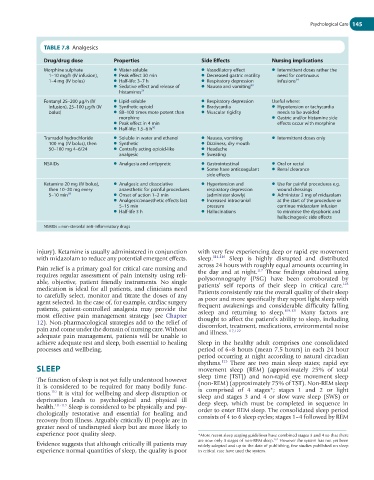
               TABLE 7.8  Analgesics

               Drug/drug dose         Properties                   Side Effects           Nursing implications
               Morphine sulphate      ●  Water-soluble             ●  Vasodilatory effect  ●  Intermittent doses rather the
                 1–10 mg/h (IV infusion),   ●  Peak effect 30 min  ●  Decreased gastric motility  need for continuous
                 1–4 mg (IV bolus)    ●  Half-life: 3–7 h          ●  Respiratory depression  infusions 34
                                      ●  Sedative effect and release of   ●  Nausea and vomiting 89
                                        histamines 34
               Fentanyl 25–200 µg/h (IV   ●  Lipid-soluble         ●  Respiratory depression  Useful where:
                 infusion), 25–100 µg/h (IV   ●  Synthetic opioid  ●  Bradycardia         ●  Hypotension or tachycardia
                 bolus)               ●  80–100 times more potent than   ●  Muscular rigidity  needs to be avoided
                                        morphine                                          ●  Gastric and/or histamine side
                                      ●  Peak effect in 4 min                               effects occur with morphine
                                      ●  Half-life: 1.5–6 h 90
               Tramadol hydrochloride   ●  Soluble in water and ethanol  ●  Nausea, vomiting  ●  Intermittent doses only
                 100 mg (IV bolus), then   ●  Synthetic            ●  Dizziness, dry mouth
                 50–100 mg 4–6/24     ●  Centrally acting opioid-like   ●  Headache
                                        analgesic                  ●  Sweating
               NSAIDs                 ●  Analgesia and antipyretic  ●  Gastrointestinal   ●  Oral or rectal
                                                                   ●  Some have anticoagulant   ●  Renal clearance
                                                                     side effects
               Ketamine 20 mg (IV bolus),   ●  Analgesic and dissociative   ●  Hypertension and   ●  Use for painful procedures e.g.
                 then 10–20 mg every    anaesthetic for painful procedures  respiratory depression   wound dressings
                 5–10 min 89          ●  Onset of action 1–2 min     (administer slowly)  ●  Administer 2 mg of midazolam
                                      ●  Analgesic/anaesthetic effects last   ●  Increased intracranial   at the start of the procedure or
                                        5–15 min                     pressure               continue midazolam infusion
                                      ●  Half-life 3 h             ●  Hallucinations        to minimise the dysphoric and
                                                                                            hallucinogenic side effects
               NSAIDs = non-steroidal anti-inflammatory drugs


             injury). Ketamine is usually administered in conjunction   with very few experiencing deep or rapid eye movement
             with midazolam to reduce any potential emergent effects.  sleep. 114-116   Sleep  is  highly  disrupted  and  distributed
                                                                  across 24 hours with roughly equal amounts occurring in
             Pain relief is a primary goal for critical care nursing and             117
             requires regular assessment of pain intensity using reli-  the  day  and  at  night.   These  findings  obtained  using
             able,  objective,  patient  friendly  instruments.  No  single   polysomnography  (PSG)  have  been  corroborated  by
                                                                                                                 118
             medication is ideal for all patients, and clinicians need   patients’  self  reports  of  their  sleep  in  critical  care.
             to carefully select, monitor and titrate the doses of any   Patients consistently rate the overall quality of their sleep
             agent selected. In the case of, for example, cardiac surgery   as poor and more specifically they report light sleep with
             patients,  patient-controlled  analgesia  may  provide  the   frequent  awakenings  and  considerable  difficulty  falling
                                                                                              119-121
             most  effective  pain  management  strategy  (see  Chapter   asleep  and  returning  to  sleep.    Many  factors  are
             12). Non-pharmacological strategies add to the relief of   thought to affect the patient’s ability to sleep, including
             pain and come under the domain of nursing care. Without   discomfort, treatment, medications, environmental noise
                                                                            117,122
             adequate  pain  management,  patients  will  be  unable  to   and illness.
             achieve adequate rest and sleep, both essential to healing   Sleep  in  the  healthy  adult  comprises  one  consolidated
             processes and wellbeing.                             period of 6–8 hours (mean 7.5 hours) in each 24 hour
                                                                  period occurring at night according to natural circadian
                                                                  rhythms. 123   There  are  two  main  sleep  states;  rapid  eye
             SLEEP                                                movement  sleep  (REM)  (approximately  25%  of  total
                                                                  sleep  time  [TST])  and  non-rapid  eye  movement  sleep
             The function of sleep is not yet fully understood however   (non-REM) (approximately 75% of TST). Non-REM sleep
             it  is  considered  to  be  required  for  many  bodily  func-  is  comprised  of  4  stages*;  stages  1  and  2  or  light
                  110
             tions.  It is vital for wellbeing and sleep disruption or   sleep  and  stages  3  and  4  or  slow  wave  sleep  (SWS)  or
             deprivation  leads  to  psychological  and  physical  ill   deep  sleep,  which  must  be  completed  in  sequence  in
             health. 111-113  Sleep is considered to be physically and psy-  order to enter REM sleep. The consolidated sleep period
             chologically  restorative  and  essential  for  healing  and   consists of 4 to 6 sleep cycles; stages 1–4 followed by REM
             recovery from illness. Arguably critically ill people are in
             greater need of undisrupted sleep but are more likely to
             experience poor quality sleep.                       *More recent sleep staging guidelines have combined stages 3 and 4 so that there
             Evidence suggests that although critically ill patients may   are now only 3 stages of non-REM sleep. 162  However the system has not yet been
                                                                  widely adopted and up to the date of publishing, few studies published on sleep
             experience normal quantities of sleep, the quality is poor   in critical care have used the system.

