


Page 166 - ACCCN's Critical Care Nursing
P. 166
Psychological Care 143


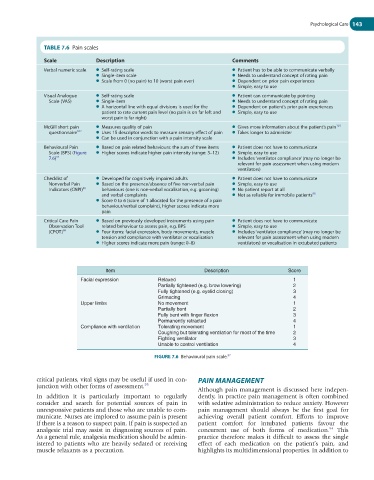
               TABLE 7.6  Pain scales

               Scale             Description                                 Comments
               Verbal numeric scale  ●  Self-rating scale                    ●  Patient has to be able to communicate verbally
                                 ●  Single-item scale                        ●  Needs to understand concept of rating pain
                                 ●  Scale from 0 (no pain) to 10 (worst pain ever)  ●  Dependent on prior pain experiences
                                                                             ●  Simple, easy to use
               Visual Analogue   ●  Self-rating scale                        ●  Patient can communicate by pointing
                 Scale (VAS)     ●  Single-item                              ●  Needs to understand concept of rating pain
                                 ●  A horizontal line with equal divisions is used for the   ●  Dependent on patient’s prior pain experiences
                                  patient to rate current pain level (no pain is on far left and   ●  Simple, easy to use
                                  worst pain is far right)
               McGill short pain   ●  Measures quality of pain               ●  Gives more information about the patient’s pain 103
                 questionnaire 102  ●  Uses 15 descriptor words to measure sensory effect of pain  ●  Takes longer to administer
                                 ●  Can be used in conjunction with a pain intensity scale
               Behavioural Pain   ●  Based on pain related behaviours: the sum of three items  ●  Patient does not have to communicate
                 Scale (BPS) (Figure   ●  Higher scores indicate higher pain intensity (range: 3–12)  ●  Simple, easy to use
                 7.6) 97                                                     ●  Includes ‘ventilator compliance’ (may no longer be
                                                                               relevant for pain assessment when using modern
                                                                               ventilators)
               Checklist of     ●  Developed for cognitively impaired adults  ●  Patient does not have to communicate
                 Nonverbal Pain   ●  Based on the presence/absence of five non-verbal pain   ●  Simple, easy to use
                 Indicators (CNPI) 98  behaviours (one is non-verbal vocalisation, e.g. groaning)   ●  No patient report at all
                                  and verbal complaints                      ●  Not as reliable for immobile patients 98
                                ●  Score 0 to 6 (score of 1 allocated for the presence of a pain
                                  behaviour/verbal complaint), higher scores indicate more
                                  pain
               Critical Care Pain   ●  Based on previously developed instruments using pain   ●  Patient does not have to communicate
                 Observation Tool   related behaviour to assess pain, e.g. BPS  ●  Simple, easy to use
                 (CPOT) 99      ●  Four items: facial expression, body movements, muscle   ●  Includes ‘ventilator compliance’ (may no longer be
                                  tension and compliance with ventilator or vocalisation  relevant for pain assessment when using modern
                                ●  Higher scores indicate more pain (range: 0–8)  ventilators) or vocalisation in extubated patients


                                    Item                            Description                Score
                           Facial expression         Relaxed                                     1
                                                     Partially tightened (e.g. brow lowering)    2
                                                     Fully tightened (e.g. eyelid closing)       3
                                                     Grimacing                                   4
                           Upper limbs               No movement                                 1
                                                     Partially bent                              2
                                                     Fully bent with finger flexion              3
                                                     Permanently retracted                       4
                           Compliance with ventilation  Tolerating movement                      1
                                                     Coughing but tolerating ventilation for most of the time  2
                                                     Fighting ventilator                         3
                                                     Unable to control ventilation               4
                                                    FIGURE 7.6  Behavioural pain scale.
                                                                           97


             critical patients, vital signs may be useful if used in con-  PAIN MANAGEMENT
             junction with other forms of assessment. 95
                                                                  Although pain management is discussed here  indepen-
             In  addition  it  is  particularly  important  to  regularly     dently, in practice pain management is often combined
             consider  and  search  for  potential  sources  of  pain  in   with sedative administration to reduce anxiety. However
             un responsive patients and those who are unable to com-  pain  management  should  always  be  the  first  goal  for
             municate. Nurses are implored to assume pain is present   achieving  overall  patient  comfort.  Efforts  to  improve
             if there is a reason to suspect pain. If pain is suspected an   patient  comfort  for  intubated  patients  favour  the
                                                                                                             94
             analgesic trial may assist in diagnosing sources of pain.   concurrent  use  of  both  forms  of  medication.   This
             As a general rule, analgesia medication should be admin-  practice  therefore  makes  it  difficult  to  assess  the  single
             istered to patients who are heavily sedated or receiving   effect  of  each  medication  on  the  patient’s  pain,  and
             muscle relaxants as a precaution.                    highlights its multidimensional properties. In addition to

