


Page 171 - ACCCN's Critical Care Nursing
P. 171
148  P R I N C I P L E S   A N D   P R A C T I C E   O F   C R I T I C A L   C A R E

         ●  Many medications administered in critical care affect   adverse drug reactions is important in the prevention
            sleep architecture. Even vasoactive medications such   of escalating sleep disturbances.
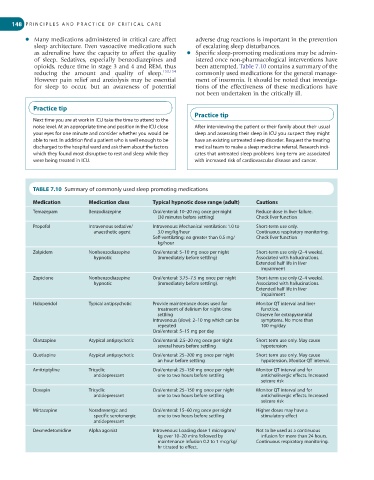
            as  adrenaline  have  the  capacity  to  affect  the  quality    ●  Specific sleep-promoting medications may be admin-
            of  sleep.  Sedatives,  especially  benzodiazepines  and   istered once non-pharmacological interventions have
            opioids, reduce time in stage 3 and 4 and REM, thus   been attempted. Table 7.10 contains a summary of the
            reducing  the  amount  and  quality  of  sleep. 153,154    commonly used medications for the general manage-
            However pain relief and anxiolysis may be essential   ment of insomnia. It should be noted that investiga-
            for  sleep  to  occur,  but  an  awareness  of  potential   tions  of  the  effectiveness  of  these  medications  have
                                                                 not been undertaken in the critically ill.

            Practice tip
                                                                 Practice tip
            Next time you are at work in ICU take the time to attend to the
            noise level. At an appropriate time and position in the ICU close   After interviewing the patient or their family about their usual
            your eyes for one minute and consider whether you would be   sleep and assessing their sleep in ICU you suspect they might
            able to rest. In addition find a patient who is well enough to be   have an existing untreated sleep disorder. Request the treating
            discharged to the hospital ward and ask them about the factors   medical team to make a sleep medicine referral. Research indi-
            which they found most disruptive to rest and sleep while they   cates that untreated sleep problems long-term are associated
            were being treated in ICU.                           with increased risk of cardiovascular disease and cancer.


            TABLE 7.10  Summary of commonly used sleep promoting medications
            Medication        Medication class     Typical hypnotic dose range (adult)  Cautions
            Temazepam         Benzodiazepine       Oral/enteral: 10–20 mg once per night    Reduce dose in liver failure.
                                                     (30 minutes before settling)    Check liver function
            Propofol          Intravenous sedative/  Intravenous: Mechanical ventilation: 1.0 to   Short-term use only.
                                anaesthetic agent    3.0 mg/kg/hour                  Continuous respiratory monitoring.
                                                   Self-ventilating: no greater than 0.5 mg/  Check liver function
                                                     kg/hour
            Zolpidem          Nonbenzodiazepine    Oral/enteral: 5–10 mg once per night   Short-term use only (2–4 weeks).
                                hypnotic             (immediately before settling)   Associated with hallucinations.
                                                                                     Extended half life in liver
                                                                                      impairment
            Zopiclone         Nonbenzodiazepine    Oral/enteral: 3.75–7.5 mg once per night   Short-term use only (2–4 weeks).
                                hypnotic             (immediately before settling).  Associated with hallucinations.
                                                                                     Extended half life in liver
                                                                                      impairment
            Haloperidol       Typical antipsychotic  Provide maintenance doses used for   Monitor QT interval and liver
                                                     treatment of delirium for night-time   function.
                                                     settling                        Observe for extrapyramidal
                                                   Intravenous (slow): 2–10 mg which can be   symptoms. No more than
                                                     repeated                         100 mg/day
                                                   Oral/enteral: 5–15 mg per day
            Olanzapine        Atypical antipsychotic  Oral/enteral: 2.5–20 mg once per night   Short term use only. May cause
                                                     several hours before settling    hypotension
            Quetiapine        Atypical antipsychotic  Oral/enteral: 25–200 mg once per night   Short term use only. May cause
                                                     an hour before settling          hypotension. Monitor QT interval.
            Amitriptyline     Tricyclic            Oral/enteral: 25–150 mg once per night   Monitor QT interval and for
                                antidepressant       one to two hours before settling  anticholinergic effects. Increased
                                                                                      seizure risk
            Doxepin           Tricyclic            Oral/enteral: 25–150 mg once per night   Monitor QT interval and for
                                antidepressant       one to two hours before settling  anticholinergic effects. Increased
                                                                                      seizure risk
            Mirtazapine       Noradrenergic and    Oral/enteral: 15–60 mg once per night   Higher doses may have a
                                specific serotonergic   one to two hours before settling  stimulatory effect
                                antidepressant
            Dexmedetomidine   Alpha agonist        Intravenous: Loading dose 1 microgram/  Not to be used as a continuous
                                                     kg over 10–20 mins followed by   infusion for more than 24 hours.
                                                     maintenance infusion 0.2 to 1 mcg/kg/  Continuous respiratory monitoring.
                                                     hr titrated to effect.

