


Page 164 - ACCCN's Critical Care Nursing
P. 164
Psychological Care 141


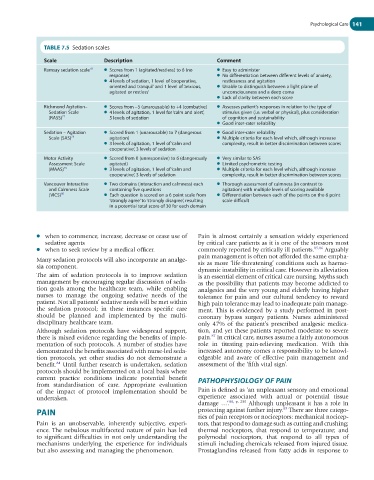
               TABLE 7.5  Sedation scales

               Scale               Description                          Comment
               Ramsay sedation scale 76  ●  Scores from 1 (agitated/restless) to 6 (no   ●  Easy to administer
                                     response)                          ●  No differentiation between different levels of anxiety,
                                   ●  4 levels of sedation, 1 level of ‘cooperative,   restlessness and agitation
                                     oriented and tranquil’ and 1 level of ‘anxious,   ●  Unable to distinguish between a light plane of
                                     agitated or restless’                unconsciousness and a deep coma
                                                                        ●  Lack of clarity between each score
               Richmond Agitation–  ●  Scores from −5 (unarousable) to +4 (combative)  ●  Assesses patient’s responses in relation to the type of
                 Sedation Scale    ●  4 levels of agitation, 1 level for ‘calm and alert’,   stimulus given (i.e. verbal or physical), plus consideration
                 (RASS) 77           5 levels of sedation                 of cognition and sustainability
                                                                        ●  Good inter-rater reliability
               Sedation – Agitation   ●  Scored from 1 (unarousable) to 7 (dangerous   ●  Good inter-rater reliability
                 Scale (SAS) 78      agitation)                         ●  Multiple criteria for each level which, although increase
                                   ●  3 levels of agitation, 1 level of ‘calm and   complexity, result in better discrimination between scores
                                     cooperative’, 3 levels of sedation
               Motor Activity      ●  Scored from 0 (unresponsive) to 6 (dangerously   ●  Very similar to SAS
                 Assessment Scale    agitated)                          ●  Limited psychometric testing
                 (MAAS) 79         ●  3 levels of agitation, 1 level of ‘calm and   ●  Multiple criteria for each level which, although increase
                                     cooperative’, 3 levels of sedation   complexity, result in better discrimination between scores
               Vancouver Interactive   ●  Two domains (interaction and calmness) each   ●  Thorough assessment of calmness (in contrast to
                 and Calmness Scale   containing five questions           agitation) with multiple levels of scoring available
                 (VICS) 80         ●  Each question is scored on a 6 point scale from   ●  Differentiation between each of the points on the 6 point
                                     ‘strongly agree’ to ‘strongly disagree’, resulting   scale difficult
                                     in a potential total score of 30 for each domain


             ●  when to commence, increase, decrease or cease use of   Pain is almost certainly a sensation widely experienced
                sedative agents                                   by critical care patients as it is one of the stressors most
             ●  when to seek review by a medical officer.         commonly reported by critically ill patients. 85,86  Arguably
                                                                  pain management is often not afforded the same empha-
             Many sedation protocols will also incorporate an analge-  sis as more ‘life-threatening’ conditions such as haemo-
             sia component.                                       dynamic instability in critical care. However its alleviation
             The  aim  of  sedation  protocols  is  to  improve  sedation   is an essential element of critical care nursing. Myths such
             management by encouraging regular discussion of seda-  as the possibility that patients may become addicted to
             tion  goals  among  the  healthcare  team,  while  enabling   analgesics and the very young and elderly having higher
             nurses  to  manage  the  ongoing  sedative  needs  of  the   tolerance for pain and our cultural tendency to reward
             patient. Not all patients’ sedative needs will be met within   high pain tolerance may lead to inadequate pain manage-
             the  sedation  protocol;  in  these  instances  specific  care   ment.  This  is  evidenced  by  a  study  performed  in  post-
             should  be  planned  and  implemented  by  the  multi-  coronary  bypass  surgery  patients.  Nurses  administered
             disciplinary healthcare team.                        only  47%  of  the  patient’s  prescribed  analgesic  medica-
             Although  sedation  protocols  have  widespread  support,   tion, and yet these patients reported moderate to severe
                                                                      87
             there is mixed evidence regarding the benefits of imple-  pain.  In critical care, nurses assume a fairly autonomous
             mentation of such protocols. A number of studies have   role  in  titrating  pain-relieving  medication.  With  this
             demonstrated the benefits associated with nurse-led seda-  increased autonomy comes a responsibility to be knowl-
             tion  protocols,  yet  other  studies  do  not  demonstrate  a   edgeable  and  aware  of  effective  pain  management  and
                   84
             benefit.  Until further research is undertaken, sedation   assessment of the ‘fifth vital sign’.
             protocols should be implemented on a local basis where
             current  practice  conditions  indicate  potential  benefit   PATHOPHYSIOLOGY OF PAIN
             from  standardisation  of  care.  Appropriate  evaluation
             of  the  impact  of  protocol  implementation  should  be   Pain is defined as ‘an unpleasant sensory and emotional
             undertaken.                                          experience  associated  with  actual  or  potential  tissue
                                                                  damage …’. 88, p. 250  Although unpleasant it has a role in
             PAIN                                                 protecting against further injury.  There are three catego-
                                                                                              89
                                                                  ries of pain receptors or nociceptors: mechanical nocicep-
             Pain  is  an  unobservable,  inherently  subjective,  experi-  tors, that respond to damage such as cutting and crushing;
             ence. The nebulous multifaceted nature of pain has led   thermal  nociceptors,  that  respond  to  temperature;  and
             to significant difficulties in not only understanding the   polymodal  nociceptors,  that  respond  to  all  types  of
             mechanisms  underlying  the  experience  for  individuals   stimuli including chemicals released from injured tissue.
             but also assessing and managing the phenomenon.      Prostaglandins  released  from  fatty  acids  in  response  to

