


Page 253 - ACCCN's Critical Care Nursing
P. 253
230  P R I N C I P L E S   A N D   P R A C T I C E   O F   C R I T I C A L   C A R E

         The final compensatory mechanism to be activated is the   exists when the ventricle has an ejection fraction of less
         neurohormonal response which takes days to be activated.   than  40%,  resulting  in  increased  end-diastolic  volume
                                                                                               64
         This response involves the activation of vasopressin and   and increased intraventricular pressure.  The left atrium is
         atrial natriuretic peptide (ANP). Vasopressin is a potent   unable  to  empty  into  the  left  ventricle  adequately  and
         vasoconstrictor and also an antidiuretic hormone. ANP is   pressure in the left atrium rises. This pressure is reflected in
         important  in  the  regulation  of  cardiovascular  volume   the pulmonary veins and causes pulmonary congestion.
         homeostasis. It is released from the atria in response to   When pulmonary venous congestion exceeds 20 mmHg,
         atrial  stretching  due  to  an  increased  circulating  blood   fluid moves into the pulmonary interstitium. Raised pul-
         volume. ANP blocks the effect of the sympathetic nervous   monary interstitial pressure reduces pulmonary compli-
         system, RAAS and vasopressin. It reduces tachycardia via   ance, increases the work of breathing and is experienced
         the baroreceptors and reduces circulating blood volume   by  the  patient  as  shortness  of  breath.  Increased  blood
         by  increasing  salt  and  water  excretion  in  the  kidneys.   volume in the lung also initiates shallow, rapid breathing
         Plasma ANP is increased in acute heart failure but depleted   and the sensation of breathlessness. Patients also experi-
         in chronic heart failure.                            ence orthopnoea (dyspnoea while lying flat) and paroxys-
         Whilst in the healthy heart, these compensatory mecha-  mal  nocturnal  dyspnoea  (PND),  because  when  lying,
         nisms  would  result  in  an  adequate  cardiac  output,  in   blood is redistributed from gravity-dependent areas of the
         heart failure they do not, depending on the aetiology. In   body to the lung. Sitting upright or standing, and sleeping
                                                                                                              64
         ischaemic  heart  failure  the  damaged  myocardium  is   with additional pillows, relieves breathlessness at night.
         unable  to  respond  adequately  to  the  Frank-Starling   Acute pulmonary oedema results when pulmonary capil-
         response  and  ventricular  remodelling  develops.  Heart   lary pressure exceeds approximately 30 mmHg, and then
         failure caused by hypertension or valvular heart disease   fluid from the vessels begins to leak into the alveoli (see
         results in persistent pressure or volume overload which   Figure 10.10).  This fluid leak decreases the area available
                                                                          63
         is exacerbated by the Frank-Starling response and sympa-  for normal gas exchange and severe shortness of breath
         thetic  nervous  system  compensatory  mechanisms.  This   results, often accompanied by pink, frothy sputum and
         causes ventricular remodelling and depletion of norepi-  noisy respirations. This causes patients to experience severe
         nephrine  and  a  reduction  of  inotropic  response  to  the   anxiety and decreased oxygen levels. Pulmonary oedema
         cardiac sympathetic nervous system. These all exacerbate   is a medical emergency and requires urgent treatment.
         the  reduction  in  circulating  blood  volume  and  kidney   In addition to pulmonary symptoms, patients with left
         perfusion. Many patients with heart failure often have a   ventricular failure experience signs and symptoms related
         high plasma renin activity due to the continual activation   to decreased left ventricular output, including weakness,
         of the RAAS compensatory mechanism.
                                                              fatigue, difficulty in concentrating and decreased exercise
         In  heart  failure  patients  the  inadequate  cardiac  output   tolerance. These symptoms may be present for some time
         results in signs and symptoms of hypoperfusion (oliguria,   before  an  accurate  diagnosis  of  heart  failure  is  made,
         cognitive impairment and cold peripheries) and conges-  because  they  are  non-specific  and  are  consistent  with
         tion of the venous and pulmonary systems (acute pulmo-  other diagnoses such as depression. Other signs that are
         nary oedema, dyspnoea, hypoxaemia, peripheral oedema   useful in diagnosis include the presence of S3 (ventricular
         and liver congestion). Classification of signs and symp-  gallop), crackles over lung fields that do not clear with a
         toms is usually considered in the context of left or right   cough,  cardiomegaly  and  the  presence  of  pulmonary
         ventricular failure.                                 vessels on chest X-ray.
         LEFT VENTRICULAR FAILURE                             RIGHT VENTRICULAR FAILURE
         Left ventricular failure (LVF), compared with other forms   Right ventricular failure (RVF) does not usually occur in
         of heart failure, is characterised by breathlessness, orthop-  isolation, except in the presence of severe lung disease,
         noea  and  paroxysmal  nocturnal  dyspnoea,  irritating   such as chronic obstructive pulmonary disease, pulmo-
                                                                                                            60
         cough and fatigue (see Table 10.4). Left ventricular failure   nary hypertension or a massive pulmonary embolus.  In


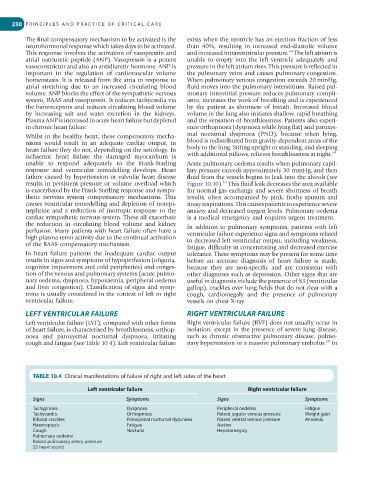
            TABLE 10.4  Clinical manifestations of failure of right and left sides of the heart

                              Left ventricular failure                            Right ventricular failure
            Signs                         Symptoms                      Signs                        Symptoms
            Tachypnoea                     Dyspnoea                     Peripheral oedema            Fatigue
            Tachycardia                    Orthopnoea                   Raised jugular venous pressure  Weight gain
            Bibasal crackles               Paroxysmal nocturnal dyspnoea  Raised central venous pressure  Anorexia
            Haemoptysis                    Fatigue                      Ascites
            Cough                          Nocturia                     Hepatomegaly
            Pulmonary oedema
            Raised pulmonary artery pressure
            S3 heart sound

