


Page 254 - ACCCN's Critical Care Nursing
P. 254
Cardiovascular Alterations and Management 231


                                                                             Alveolus
                                                              Proteins


                                                             A  Capillary    Lymphatics    B


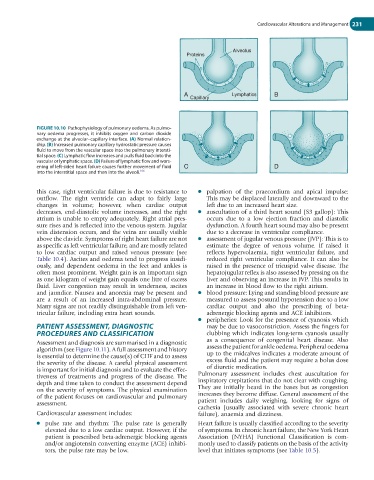
             FIGURE 10.10  Pathophysiology of pulmonary oedema. As pulmo-
             nary  oedema  progresses,  it  inhibits  oxygen  and  carbon  dioxide
             exchange at the alveolar–capillary interface. (A) Normal relation-
             ship. (B) Increased pulmonary capillary hydrostatic pressure causes
             fluid to move from the vascular space into the pulmonary intersti-
             tial space. (C) Lymphatic flow increases and pulls fluid back into the
             vascular or lymphatic space. (D) Failure of lymphatic flow and wors-
             ening of left-sided heart failure causes further movement of fluid   C        D
                                               106
             into the interstitial space and then into the alveoli.

             this case, right ventricular failure is due to resistance to   ●  palpation  of  the  praecordium  and  apical  impulse:
             outflow.  The  right  ventricle  can  adapt  to  fairly  large   This may be displaced laterally and downward to the
             changes  in  volume;  however,  when  cardiac  output   left due to an increased heart size.
             decreases, end-diastolic volume increases, and the right   ●  auscultation of a third heart sound (S3 gallop): This
             atrium is unable to empty adequately. Right atrial pres-  occurs  due  to  a  low  ejection  fraction  and  diastolic
             sure rises and is reflected into the venous system. Jugular   dysfunction. A fourth heart sound may also be present
             vein distension occurs, and the veins are usually visible   due to a decrease in ventricular compliance.
             above the clavicle. Symptoms of right heart failure are not   ●  assessment of jugular venous pressure (JVP): This is to
             as specific as left ventricular failure, and are mostly related   estimate  the  degree  of  venous  volume.  If  raised  it
             to  low  cardiac  output  and  raised  venous  pressure  (see   reflects  hypervolaemia,  right  ventricular  failure,  and
             Table 10.4). Ascites and oedema tend to progress insidi-  reduced  right  ventricular  compliance.  It  can  also  be
             ously, and dependent oedema in the feet and ankles is   raised in the presence of tricuspid valve disease. The
             often most prominent. Weight gain is an important sign   hepatojugular reflex is also assessed by pressing on the
             as one kilogram of weight gain equals one litre of excess   liver and observing an increase in JVP. This results in
             fluid. Liver congestion may result in tenderness, ascites   an increase in blood flow to the right atrium.
             and jaundice. Nausea and anorexia may be present and   ●  blood pressure: Lying and standing blood pressure are
             are  a  result  of  an  increased  intra-abdominal  pressure.   measured to assess postural hypotension due to a low
             Many signs are not readily distinguishable from left ven-  cardiac  output  and  also  the  prescribing  of  beta-
             tricular failure, including extra heart sounds.         adrenergic blocking agents and ACE inhibitors.
                                                                  ●  peripheries: Look for the presence of cyanosis which
             PATIENT ASSESSMENT, DIAGNOSTIC                          may be due to vasoconstriction. Assess the fingers for
             PROCEDURES AND CLASSIFICATION                           clubbing which indicates long-term cyanosis usually
             Assessment and diagnosis are summarised in a diagnostic   as  a  consequence  of  congenital  heart  disease.  Also
             algorithm (see Figure 10.11). A full assessment and history   assess the patient for ankle oedema. Peripheral oedema
             is essential to determine the cause(s) of CHF and to assess   up to the midcalves indicates a moderate amount of
             the severity of the disease. A careful physical assessment   excess fluid and the patient may require a bolus dose
             is important for initial diagnosis and to evaluate the effec-  of diuretic medication.
             tiveness  of  treatments  and  progress  of  the  disease.  The   Pulmonary  assessment  includes  chest  auscultation  for
             depth and time taken to conduct the assessment depend   inspiratory crepitations that do not clear with coughing.
             on the severity of symptoms. The physical examination   They  are  initially  heard  in  the  bases  but  as  congestion
             of the patient focuses on cardiovascular and pulmonary   increases they become diffuse. General assessment of the
             assessment.                                          patient  includes  daily  weighing,  looking  for  signs  of
                                                                  cachexia  (usually  associated  with  severe  chronic  heart
             Cardiovascular assessment includes:                  failure), anaemia and dizziness.
             ●  pulse  rate  and  rhythm:  The  pulse  rate  is  generally   Heart failure is usually classified according to the severity
                elevated due to a low cardiac output. However, if the   of symptoms. In chronic heart failure, the New York Heart
                patient is prescribed beta-adrenergic blocking agents   Association  (NYHA)  Functional  Classification  is  com-
                and/or angiotensin converting enzyme (ACE) inhibi-  monly used to classify patients on the basis of the activity
                tors, the pulse rate may be low.                  level that initiates symptoms (see Table 10.5).

