


Page 276 - ACCCN's Critical Care Nursing
P. 276
Cardiac Rhythm Assessment and Management  253


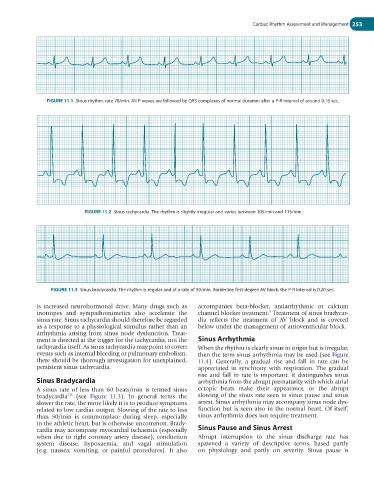
                FIGURE 11.1  Sinus rhythm, rate 78/min. All P waves are followed by QRS complexes of normal duration after a P-R interval of around 0.16 sec.


                             FIGURE 11.2  Sinus tachycardia. The rhythm is slightly irregular and varies between 105/min and 115/min.


                  FIGURE 11.3  Sinus bradycardia. The rhythm is regular and at a rate of 50/min. Borderline first-degree AV block: the P-R interval is 0.20 sec.


             is  increased  neurohormonal  drive.  Many  drugs  such  as   accompanies  beta-blocker,  antiarrhythmic  or  calcium
                                                                                         9
             inotropes  and  sympathomimetics  also  accelerate  the   channel blocker treatment.  Treatment of sinus bradycar-
             sinus rate. Sinus tachycardia should therefore be regarded   dia  reflects  the  treatment  of  AV  block  and  is  covered
             as a response to a physiological stimulus rather than an   below under the management of atrioventricular block.
             arrhythmia  arising  from  sinus  node  dysfunction.  Treat-
             ment is directed at the trigger for the tachycardia, not the   Sinus Arrhythmia
             tachycardia itself. As sinus tachycardia may point to covert   When the rhythm is clearly sinus in origin but is irregular,
             events such as internal bleeding or pulmonary embolism,   then the term sinus arrhythmia may be used (see Figure
             there should be thorough investigation for unexplained,   11.4).  Generally,  a  gradual  rise  and  fall  in  rate  can  be
             persistent sinus tachycardia.                        appreciated  in  synchrony  with  respiration.  The  gradual
                                                                  rise  and  fall  in  rate  is  important:  it  distinguishes  sinus
             Sinus Bradycardia                                    arrhythmia from the abrupt prematurity with which atrial
             A  sinus  rate  of  less  than  60  beats/min  is  termed  sinus   ectopic  beats  make  their  appearance,  or  the  abrupt
                       7,8
             bradycardia   (see  Figure  11.3).  In  general  terms  the   slowing of the sinus rate seen in sinus pause and sinus
             slower the rate, the more likely it is to produce symptoms   arrest. Sinus arrhythmia may accompany sinus node dys-
             related to low cardiac output. Slowing of the rate to less   function but is seen also in the normal heart. Of itself,
             than  50/min  is  commonplace  during  sleep,  especially    sinus arrhythmia does not require treatment.
             in the athletic heart, but is otherwise uncommon. Brady-
             cardia may accompany myocardial ischaemia (especially   Sinus Pause and Sinus Arrest
             when due to right coronary artery disease), conduction   Abrupt  interruption  to  the  sinus  discharge  rate  has
             system  disease,  hypoxaemia,  and  vagal  stimulation     spawned  a  variety  of  descriptive  terms,  based  partly
             (e.g.  nausea,  vomiting,  or  painful  procedures).  It  also   on  physiology  and  partly  on  severity.  Sinus  pause  is

