


Page 279 - ACCCN's Critical Care Nursing
P. 279
256  P R I N C I P L E S   A N D   P R A C T I C E   O F   C R I T I C A L   C A R E


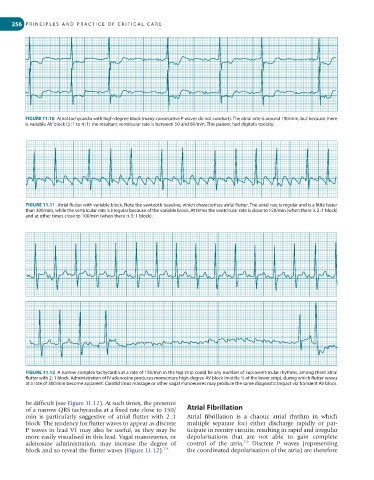
         FIGURE 11.10  Atrial tachycardia with high-degree block (many consecutive P waves do not conduct). The atrial rate is around 190/min, but because there
         is variable AV block (3 : 1 to 4 : 1) the resultant ventricular rate is between 50 and 60/min. This patient had digitalis toxicity.


         FIGURE 11.11  Atrial flutter with variable block. Note the sawtooth baseline, which characterises atrial flutter. The atrial rate is regular and is a little faster
         than 300/min, while the ventricular rate is irregular because of the variable block. At times the ventricular rate is close to 150/min (when there is 2 : 1 block)
         and at other times close to 100/min (when there is 3 : 1 block).


         FIGURE 11.12  A narrow complex tachycardia at a rate of 150/min in the top strip could be any number of supraventricular rhythms, among them atrial
         flutter with 2 : 1 block. Administration of IV adenosine produces momentary high-degree AV block (middle ⅔ of the lower strip), during which flutter waves
         at a rate of 300/min become apparent. Carotid sinus massage or other vagal manoeuvres may produce the same diagnostic impact via transient AV block.


         be difficult (see Figure 11.12). At such times, the presence
         of a narrow QRS tachycardia at a fixed rate close to 150/  Atrial Fibrillation
         min  is  particularly  suggestive  of  atrial  flutter  with  2 : 1   Atrial  fibrillation  is  a  chaotic  atrial  rhythm  in  which
         block. The tendency for flutter waves to appear as discrete   multiple  separate  foci  either  discharge  rapidly  or  par-
         P waves in lead V1 may also be useful, as they may be   ticipate in reentry circuits, resulting in rapid and irregular
         more easily visualised in this lead. Vagal manoeuvres, or   depolarisations  that  are  not  able  to  gain  complete
                                                                                 7,9
         adenosine  administration,  may  increase  the  degree  of   control  of  the  atria.   Discrete  P  waves  (representing
         block and so reveal the flutter waves (Figure 11.12). 7,8  the coordinated depolarisation of the atria) are therefore

