


Page 280 - ACCCN's Critical Care Nursing
P. 280
Cardiac Rhythm Assessment and Management  257


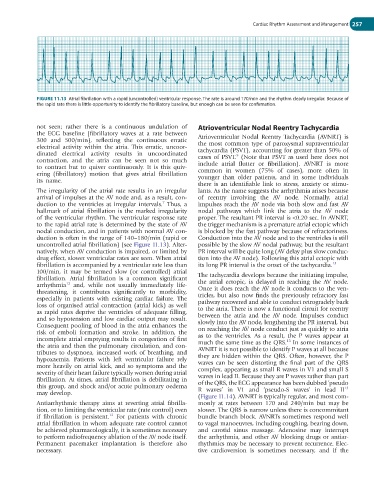
             FIGURE 11.13  Atrial fibrillation with a rapid (uncontrolled) ventricular response. The rate is around 170/min and the rhythm clearly irregular. Because of
             the rapid rate there is little opportunity to identify the fibrillatory baseline, but enough can be seen for confirmation.


             not  seen;  rather  there  is  a  continuous  undulation  of   Atrioventricular Nodal Reentry Tachycardia
             the  ECG  baseline  (fibrillatory  waves  at  a  rate  between   Atrioventricular  Nodal  Reentry  Tachycardia  (AVNRT)  is
             300  and  500/min),  reflecting  the  continuous  erratic   the  most  common  type  of  paroxysmal  supraventricular
             electrical  activity  within  the  atria.  This  erratic,  uncoor-  tachycardia (PSVT), accounting for greater than 50% of
             dinated  electrical  activity  results  in  uncoordinated     cases  of  PSVT.   (Note  that  PSVT  as  used  here  does  not
                                                                              5
             contraction,  and  the  atria  can  be  seen  not  so  much   include  atrial  flutter  or  fibrillation).  AVNRT  is  more
             to  contract  but  to  quiver  continuously.  It  is  this  quiv-  common  in  women  (75%  of  cases),  more  often  in
             ering  (fibrillatory)  motion  that  gives  atrial  fibrillation    younger  than  older  patients,  and  in  some  individuals
             its  name.
                                                                  there  is  an  identifiable  link  to  stress,  anxiety  or  stimu-
             The  irregularity  of  the  atrial  rate  results  in  an  irregular   lants. As the name suggests the arrhythmia arises because
             arrival of impulses at the AV node and, as a result, con-  of  reentry  involving  the  AV  node.  Normally,  atrial
             duction  to  the  ventricles  at  irregular  intervals.   Thus,  a   impulses reach the AV node via both slow and fast AV
                                                      7
             hallmark  of  atrial  fibrillation  is  the  marked  irregularity   nodal  pathways  which  link  the  atria  to  the  AV  node
             of the ventricular rhythm. The ventricular response rate   proper. The resultant PR interval is <0.20 sec. In AVNRT,
             to the rapid atrial rate is determined by the state of AV   the trigger mechanism is a premature atrial ectopic which
             nodal conduction, and in patients with normal AV con-  is blocked by the fast pathway because of refractoriness.
             duction is often in the range of 140–180/min (rapid or   Conduction into the AV node and to the ventricles is still
             uncontrolled atrial fibrillation) (see Figure 11.13). Alter-  possible by the slow AV nodal pathway, but the resultant
             natively, when AV conduction is impaired, or limited by   PR interval will be quite long (AV delay plus slow conduc-
             drug effect, slower ventricular rates are seen. When atrial   tion into the AV node). Following this atrial ectopic with
             fibrillation is accompanied by a ventricular rate less than   its long PR interval is the onset of the tachycardia. 13
             100/min,  it  may  be  termed  slow  (or  controlled)  atrial
             fibrillation.  Atrial  fibrillation  is  a  common  significant   The tachycardia develops because the initiating impulse,
             arrhythmia   and,  while  not  usually  immediately  life-  the  atrial  ectopic,  is  delayed  in  reaching  the  AV  node.
                       12
             threatening,  it  contributes  significantly  to  morbidity,   Once it does reach the AV node it conducts to the ven-
             especially  in  patients  with  existing  cardiac  failure.  The   tricles, but also now finds the previously refractory fast
             loss of organised atrial contraction (atrial kick) as well   pathway recovered and able to conduct retrogradely back
             as rapid rates deprive the ventricles of adequate filling,   to the atria. There is now a functional circuit for reentry
             and so hypotension and low cardiac output may result.   between  the  atria  and  the  AV  node.  Impulses  conduct
             Consequent pooling of blood in the atria enhances the   slowly into the AV node, lengthening the PR interval, but
             risk  of  emboli  formation  and  stroke.  In  addition,  the   on reaching the AV node conduct just as quickly to atria
             incomplete atrial emptying results in congestion of first   as  to  the  ventricles.  As  a  result,  the  P  waves  appear  at
                                                                                               13
             the atria and then the pulmonary circulation, and con-  much the same time as the QRS.  In some instances of
             tributes  to  dyspnoea,  increased  work  of  breathing,  and   AVNRT it is not possible to identify P waves at all because
             hypoxaemia.  Patients  with  left  ventricular  failure  rely   they are hidden within the QRS. Often, however, the P
             more  heavily  on  atrial  kick,  and  so  symptoms  and  the   waves  can  be  seen  distorting  the  final  part  of  the  QRS
             severity of their heart failure typically worsen during atrial   complex, appearing as small R waves in V1 and small S
             fibrillation. At times, atrial fibrillation is debilitating in   waves in lead II. Because they are P waves rather than part
             this group, and shock and/or acute pulmonary oedema   of the QRS, the ECG appearance has been dubbed ‘pseudo
                                                                                                                  13
             may develop.                                         R  waves’  in  V1  and  ‘pseudo-S  waves’  in  lead  II
                                                                  (Figure 11.14). AVNRT is typically regular, and most com-
             Antiarrhythmic  therapy  aims  at  reverting  atrial  fibrilla-  monly  at  rates  between  170  and  240/min  but  may  be
             tion, or to limiting the ventricular rate (rate control) even   slower. The QRS is narrow unless there is concommitant
                                     12
             if  fibrillation  is  persistent.   For  patients  with  chronic   bundle branch block. AVNRTs sometimes respond well
             atrial fibrillation in whom adequate rate control cannot   to vagal manoeuvres, including coughing, bearing down,
             be achieved pharmacologically, it is sometimes necessary   and  carotid  sinus  massage.  Adenosine  may  interrupt
             to perform radiofrequency ablation of the AV node itself.   the arrhythmia, and other AV blocking drugs or antiar-
             Permanent  pacemaker  implantation  is  therefore  also   rhythmics may be necessary to prevent recurrence. Elec-
             necessary.                                           tive  cardioversion  is  sometimes  necessary,  and  if  the

