


Page 278 - ACCCN's Critical Care Nursing
P. 278
Cardiac Rhythm Assessment and Management  255


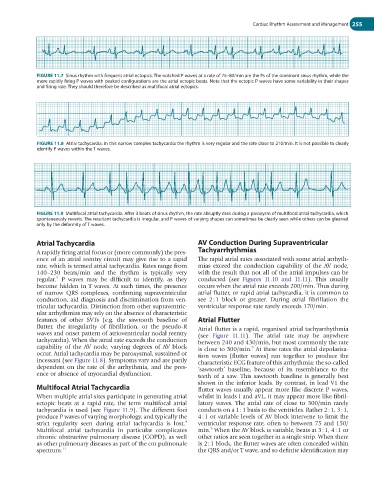
             FIGURE 11.7  Sinus rhythm with frequent atrial ectopics. The notched P waves at a rate of 75–80/min are the Ps of the dominant sinus rhythm, while the
             more rapidly firing P waves with peaked configurations are the atrial ectopic beats. Note that the ectopic P waves have some variability in their shapes
             and firing rate. They should therefore be described as multifocal atrial ectopics.


             FIGURE 11.8  Atrial tachycardia. In this narrow complex tachycardia the rhythm is very regular and the rate close to 210/min. It is not possible to clearly
             identify P waves within the T waves.


             FIGURE 11.9  Multifocal atrial tachycardia. After 3 beats of sinus rhythm, the rate abruptly rises during a paroxysm of multifocal atrial tachycardia, which
             spontaneously reverts. The resultant tachycardia is irregular, and P waves of varying shapes can sometimes be clearly seen while others can be gleaned
             only by the deformity of T waves.


             Atrial Tachycardia                                   AV Conduction During Supraventricular
             A rapidly firing atrial focus or (more commonly) the pres-  Tachyarrhythmias
             ence of an atrial reentry circuit may give rise to a rapid   The rapid atrial rates associated with some atrial arrhyth-
             rate, which is termed atrial tachycardia. Rates range from   mias  exceed  the  conduction  capability  of  the  AV  node,
             140–230  beats/min  and  the  rhythm  is  typically  very   with the result that not all of the atrial impulses can be
                   5
             regular.   P  waves  may  be  difficult  to  identify,  as  they   conducted  (see  Figures  11.10  and  11.11).  This  usually
             become hidden in T waves. At such times, the presence   occurs when the atrial rate exceeds 200/min. Thus during
             of  narrow  QRS  complexes,  confirming  supraventricular   atrial flutter, or rapid atrial tachycardia, it is common to
             conduction, aid diagnosis and discrimination from ven-  see  2 : 1  block  or  greater.  During  atrial  fibrillation  the
             tricular tachycardia. Distinction from other supraventric-  ventricular response rate rarely exceeds 170/min.
             ular arrhythmias may rely on the absence of characteristic
             features  of  other  SVTs  (e.g.  the  sawtooth  baseline  of   Atrial Flutter
             flutter,  the  irregularity  of  fibrillation,  or  the  pseudo-R   Atrial flutter is a rapid, organised atrial tachyarrhythmia
             waves and onset pattern of atrioventricular nodal reentry   (see  Figure  11.11).  The  atrial  rate  may  be  anywhere
             tachycardia). When the atrial rate exceeds the conduction   between 240 and 430/min, but most commonly the rate
             capability  of  the  AV  node,  varying  degrees  of  AV  block   is close to 300/min.  At these rates the atrial depolarisa-
                                                                                   9
             occur. Atrial tachycardia may be paroxysmal, sustained or   tion  waves  (flutter  waves)  run  together  to  produce  the
             incessant (see Figure 11.8). Symptoms vary and are partly   characteristic ECG feature of this arrhythmia: the so-called
             dependent on the rate of the arrhythmia, and the pres-  ‘sawtooth’  baseline,  because  of  its  resemblance  to  the
             ence or absence of myocardial dysfunction.           teeth of a saw. This sawtooth baseline is generally best
                                                                  shown in the inferior leads. By contrast, in lead V1 the
             Multifocal Atrial Tachycardia                        flutter waves usually appear more like discrete P waves,
             When multiple atrial sites participate in generating atrial   whilst in leads I and aVL, it may appear more like fibril-
             ectopic  beats  at  a  rapid  rate,  the  term  multifocal  atrial   latory  waves.  The  atrial  rate  of  close  to  300/min  rarely
             tachycardia  is  used  (see  Figure  11.9).  The  different  foci   conducts on a 1 : 1 basis to the ventricles. Rather 2 : 1, 3 : 1,
             produce P waves of varying morphology, and typically the   4 : 1 or variable levels of AV block intervene to limit the
                                                              9
             strict  regularity  seen  during  atrial  tachycardia  is  lost.    ventricular response rate, often to between 75 and 150/
                                                                      9
             Multifocal  atrial  tachycardia  in  particular  complicates   min.  When the AV block is variable, beats at 3 : 1, 4 : 1 or
             chronic obstructive pulmonary disease (COPD), as well   other ratios are seen together in a single strip. When there
             as other pulmonary diseases as part of the cor pulmonale   is 2 : 1 block, the flutter waves are often concealed within
             spectrum. 11                                         the QRS and/or T wave, and so definite identification may

