


Page 277 - ACCCN's Critical Care Nursing
P. 277
254  P R I N C I P L E S   A N D   P R A C T I C E   O F   C R I T I C A L   C A R E


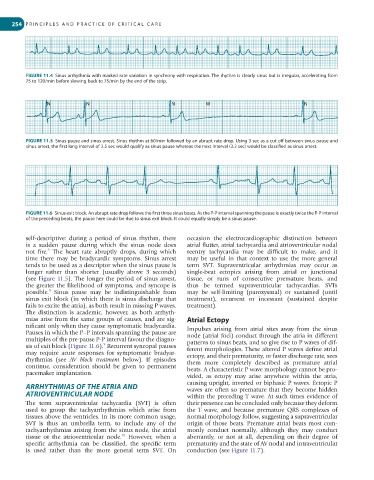
         FIGURE 11.4  Sinus arrhythmia with marked rate variation in synchrony with respiration. The rhythm is clearly sinus but is irregular, accelerating from
         75 to 120/min before slowing back to 75/min by the end of the strip.


                N            N                           N          M                               N


          FIGURE 11.5  Sinus pause and sinus arrest. Sinus rhythm at 60/min followed by an abrupt rate drop. Using 3 sec as a cut off between sinus pause and
          sinus arrest, the first long interval of 2.5 sec would qualify as sinus pause whereas the next interval (3.2 sec) would be classified as sinus arrest.


          FIGURE 11.6  Sinus exit block. An abrupt rate drop follows the first three sinus beats. As the P-P interval spanning the pause is exactly twice the P-P interval
          of the preceding beats, the pause here could be due to sinus exit block. It could equally simply be a sinus pause.


         self-descriptive:  during  a  period  of  sinus  rhythm,  there     occasion  the  electrocardiographic  distinction  between
         is  a  sudden  pause  during  which  the  sinus  node  does     atrial flutter, atrial tachycardia and atrioventricular nodal
                 9
         not  fire.   The  heart  rate  abruptly  drops,  during  which   reentry  tachycardia  may  be  difficult  to  make,  and  it
         time  there  may  be  bradycardic  symptoms.  Sinus  arrest   may  be  useful  in  that  context  to  use  the  more  general
         tends to be used as a descriptor when the sinus pause is   term  SVT.  Supraventricular  arrhythmias  may  occur  as
         longer  rather  than  shorter  (usually  above  3  seconds)    single-beat  ectopics  arising  from  atrial  or  junctional
         (see Figure 11.5). The longer the period of sinus arrest,   tissue,  or  runs  of  consecutive  premature  beats,  and
         the greater the likelihood of symptoms, and syncope is   thus  be  termed  supraventricular  tachycardias.  SVTs
                 9
         possible.   Sinus  pause  may  be  indistinguishable  from   may  be  self-limiting  (paroxysmal)  or  sustained  (until
         sinus exit block (in which there is sinus discharge that   treatment),  recurrent  or  incessant  (sustained  despite
         fails to excite the atria), as both result in missing P waves.   treatment).
         The  distinction  is  academic,  however,  as  both  arrhyth-
         mias arise from the same groups of causes, and are sig-  Atrial Ectopy
         nificant only when they cause symptomatic bradycardia.   Impulses  arising  from  atrial  sites  away  from  the  sinus
         Pauses in which the P–P intervals spanning the pause are   node (atrial foci) conduct through the atria in different
         multiples of the pre-pause P-P interval favour the diagno-  patterns to sinus beats, and so give rise to P waves of dif-
                                   5
         sis of exit block (Figure 11.6).  Recurrent syncopal pauses   ferent morphologies. These altered P waves define atrial
         may  require  acute  responses  for  symptomatic  bradyar-  ectopy, and their prematurity, or faster discharge rate, sees
         rhythmias  (see  AV  block  treatment  below).  If  episodes   them  more  completely  described  as  premature  atrial
         continue,  consideration  should  be  given  to  permanent   beats. A characteristic P wave morphology cannot be pro-
         pacemaker implantation.
                                                              vided,  as  ectopy  may  arise  anywhere  within  the  atria,
         ARRHYTHMIAS OF THE ATRIA AND                         causing upright, inverted or biphasic P waves. Ectopic P
                                                              waves are often so premature that they become hidden
         ATRIOVENTRICULAR NODE                                within the preceding T wave. At such times evidence of
         The  term  supraventricular  tachycardia  (SVT)  is  often   their presence can be concluded only because they deform
         used  to  group  the  tachyarrhythmias  which  arise  from   the  T  wave,  and  because  premature  QRS  complexes  of
         tissues above the ventricles. In its more common usage,   normal morphology follow, suggesting a supraventricular
         SVT  is  thus  an  umbrella  term,  to  include  any  of  the   origin of those beats. Premature atrial beats most com-
         tachyarrhythmias arising from the sinus node, the atrial   monly  conduct  normally,  although  they  may  conduct
                                         10
         tissue  or  the  atrioventricular  node.   However,  when  a   aberrantly,  or  not  at  all,  depending  on  their  degree  of
         specific  arrhythmia  can  be  classified,  the  specific  term   prematurity and the state of AV nodal and intraventricular
         is  used  rather  than  the  more  general  term  SVT.  On   conduction (see Figure 11.7).

