


Page 301 - ACCCN's Critical Care Nursing
P. 301
278  P R I N C I P L E S   A N D   P R A C T I C E   O F   C R I T I C A L   C A R E

         month or so, output safety margins need to be set more   right  atrium  and  then  steered  back  upwards  to  engage
         generously  and  patients  are  typically  sent  home  with   the  atrial  appendage.  Both  ventricular  and  atrial  leads
         outputs set high (e.g. 3.5–5 Volts) even when thresholds   are  tested  for  performance  following  placement.  Leads
         at implantation may have been only 0.5–1 Volts. Chronic   are  then  secured  within  the  pacemaker  pocket  and  the
         output settings will then be established at the first post-  pulse generator is attached to the leads and secured in
         operative visit to the doctor in 6–8 weeks. 37       the pocket. The pocket is closed and testing is repeated to
                                                              confirm secure connections of the leads to the pacemaker.
         Implantation Activities                              Device and lead testing is repeated on day 1, weeks 6–8
         Devices are inserted under light conscious sedation and   and then every 12 months to confirm operation. 38
         local anaesthesia. Analgesia may also be administered at
         the  outset  of  the  case,  and  antibiotics  are  commenced   Pacemaker Parameters: Programming
         before  skin  incision.  An  anaesthetist  is  usually  only   and Status Reports
         present if judged necessary by the implanting doctor.
                                                              Knowing  how  a  patient’s  pacemaker  is  programmed  is
         Passage of leads into the heart during insertion may result   crucial to interpreting pacemaker behaviour in the clini-
         in  endocardial  contact,  causing  AV  block  or  bundle   cal  setting.  This  has  become  increasingly  important  to
         branch block. Therefore a femoral temporary pacing wire   enable determination of whether a change in behaviour
         may be inserted before progressing to placement of the   is a problem or simply an automated behaviour. Device
         permanent  pacing  leads,  particularly  to  ensure  reliable   printouts are available whenever a device is interrogated
         ventricular rhythm during the insertion procedure. His-  or  reprogrammed.  The  following  section  is  a  guide  to
         torically, ventricular leads were implanted at the apex of   how to interpret device printouts to access key informa-
         the right ventricle, a position easily accessed and thought   tion about pacemaker programming, highlighting some
         well  tolerated.  However  recent  trends  have  moved  to     of  the  features  of  the  modern  permanent  pacemaker,
         ventricular lead placement in the right ventricular outflow   as  well  as  some  of  the  clinical  and  diagnostic  value  of
         tract (RVOT), 66,73  to produce a more normal contractile   the  information  provided.  Device  printouts  contain  an
         pattern than from the apex and to prevent the ventricular   enormous  amount  of  information,  but  of  immediate
         remodelling seen in chronic RV apical pacing. 66,73  Atrial   importance are the summary pages that outline all of the
         lead  insertion  is  most  commonly  at  the  right  atrial   operating parameters, active automated features, results
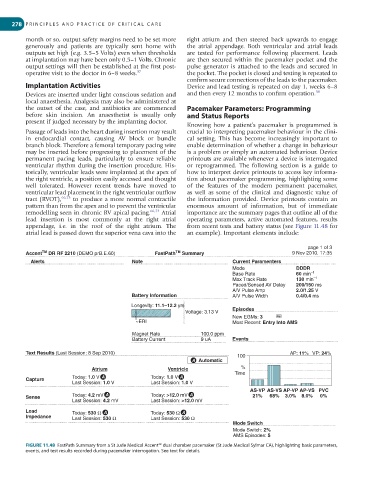
         appendage,  i.e.  in  the  roof  of  the  right  atrium.  The    from recent tests and battery status (see Figure 11.48 for
         atrial lead is passed down the superior vena cava into the   an example). Important elements include:

                                                                                                      page 1 of 3
         Accent TM  DR RF 2210 (DEMO prB.E.60)      FastPath TM  Summary                         9 Nov 2010. 17:35
           Alerts                           Note                             Current Paramenters
                                                                             Mode                 DDDR
                                                                             Base Rate            60 min –1
                                                                             Max Track Rate       130 min –1
                                                                             Paced/Sensed AV Delay  200/150 ms
                                                                             A/V Pulse Amp        2.0/1.25 V
                                            Battery Information              A/V Pulse Width      0.4/0.4 ms
                                            Longevity: 11.1–12.2 yrs         Episodes
                                                              Voltage: 3.13 V
                                                                             New EGMs: 3
                                             ~ERI                            Most Recent: Entry Into AMS

                                            Magnet Rate            100.0 ppm
                                            Battery Current        9 uA      Events
         Text Results (Last Session: 8 Sep 2010)                                                AP: 11% VP: 24%
                                                                               100
                                                                A  Automatic
                               Atrium                   Ventricle               %
                                                                              Time
         Capture         Today: 1.0 V A           Today: 1.0 V A
                         Last Session: 1.0 V      Last Session: 1.0 V
                                                                                   AS-VP AS-VS AP-VP AP-VS PVC
         Sense           Today: 4.2 mV A          Today: >12.0 mV A                 21%  68%  3.0%  8.0%  0%
                         Last Session: 4.2 mV     Last Session: >12.0 mV
         Lead            Today: 530 Ω A           Today: 530 Ω A
         Impedance       Last Session: 530 Ω      Last Session: 530 Ω
                                                                             Mode Switch
                                                                             Mode Switch: 2%
                                                                             AMS Episodes: 5
         FIGURE 11.48  FastPath Summary from a St Jude Medical Accent™ dual chamber pacemaker (St Jude Medical Sylmar CA), highlighting basic parameters,
         events, and test results recorded during pacemaker interrogation. See text for details.

