


Page 327 - ACCCN's Critical Care Nursing
P. 327
304  P R I N C I P L E S   A N D   P R A C T I C E   O F   C R I T I C A L   C A R E


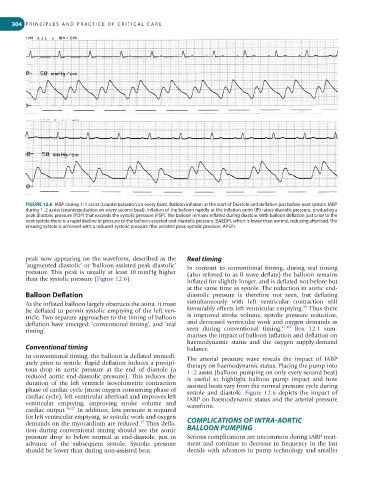
         FIGURE 12.6  IABP during 1 : 1 assist (counterpulsation on every beat). Balloon inflation at the start of Diastole and deflation just before next systole. IABP
         during 1 : 2 assist (counterpulsation on every second beat). Inflation of the balloon rapidly at the inflation point (IP) raises diastolic pressure, producing a
         peak diastolic pressure (PDP) that exceeds the systolic pressure (PSP). The balloon remains inflated during diastole. With balloon deflation just prior to the
         next systole there is a rapid decline in pressure to the balloon-assisted end-diastolic pressure (BAEDP), which is lower than normal, reducing afterload. The
         ensuing systole is achieved with a reduced systolic pressure (the assisted peak systolic pressure, APSP).


         peak now appearing on the waveform, described as the   Real timing
         ‘augmented diastolic’ or ‘balloon-assisted peak diastolic’   In  contrast  to  conventional  timing,  during  real  timing
         pressure.  This  peak  is  usually  at  least  10 mmHg  higher   (also referred to as R wave deflate) the balloon remains
         than the systolic pressure (Figure 12.6).            inflated for slightly longer, and is deflated not before but
                                                              at the same time as systole. The reduction in aortic end-
         Balloon Deflation                                    diastolic  pressure  is  therefore  not  seen,  but  deflating
         As the inflated balloon largely obstructs the aorta, it must   simultaneously  with  left  ventricular  contraction  still
                                                                                                    48
         be deflated to permit systolic emptying of the left ven-  favourably effects left ventricular emptying.  Thus there
         tricle. Two separate approaches to the timing of balloon   is  improved  stroke  volume,  systolic  pressure  reduction,
         deflation have emerged: ‘conventional timing’, and ‘real   and decreased ventricular work and oxygen demands as
                                                                                             47,49
         timing’.                                             seen  during  conventional  timing.    Box  12.1  sum-
                                                              marises the impact of balloon inflation and deflation on
                                                              haemodynamic  status  and  the  oxygen  supply:demand
         Conventional timing                                  balance.
         In conventional timing, the balloon is deflated immedi-  The  arterial  pressure  wave  reveals  the  impact  of  IABP
         ately prior to systole. Rapid deflation induces a precipi-  therapy on haemodynamic status. Placing the pump into
         tous  drop  in  aortic  pressure  at  the  end  of  diastole  (a   1 : 2 assist (balloon pumping on only every second beat)
         reduced  aortic  end-diastolic  pressure).  This  reduces  the   is  useful  to  highlight  balloon  pump  impact  and  how
         duration  of  the  left  ventricle  isovolumetric  contraction   assisted beats vary from the normal pressure cycle during
         phase of cardiac cycle (most oxygen consuming phase of   systole  and  diastole.  Figure  12.6  depicts  the  impact  of
         cardiac cycle), left ventricular afterload and improves left   IABP on haemodynamic status and the arterial pressure
         ventricular  emptying,  improving  stroke  volume  and   waveform.
         cardiac output. 46,47  In addition, less pressure is required
         for left ventricular emptying, so systolic work and oxygen
         demands on the myocardium are reduced.  Thus defla-  COMPLICATIONS OF INTRA-AORTIC
                                               47
         tion  during  conventional  timing  should  see  the  aortic   BALLOON PUMPING
         pressure  drop  to  below  normal  at  end-diastole,  just  in   Serious complications are uncommon during IABP treat-
         advance  of  the  subsequent  systole.  Systolic  pressure   ment and continue to decrease in frequency in the last
         should be lower than during non-assisted beat.       decade with advances in pump technology and smaller

