


Page 326 - ACCCN's Critical Care Nursing
P. 326
Cardiac Surgery and Transplantation  303


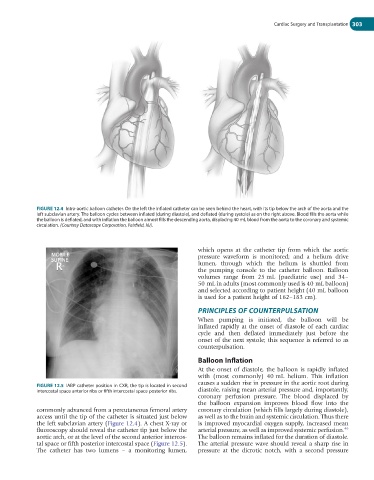
             FIGURE 12.4  Intra-aortic balloon catheter. On the left the inflated catheter can be seen behind the heart, with its tip below the arch of the aorta and the
             left subclavian artery. The balloon cycles between inflated (during diastole), and deflated (during systole) as on the right above. Blood fills the aorta while
             the balloon is deflated, and with inflation the balloon almost fills the descending aorta, displacing 40 mL blood from the aorta to the coronary and systemic
             circulation. (Courtesy Datascope Corporation, Fairfield, NJ).


                                                                  which  opens  at  the  catheter  tip  from  which  the  aortic
                                                                  pressure  waveform  is  monitored;  and  a  helium  drive
                                                                  lumen,  through  which  the  helium  is  shuttled  from
                                                                  the  pumping  console  to  the  catheter  balloon.  Balloon
                                                                  volumes  range  from  25 mL  (paediatric  use)  and  34–
                                                                  50 mL in adults (most commonly used is 40 mL balloon)
                                                                  and selected according to patient height (40 mL balloon
                                                                  is used for a patient height of 162–183 cm).
                                                                  PRINCIPLES OF COUNTERPULSATION
                                                                  When  pumping  is  initiated,  the  balloon  will  be
                                                                  inflated rapidly at the onset of diastole of each cardiac
                                                                  cycle  and  then  deflated  immediately  just  before  the
                                                                  onset of the next systole; this sequence is referred to as
                                                                  counterpulsation.
                                                                  Balloon Inflation

                                                                  At the onset of diastole, the balloon is rapidly inflated
                                                                  with  (most  commonly)  40 mL  helium.  This  inflation
                                                                  causes a sudden rise in pressure in the aortic root during
             FIGURE 12.5  IABP catheter position in CXR, the tip is located in second
             intercostal space anterior ribs or fifth intercostal space posterior ribs.   diastole, raising mean arterial pressure and, importantly,
                                                                  coronary  perfusion  pressure.  The  blood  displaced  by
                                                                  the  balloon  expansion  improves  blood  flow  into  the
             commonly advanced from a percutaneous femoral artery   coronary circulation (which fills largely during diastole),
             access until the tip of the catheter is situated just below   as well as to the brain and systemic circulation. Thus there
             the left subclavian artery (Figure 12.4). A chest X-ray or   is improved myocardial oxygen supply, increased mean
                                                                                                                  46
             fluoroscopy should reveal the catheter tip just below the   arterial pressure, as well as improved systemic perfusion.
             aortic arch, or at the level of the second anterior intercos-  The balloon remains inflated for the duration of diastole.
             tal space or fifth posterior intercostal space (Figure 12.5).   The arterial pressure wave should reveal a sharp rise in
             The  catheter  has  two  lumens  –  a  monitoring  lumen,   pressure  at  the  dicrotic  notch,  with  a  second  pressure

