


Page 335 - ACCCN's Critical Care Nursing
P. 335
312  P R I N C I P L E S   A N D   P R A C T I C E   O F   C R I T I C A L   C A R E


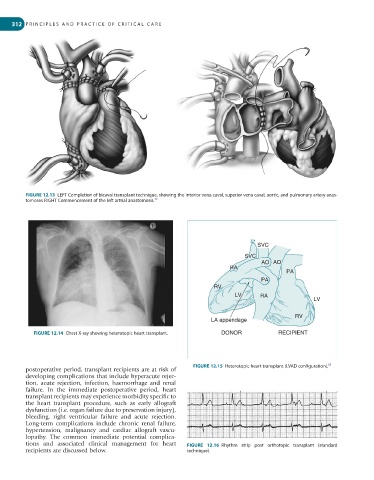
         FIGURE 12.13  LEFT Completion of bicaval transplant technique, showing the interior vena caval, superior vena caval, aortic, and pulmonary artery anas-
                                                    79
         tomoses RIGHT Commencement of the left artrial anastomosis.


                                                                                     SVC

                                                                                 SVC
                                                                                       AO AO
                                                                            RA
                                                                                               PA
                                                                                      PA
                                                                       RV
                                                                              LV      RA
                                                                                                        LV

                                                                                                  RV
                                                                      LA appendage
            FIGURE 12.14  Chest X-ray showing heterotopic heart transplant.   DONOR         RECIPIENT


                                                                FIGURE 12.15  Heterotopic heart transplant (LVAD configuration).
                                                                                                            85
         postoperative period, transplant recipients are at risk of
         developing complications that include hyperacute rejec-
         tion,  acute  rejection,  infection,  haemorrhage  and  renal
         failure.  In  the  immediate  postoperative  period,  heart
         transplant recipients may experience morbidity specific to
         the  heart  transplant  procedure,  such  as  early  allograft
         dysfunction (i.e. organ failure due to preservation injury),
         bleeding,  right  ventricular  failure  and  acute  rejection.
         Long-term  complications  include  chronic  renal  failure,
         hypertension,  malignancy  and  cardiac  allograft  vascu-
         lopathy.  The  common  immediate  potential  complica-
         tions  and  associated  clinical  management  for  heart   FIGURE  12.16  Rhythm  strip  post  orthotopic  transplant  (standard
         recipients are discussed below.                      technique).

