


Page 356 - ACCCN's Critical Care Nursing
P. 356
Respiratory Assessment and Monitoring 333

                                   Apex                           bicarbonate and pH returns to normal (i.e. the respiratory
                        Alveolus                                                         11
                                                       Zone I     alkalosis is compensated).
                                           Capillary
                       Arteriole                       PA . Pa . Pv
                                             Venule
                                                                  PATHOPHYSIOLOGY
                                                                  Three  common  pathophysiological  concepts  that  influ-
                                                       Zone II    ence  respiratory  function  in  critically  ill  patients  are
             Alveolus                                  Pa . PA . Pv  hypoxaemia, inflammation and oedema. The principles
                                                                  for these phenomena are discussed below. Related pre-
          Pulmonary                                     Pulmonary  senting disease states including respiratory failure, pneu-
              artery                                    vein
                                                                  monia, acute lung injury, asthma and chronic obstructive
                                                                  pulmonary disease are described in Chapter 14.
             Alveolus
                                                       Zone III   HYPOXAEMIA
                                                       Pa . Pv . PA
                                                                  Hypoxaemia describes a decrease in the partial pressure
                                                                                                                  4
                                                                  of oxygen in arterial blood (PaO 2 ) of less than 60 mmHg.
                                                                  This state leads to less efficient anaerobic metabolism at
                                                                  the  tissue  and  end-organ  level,  and  resulting  compro-
                                                                  mised cellular function. Hypoxia is abnormally low PO 2
                                                                  in the tissues, and can be due to:
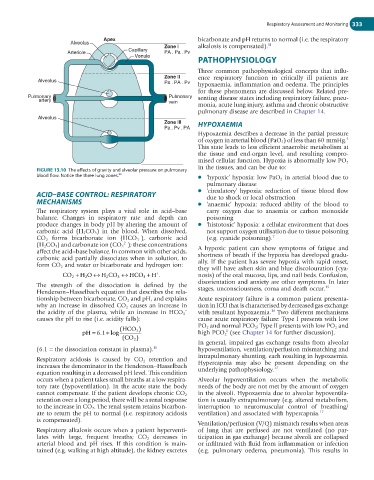
             FIGURE 13.10  The effects of gravity and alveolar pressure on pulmonary
                                        86
             blood flow. Notice the three lung zones.             ●  ‘hypoxic’ hypoxia: low PaO 2  in arterial blood due to
                                                                     pulmonary disease
             ACID–BASE CONTROL: RESPIRATORY                       ●  ‘circulatory’  hypoxia:  reduction  of  tissue  blood  flow
                                                                     due to shock or local obstruction
             MECHANISMS                                           ●  ‘anaemic’  hypoxia:  reduced  ability  of  the  blood  to
             The  respiratory  system  plays  a  vital  role  in  acid–base   carry  oxygen  due  to  anaemia  or  carbon  monoxide
             balance.  Changes  in  respiratory  rate  and  depth  can   poisoning
             produce changes in body pH by altering the amount of   ●  ‘histotoxic’ hypoxia: a cellular environment that does
             carbonic  acid  (H 2 CO 3 )  in  the  blood.  When  dissolved,   not support oxygen utilisation due to tissue poisoning
                                              −
             CO 2   forms  bicarbonate  ion  (HCO 3 ),  carbonic  acid   (e.g. cyanide poisoning). 7
                                         2−
             (H 2 CO 3 ) and carbonate ion (CO 3 ); these concentrations
             affect the acid–base balance. In common with other acids,   A  hypoxic  patient  can  show  symptoms  of  fatigue  and
             carbonic  acid  partially  dissociates  when  in  solution,  to   shortness of breath if the hypoxia has developed gradu-
             form CO 2  and water or bicarbonate and hydrogen ion:  ally. If the patient has severe hypoxia with rapid onset,
                                                                  they will have ashen skin and blue discolouration (cya-
                      CO 2 + H O ↔  H CO 3 ↔  HCO 3 +  H .        nosis) of the oral mucosa, lips, and nail beds. Confusion,
                                                    +
                                    2
                             2
                                                                  disorientation and anxiety are other symptoms. In later
             The  strength  of  the  dissociation  is  defined  by  the                                    15
             Henderson–Hasselbach equation that describes the rela-  stages, unconsciousness, coma and death occur.
             tionship between bicarbonate, CO 2  and pH, and explains   Acute respiratory failure is a common patient presenta-
             why an increase in dissolved CO 2  causes an increase in   tion in ICU that is characterised by decreased gas exchange
                                                              −
                                                                                          16
             the  acidity  of  the  plasma,  while  an  increase  in  HCO 3    with resultant hypoxaemia.  Two different mechanisms
             causes the pH to rise (i.e. acidity falls):          cause acute respiratory failure: Type I presents with low
                                                                  PO 2  and normal PCO 2 ; Type II presents with low PO 2  and
                                        ( HCO 3 )
                                                                           1
                                    +
                            pH = 6 1 log                          high PCO 2  (see Chapter 14 for further discussion).
                                  .
                                         ( CO 2 )
                                                                  In general, impaired gas exchange results from alveolar
             (6.1 = the dissociation constant in plasma). 11      hypoventilation, ventilation/perfusion mismatching and
                                                                  intrapulmonary shunting, each resulting in hypoxaemia.
             Respiratory  acidosis  is  caused  by  CO 2   retention  and
             increases the denominator in the Henderson–Hasselbach   Hypercapnia  may  also  be  present  depending  on  the
                                                                                           17
             equation resulting in a decreased pH level. This condition   underlying pathophysiology.
             occurs when a patient takes small breaths at a low respira-  Alveolar  hypoventilation  occurs  when  the  metabolic
             tory rate (hypoventilation). In the acute state the body   needs of the body are not met by the amount of oxygen
             cannot compensate. If the patient develops chronic CO 2    in the alveoli. Hypoxaemia due to alveolar hypoventila-
             retention over a long period, there will be a renal response   tion is usually extrapulmonary (e.g. altered metabolism,
             to the increase in CO 2 . The renal system retains bicarbon-  interruption  to  neuromuscular  control  of  breathing/
             ate to return the pH to normal (i.e. respiratory acidosis   ventilation) and associated with hypercapnia. 17
             is compensated).
                                                                  Ventilation/perfusion (V/Q) mismatch results when areas
             Respiratory  alkalosis  occurs  when  a  patient  hyperventi-  of  lung  that  are  perfused  are  not  ventilated  (no  par-
             lates  with  large,  frequent  breaths;  CO 2   decreases  in   ticipation in gas exchange) because alveoli are collapsed
             arterial  blood  and  pH  rises.  If  this  condition  is  main-  or infiltrated with fluid from inflammation or infection
             tained (e.g. walking at high altitude), the kidney excretes   (e.g.  pulmonary  oedema,  pneumonia).  This  results  in

