


Page 355 - ACCCN's Critical Care Nursing
P. 355
332  P R I N C I P L E S   A N D   P R A C T I C E   O F   C R I T I C A L   C A R E  including  haemoglobin.  The  dissolved  carbon  dioxide


                    %O 2 saturation  80  Curve before         constitutes  PaCO 2   and  is  measured  by  arterial  blood
                     100
                                                              gases. The greater solubility of CO 2  when compared with
                                                              oxygen  results  in  rapid  diffusion  across  the  capillary
                                   shift
                      60
                                                                            4
                                                              for elimination.  Carbon dioxide, a byproduct of cellular
                      40           Curve shifts to right      membranes, and therefore the gas can be easily removed
                                   as pH    CO 2              respiration,  is  produced  at  a  rate  of  200 mL/min,  with
            Increased   20         temperature                only minor differences in normal concentrations in arte-
            oxygen                                            rial (480 mL/L) and venous (520 mL/L) blood. 9
            release    0
            to tissue    0  20  40  60  80  100
                                PO 2 (mmHg)
                       PO 2 in tissue                         Relationship Between Ventilation
                                                              and Perfusion
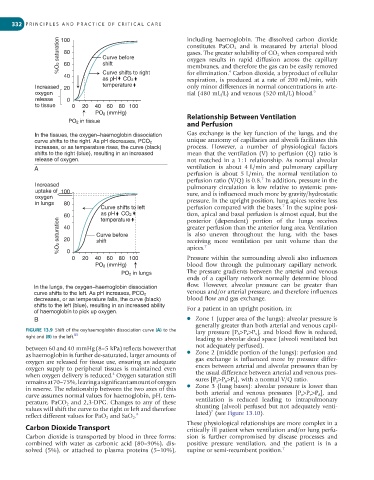
            In the tissues, the oxygen–haemoglobin dissociation   Gas exchange is the key function of the lungs, and the
            curve shifts to the right. As pH decreases, PCO 2   unique anatomy of capillaries and alveoli facilitates this
            increases, or as temperature rises, the curve (black)   process.  However,  a  number  of  physiological  factors
            shifts to the right (blue), resulting in an increased   mean that the ventilation (V) to perfusion (Q) ratio is
            release of oxygen.                                not  matched  in  a  1 : 1  relationship.  As  normal  alveolar
            A                                                 ventilation  is  about  4 L/min  and  pulmonary  capillary
                                                              perfusion  is  about  5 L/min,  the  normal  ventilation  to
                                                                                       7
                                                              perfusion ratio (V/Q) is 0.8.  In addition, pressure in the
            Increased                                         pulmonary  circulation  is  low  relative  to  systemic  pres-
            uptake of  100                                    sure, and is influenced much more by gravity/hydrostatic
            oxygen
            in lungs  80                                      pressure. In the upright position, lung apices receive less
                                                                                             7
                                  Curve shifts to left        perfusion compared with the bases.  In the supine posi-
                      60          as pH    CO 2               tion, apical and basal perfusion is almost equal, but the
                                  temperature
                    %O 2 saturation  40  Curve before         greater perfusion than the anterior lung area. Ventilation
                                                              posterior  (dependent)  portion  of  the  lungs  receives
                                                              is  also  uneven  throughout  the  lung,  with  the  bases
                      20
                                 shift
                                                              receiving  more  ventilation  per  unit  volume  than  the
                                                                    7
                       0
                                                              Pressure  within  the  surrounding  alveoli  also  influences
                         0  20  40  60  80  100               apices.
                                PO 2 (mmHg)                   blood  flow  through  the  pulmonary  capillary  network.
                                         PO 2 in lungs        The pressure gradients between the arterial and venous
                                                              ends  of  a  capillary  network  normally  determine  blood
            In the lungs, the oxygen–haemoglobin dissociation   flow.  However,  alveolar  pressure  can  be  greater  than
            curve shifts to the left. As pH increases, PCO 2   venous and/or arterial pressure, and therefore influences
            decreases, or as temperature falls, the curve (black)   blood flow and gas exchange.
            shifts to the left (blue), resulting in an increased ability   For a patient in an upright position, in:
            of haemoglobin to pick up oxygen.
            B                                                 ●  Zone 1 (upper area of the lungs): alveolar pressure is
                                                                 generally greater than both arterial and venous capil-
         FIGURE 13.9  Shift of the oxyhaemoglobin dissociation curve (A) to the   lary  pressure  [P A >P a >P v ],  and  blood  flow  is  reduced,
                         85
         right and (B) to the left.                              leading to alveolar dead space (alveoli ventilated but
                                                                 not adequately perfused).
         between 60 and 40 mmHg (8–5 kPa) reflects however that
         as haemoglobin is further de-saturated, larger amounts of   ●  Zone 2 (middle portion of the lungs): perfusion and
         oxygen are released for tissue use, ensuring an adequate   gas  exchange  is  influenced  more  by  pressure  differ-
         oxygen  supply  to  peripheral  tissues  is  maintained  even   ences between arterial and alveolar pressures than by
                                      4
         when oxygen delivery is reduced.  Oxygen saturation still   the usual difference between arterial and venous pres-
         remains at 70–75%, leaving a significant amount of oxygen   sures [P a >P A >P v ], with a normal V/Q ratio.
         in reserve. The relationship between the two axes of this   ●  Zone 3 (lung bases): alveolar pressure is lower than
         curve assumes normal values for haemoglobin, pH, tem-   both  arterial  and  venous  pressures  [P a >P v >P A ],  and
         perature, PaCO 2 and 2,3-DPG. Changes to any of these   ventilation  is  reduced  leading  to  intrapulmonary
         values will shift the curve to the right or left and therefore   shunting (alveoli perfused but not adequately venti-
                                                                      7
         reflect different values for PaO 2  and SaO 2 . 8       lated)  (see Figure 13.10).
                                                              These physiological relationships are more complex in a
         Carbon Dioxide Transport                             critically ill patient when ventilation and/or lung perfu-
         Carbon dioxide is transported by blood in three forms:   sion  is  further  compromised  by  disease  processes  and
         combined  with  water  as  carbonic  acid  (80–90%),  dis-  positive  pressure  ventilation,  and  the  patient  is  in  a
         solved  (5%),  or  attached  to  plasma  proteins  (5–10%),   supine or semi-recumbent position. 7

