


Page 369 - ACCCN's Critical Care Nursing
P. 369
346  P R I N C I P L E S   A N D   P R A C T I C E   O F   C R I T I C A L   C A R E


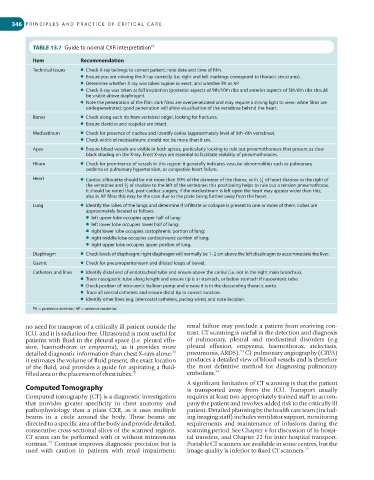
            TABLE 13.7  Guide to normal CXR interpretation 65

            Item           Recommendation
            Technical issues  ●  Check X-ray belongs to correct patient; note date and time of film.
                           ●  Ensure you are viewing the X-ray correctly (i.e. right and left markings correspond to thoracic structures).
                           ●  Determine whether X-ray was taken supine or erect, and whether PA or AP.
                           ●  Check X-ray was taken at full inspiration (posterior aspects of 9th/10th ribs and anterior aspects of 5th/6th ribs should
                             be visible above diaphragm).
                           ●  Note the penetration of the film: dark films are overpenetrated and may require a strong light to view; white films are
                             underpenetrated; good penetration will allow visualisation of the vertebrae behind the heart.
            Bones          ●  Check along each rib from vertebral origin, looking for fractures.
                           ●  Ensure clavicles and scapulas are intact.
            Mediastinum    ●  Check for presence of trachea and identify carina (approximately level of 5th–6th vertebrae).
                           ●  Check width of mediastinum: should not be more than 8 cm.
            Apex           ●  Ensure blood vessels are visible in both apices, particularly looking to rule out pneumothoraces that present as clear
                             black shading on the X-ray. Erect X-rays are essential to facilitate visibility of pneumothoraces.
            Hilum          ●  Check for prominence of vessels in this region: it generally indicates vascular abnormalities such as pulmonary
                             oedema or pulmonary hypertension, or congestive heart failure.
            Heart          ●  Cardiac silhouette should be not more than 50% of the diameter of the thorax, with  3  of heart shadow to the right of
                                                                                      1
                             the vertebrae and  3  of shadow to the left of the vertebrae; this positioning helps to rule out a tension pneumothorax.
                                          2
                             It should be noted that, post-cardiac surgery, if the mediastinum is left open the heart may appear wider than this;
                             also in AP films this may be the case due to the plate being further away from the heart.
            Lung           ●  Identify the lobes of the lungs and determine if infiltrate or collapse is present in one or more of them. Lobes are
                             approximately located as follows:
                             ●  left upper lobe occupies upper half of lung;
                             ●  left lower lobe occupies lower half of lung;
                             ●  right lower lobe occupies costophrenic portion of lung;
                             ●  right middle lobe occupies cardiophrenic portion of lung;
                             ●  right upper lobe occupies upper portion of lung.
            Diaphragm      ●  Check levels of diaphragm: right diaphragm will normally be 1–2 cm above the left diaphragm to accommodate the liver.
            Gastric        ●  Check for pneumoperitoneum and dilated loops of bowel.
            Catheters and lines  ●  Identify distal end of endotracheal tube and ensure above the carina (i.e. not in the right main bronchus).
                           ●  Trace nasogastric tube along length and ensure tip is in stomach, or below stomach if nasoenteric tube.
                           ●  Check position of intra-aortic balloon pump and ensure it is in the descending thoracic aorta.
                           ●  Trace all central catheters and ensure distal tip in correct location.
                           ●  Identify other lines (e.g. intercostal catheters, pacing wires) and note location.
            PA = posterior-anterior; AP = anterior-posterior.


         no need for transport of a critically ill patient outside the   renal failure may preclude a patient from receiving con-
         ICU, and it is radiation-free. Ultrasound is most useful for   trast. CT scanning is useful in the detection and diagnosis
         patients with fluid in the pleural space (i.e. pleural effu-  of  pulmonary,  pleural  and  mediastinal  disorders  (e.g
         sion,  haemothorax  or  empyema),  as  it  provides  more   pleural  effusion,  empyema,  haemothorax,  atelectasis,
                                                                                73
                                                         70
         detailed diagnostic information than chest X-rays alone;    pneumonia, ARDS).  CT pulmonary angiography (CTPA)
         it estimates the volume of fluid present, the exact location   produces a detailed view of blood vessels and is therefore
         of the fluid, and provides a guide for aspirating a fluid-  the  most  definitive  method  for  diagnosing  pulmonary
         filled area or the placement of chest tubes. 71      embolism. 74
                                                              A significant limitation of CT scanning is that the patient
         Computed Tomography                                  is  transported  away  from  the  ICU.  Transport  usually
         Computed tomography (CT) is a diagnostic investigation   requires at least two appropriately trained staff to accom-
         that  provides  greater  specificity  in  chest  anatomy  and   pany the patient and involves added risk to the critically ill
         pathophysiology  than  a  plain  CXR,  as  it  uses  multiple   patient. Detailed planning by the health care team (includ-
         beams  in  a  circle  around  the  body.  These  beams  are   ing imaging staff) includes ventilator support, monitoring
         directed to a specific area of the body and provide detailed,   requirements  and  maintenance  of  infusions  during  the
         consecutive cross-sectional slices of the scanned regions.   scanning period. See Chapter 6 for discussion of in-hospi-
         CT scans can be performed with or without intravenous   tal transfers, and Chapter 22 for inter-hospital transport.
                 72
         contrast.  Contrast improves diagnostic precision but is   Portable CT scanners are available in some centres, but the
         used  with  caution  in  patients  with  renal  impairment;   image quality is inferior to fixed CT scanners. 75

