


Page 368 - ACCCN's Critical Care Nursing
P. 368
Respiratory Assessment and Monitoring 345


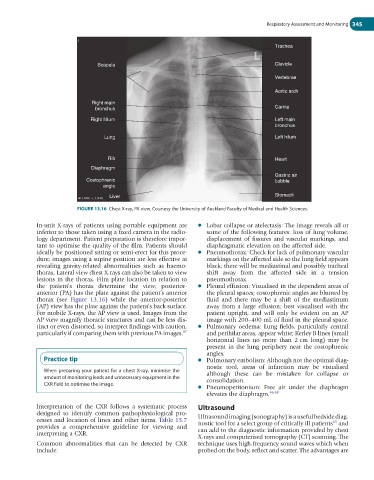
                                                                                           Trachea


                                 Scapula                                                   Clavicle
                                                                                           Vertebrae

                                                                                           Aortic arch
                               Right main
                                bronchus                                                   Carina
                               Right hilum                                                 Left main
                                                                                           bronchus
                                   Lung                                                    Left hilum


                                    Rib                                                    Heart
                               Diaphragm
                                                                                           Gastric air
                             Costophrenic                                                  bubble
                                   angle

                                     Liver                                                 Stomach
                          FIGURE 13.16  Chest X-ray, PA view. Courtesy the University of Auckland Faculty of Medical and Health Sciences.

             In-unit X-rays of patients using portable equipment are   ●  Lobar collapse or atelectasis: The image reveals all or
             inferior to those taken using a fixed camera in the radio-  some of the following features: loss of lung volume,
             logy department. Patient preparation is therefore impor-  displacement of fissures and vascular markings, and
             tant to optimise the quality of the film. Patients should   diaphragmatic elevation on the affected side.
             ideally be positioned sitting or semi-erect for this proce-  ●  Pneumothorax: Check for lack of pulmonary vascular
             dure; images using a supine position are less effective at   markings on the affected side so the lung field appears
             revealing  gravity-related  abnormalities  such  as  haemo-  black; there will be mediastinal and possibly tracheal
             thorax. Lateral view chest X-rays can also be taken to view   shift  away  from  the  affected  side  in  a  tension
             lesions in the thorax. Film plate location in relation to   pneumothorax.
             the  patient’s  thorax  determine  the  view;  posterior-   ●  Pleural effusion: Visualised in the dependent areas of
             anterior (PA) has the plate against the patient’s anterior   the pleural spaces; costophrenic angles are blunted by
             thorax  (see  Figure  13.16)  while  the  anterior-posterior   fluid  and  there  may  be  a  shift  of  the  mediastinum
             (AP) view has the plate against the patient’s back surface.   away  from  a  large  effusion;  best  visualised  with  the
             For mobile X-rays, the AP view is used. Images from the   patient  upright,  and  will  only  be  evident  on  an  AP
             AP view magnify thoracic structures and can be less dis-  image with 200–400 mL of fluid in the pleural space.
             tinct or even distorted, so interpret findings with caution,   ●  Pulmonary  oedema:  Lung  fields,  particularly  central
             particularly if comparing them with previous PA images. 67  and perihilar areas, appear white; Kerley B lines (small
                                                                     horizontal  lines  no  more  than  2 cm  long)  may  be
                                                                     present  in  the  lung  periphery  near  the  costophrenic
                                                                     angles.
               Practice tip                                       ●  Pulmonary embolism: Although not the optimal diag-
                                                                     nostic  tool,  areas  of  infarction  may  be  visualised
               When  preparing  your  patient  for  a  chest  X-ray,  minimise  the   although  these  can  be  mistaken  for  collapse  or
               amount of monitoring leads and unnecessary equipment in the   consolidation.
               CXR field to optimise the image.
                                                                  ●  Pneumoperitonium:  Free  air  under  the  diaphragm
                                                                     elevates the diaphragm. 66,68
             Interpretation  of  the  CXR  follows  a  systematic  process   Ultrasound
             designed  to  identify  common  pathophysiological  pro-
             cesses and location of lines and other items. Table 13.7   Ultrasound imaging (sonography) is a useful bedside diag-
                                                                                                              69
             provides  a  comprehensive  guideline  for  viewing  and   nostic tool for a select group of critically ill patients  and
             interpreting a CXR.                                  can add to the diagnostic information provided by chest
                                                                  X-rays and computerised tomography (CT) scanning. The
             Common  abnormalities  that  can  be  detected  by  CXR   technique uses high-frequency sound waves which when
             include:                                             probed on the body, reflect and scatter. The advantages are

