


Page 364 - ACCCN's Critical Care Nursing
P. 364
Respiratory Assessment and Monitoring 341

                                                                  Capnography is recommended as a standard component
                                                                  of respiratory monitoring in intubated and mechanically
                                                                                              41
                                                                  ventilated  patients  in  the  ICU,   during  transport  of  a
                                               D
                   40                                             critically ill patient  and during anaesthesia. 43
                                                                                  42
                                   C
                  PCO 2      (mm Hg)  20  B                       VENTILATION MONITORING
                                                                  Mechanical ventilation is a common intervention in ICU
                                                                  for patients with respiratory failure or who require respi-
                                                                  ratory support. Advances in ventilation technology have
                                                                  led  to  an  increased  ability  to  monitor  many  ventilator
                                                                  parameters. A detailed understanding of mechanical ven-
                                                                  tilation principles and functions enables patient data to
                        A                                         be  interpreted  accurately  and  managed  appropriately.
                    0                                             Chapter 15 provides a detailed discussion of mechanical
                                                                  ventilation,  including  ventilation  monitoring,  airway
                                                                  pressures  (peak  airway  pressure,  plateau  pressure  and
                                   Expiration                Inspiration  positive  end-expiratory  pressure)  and  waveforms  and
                     Time                                         loop displays.
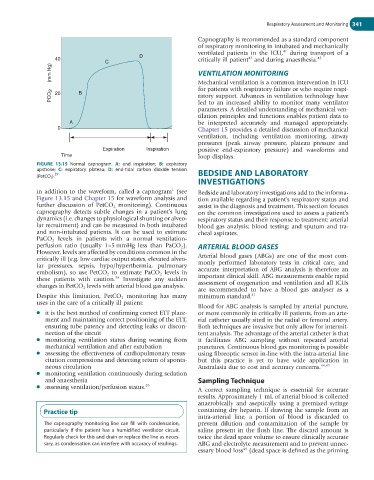
             FIGURE  13.15  Normal  capnogram.  A:  end  inspiration;  B:  expiratory
             upstroke;  C:  expiratory  plateau;  D:  end-tidal  carbon  dioxide  tension   BEDSIDE AND LABORATORY
                   39
             (PetCO 2 ).
                                                                  INVESTIGATIONS
                                                         1
             in  addition  to  the  waveform,  called  a  capnogram   (see   Bedside and laboratory investigations add to the informa-
             Figure 13.15 and Chapter 15 for waveform analysis and   tion available regarding a patient’s respiratory status and
             further  discussion  of  PetCO 2   monitoring).  Continuous   assist in the diagnosis and treatment. This section focuses
             capnography  detects  subtle  changes  in  a  patient’s  lung   on the common investigations used to assess a patient’s
             dynamics (i.e. changes to physiological shunting or alveo-  respiratory status and their response to treatment: arterial
             lar recruitment) and can be measured in both intubated   blood gas analysis; blood testing; and sputum and tra-
             and  non-intubated  patients.  It  can  be  used  to  estimate   cheal aspirates.
             PaCO 2   levels  in  patients  with  a  normal  ventilation-
             perfusion  ratio  (usually  1–5 mmHg  less  than  PaCO 2 ).   ARTERIAL BLOOD GASES
             However, levels are affected by conditions common in the
             critically ill (e.g. low cardiac output states, elevated alveo-  Arterial  blood  gases  (ABGs)  are  one  of  the  most  com-
             lar  pressures,  sepsis,  hypo/hyperthermia,  pulmonary   monly  performed  laboratory  tests  in  critical  care,  and
             embolism),  so  use  PetCO 2   to  estimate  PaCO 2   levels  in   accurate  interpretation  of  ABG  analysis  is  therefore  an
                                       38
             these  patients  with  caution.   Investigate  any  sudden   important clinical skill. ABG measurements enable rapid
             changes in PetCO 2  levels with arterial blood gas analysis.  assessment of oxygenation and ventilation and all ICUs
                                                                  are  recommended  to  have  a  blood  gas  analyser  as  a
             Despite  this  limitation,  PetCO 2   monitoring  has  many   minimum standard. 41
             uses in the care of a critically ill patient:
                                                                  Blood for ABG analysis is sampled by arterial puncture,
             ●  it is the best method of confirming correct ETT place-  or more commonly in critically ill patients, from an arte-
                ment and maintaining correct positioning of the ETT,   rial catheter usually sited in the radial or femoral artery.
                ensuring tube patency and detecting leaks or discon-  Both techniques are invasive but only allow for intermit-
                nection of the circuit                            tent analysis. The advantage of the arterial catheter is that
             ●  monitoring  ventilation  status  during  weaning  from   it  facilitates  ABG  sampling  without  repeated  arterial
                mechanical ventilation and after extubation       punctures. Continuous blood gas monitoring is possible
             ●  assessing the effectiveness of cardiopulmonary resus-  using fibreoptic sensor in-line with the intra-arterial line
                citation compressions and detecting return of sponta-  but  this  practice  is  yet  to  have  wide  application  in
                neous circulation                                 Australasia due to cost and accuracy concerns. 44,45
             ●  monitoring ventilation continuously during sedation
                and anaesthesia                                   Sampling Technique
             ●  assessing ventilation/perfusion status. 40
                                                                  A  correct  sampling  technique  is  essential  for  accurate
                                                                  results. Approximately 1 mL of arterial blood is collected
                                                                  anaerobically  and  aseptically  using  a  premixed  syringe
               Practice tip                                       containing dry heparin. If drawing the sample from an
                                                                  intra-arterial  line,  a  portion  of  blood  is  discarded  to
               The capnography monitoring line can fill with condensation,   prevent  dilution  and  contamination  of  the  sample  by
               particularly  if  the  patient  has  a  humidified  ventilator  circuit.   saline  present  in  the  flush  line.  The  discard  amount  is
               Regularly check for this and drain or replace the line as neces-  twice the dead space volume to ensure clinically accurate
               sary, as condensation can interfere with accuracy of readings.  ABG and electrolyte measurement and to prevent unnec-
                                                                  essary blood loss  (dead space is defined as the priming
                                                                                 46

