


Page 366 - ACCCN's Critical Care Nursing
P. 366
Respiratory Assessment and Monitoring 343


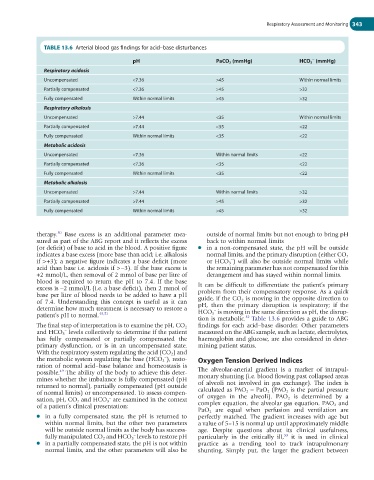
               TABLE 13.6  Arterial blood gas findings for acid–base disturbances

                                                                                                       −
                                            pH                          PaCO 2  (mmHg)             HCO 3  (mmHg)
               Respiratory acidosis
               Uncompensated                <7.36                       >45                        Within normal limits
               Partially compensated        <7.36                       >45                        >32
               Fully compensated            Within normal limits        >45                        >32
               Respiratory alkalosis
               Uncompensated                >7.44                       <35                        Within normal limits
               Partially compensated        >7.44                       <35                        <22
               Fully compensated            Within normal limits        <35                        <22
               Metabolic acidosis
               Uncompensated                <7.36                       Within normal limits       <22
               Partially compensated        <7.36                       <35                        <22
               Fully compensated            Within normal limits        <35                        <22
               Metabolic alkalosis
               Uncompensated                >7.44                       Within normal limits       >32
               Partially compensated        >7.44                       >45                        >32
               Fully compensated            Within normal limits        >45                        >32


             therapy.   Base  excess  is  an  additional  parameter  mea-  outside of normal limits but not enough to bring pH
                    50
             sured as part of the ABG report and it reflects the excess   back to within normal limits
             (or deficit) of base to acid in the blood. A positive figure   ●  in a non-compensated state, the pH will be outside
             indicates a base excess (more base than acid; i.e. alkalosis   normal limits, and the primary disruption (either CO 2
                                                                             −
             if >+3); a negative figure indicates a base deficit (more   or HCO 3 ) will also be outside normal limits while
             acid than base i.e. acidosis if >−3). If the base excess is   the remaining parameter has not compensated for this
             +2 mmol/L, then removal of 2 mmol of base per litre of   derangement and has stayed within normal limits.
             blood  is  required  to  return  the  pH  to  7.4.  If  the  base
             excess is −2 mmol/L (i.e. a base deficit), then 2 mmol of   It  can  be  difficult  to  differentiate  the  patient’s  primary
             base per litre of blood needs to be added to have a pH   problem from their compensatory response. As a quick
             of  7.4.  Understanding  this  concept  is  useful  as  it  can   guide, if the CO 2  is moving in the opposite direction to
             determine how much treatment is necessary to restore a   pH,  then  the  primary  disruption  is  respiratory;  if  the
                                                                       −
             patient’s pH to normal. 49,51                        HCO 3  is moving in the same direction as pH, the disrup-
                                                                  tion is metabolic.  Table 13.6 provides a guide to ABG
                                                                                 52
             The final step of interpretation is to examine the pH, CO 2   findings  for  each  acid–base  disorder.  Other  parameters
                      −
             and HCO 3  levels collectively to determine if the patient   measured on the ABG sample, such as lactate, electrolytes,
             has  fully  compensated  or  partially  compensated  the   haemoglobin and glucose, are also considered in deter-
             primary  dysfunction,  or  is  in  an  uncompensated  state.   mining patient status.
             With the respiratory system regulating the acid (CO 2 ) and
                                                       −
             the metabolic system regulating the base (HCO 3 ), resto-  Oxygen Tension Derived Indices
             ration of normal acid–base balance and homeostasis is
                     49
             possible.  The ability of the body to achieve this deter-  The  alveolar-arterial  gradient  is  a  marker  of  intrapul-
             mines whether the imbalance is fully compensated (pH   monary shunting (i.e. blood flowing past collapsed areas
             returned to normal), partially compensated (pH outside   of  alveoli  not  involved  in  gas  exchange).  The  index  is
             of normal limits) or uncompensated. To assess compen-  calculated as PAO 2  − PaO 2  (PAO 2  is the partial pressure
                                     −
             sation, pH, CO 2  and HCO 3  are examined in the context   of  oxygen  in  the  alveoli).  PAO 2   is  determined  by  a
             of a patient’s clinical presentation:                complex equation, the alveolar gas equation. PAO 2  and
                                                                  PaO 2   are  equal  when  perfusion  and  ventilation  are
             ●  in  a  fully  compensated  state,  the  pH  is  returned  to   perfectly  matched.  The  gradient  increases  with  age  but
                within  normal  limits,  but  the  other  two  parameters   a value of 5–15 is normal up until approximately middle
                will be outside normal limits as the body has success-  age.  Despite  questions  about  its  clinical  usefulness,
                                             −
                fully manipulated CO 2  and HCO 3  levels to restore pH  particularly  in  the  critically  ill,   it  is  used  in  clinical
                                                                                              53
             ●  in a partially compensated state, the pH is not within   practice  as  a  trending  tool  to  track  intrapulmonary
                normal limits, and the other parameters will also be   shunting.  Simply  put,  the  larger  the  gradient  between

