


Page 365 - ACCCN's Critical Care Nursing
P. 365
342  P R I N C I P L E S   A N D   P R A C T I C E   O F   C R I T I C A L   C A R E


            TABLE 13.4  Arterial blood gas normal values         TABLE 13.5  Steps for arterial blood gas interpretation

            Blood gas                         Normal             Step  Interpretation
            measurements  Description         value               1    Assess oxygenation. PaO 2  < 60 mmHg indicates
            Temperature (T)  Patient’s body   37°C                      hypoxaemia.
                           temperature. Analyser                  2    Assess the pH level. <7.36 indicates acidosis, >7.44
                           defaults to 37°C if not                      indicates alkalosis.
                           entered.
                                                                  3    Assess PaCO 2  level. <35 mmHg indicates respiratory
            Haemoglobin   Samples should be fully   Females:
             (Hb)          mixed so should be   115–165 g/L             acidosis; >45 mmHg indicates respiratory alkalosis.
                           constantly agitated until   Males:     4    Assess HCO 3  level. <22 indicates metabolic acidosis; >32
                                                                               −
                           analysed.            130–180 g/L             indicates metabolic alkalosis.
            Acid–Base status   Overall acidity or alkalinity   7.36–7.44  5  Assess pH, CO 2 and HCO 3 . Is there an acid–base
                                                                                        −
             (pH)          of blood.          (36–                      disturbance and is it fully compensated, partially
                                                44 mmol/L)              compensated or uncompensated?
            Carbon dioxide   Partial pressure of arterial   35–45 mmHg  6  Assess other ABG results. Are they within normal limits
             (CO 2 )       CO 2 . A potential acid.  (4.7–6 kPa)        for the patient?
            Oxygen (O 2 )  Partial pressure of O 2 .   80–100 mmHg
                           Varies with age.   (10.7–13.3 kPa)
                                      −
            Bicarbonate   Standardised HCO 3  (actual   22–32 mmol/L  When  assessing  PaO 2 ,  hypoxaemia  (<60 mmHg)  will
                 −
                               −
             (HCO 3 )      HCO 3  minus the                   be  the  most  common  abnormality,  and  supplemental
                               −
                           HCO 3  produced by                 oxygen  will  be  required  to  maintain  adequate  tissue
                           respiratory dysfunction)           oxygenation. Hyperoxia rarely occurs unless a patient is
                           estimates true metabolic
                           function. An alkali or             receiving  supplemental  oxygen  therapy.  Oxygen  can  be
                           base.                              toxic  to  cells  if  delivered  at  high  concentrations  for  a
                                                                              48
                                                              prolonged period.  The pH level is assessed to determine
            Base Excess (BE)  Measures acid–base   −3 to
                           balance. The number of   +3 mmol/L  if it falls on the acidic or alkaline side of 7.4.
                           molecules of acid or               On the pH scale of 1–14 (1 = the strongest acid, 14 = the
                           base required to return 1
                           litre of blood to the              strongest alkali), a pH of 7.4 is the middle of the normal
                           normal pH (7.4).                   range. pH measures the acid–base balance of the blood
                                                                                        +
                                                              sample,  where  Hydrogen  (H )  ions  are  the  acid  and
            Oxygen        Haemoglobin saturation by  94.5–98.2%    −
             saturation    oxygen in arterial blood           HCO 3  is the base or buffer. The body’s acid–base balance
                                                                                                              48
             (SaO 2 )                                         is affected by both the respiratory and metabolic systems.
                                                              Acidaemia is present with a pH of <7.36; alkalaemia is
                                                              present with a pH of >7.44.
         volume  from  sampling  port  to  catheter  tip;  this  differs   PaCO 2  is an indicator of the effectiveness of ventilation
         depending on the arterial line set up that is used). Arte-  in removing CO 2 . CO 2  is a potential acid as it combines
         rial blood exerts its own pressure, which is sufficient to   with H 2 O in the blood to form carbonic acid (H 2 CO 3 ).
         fill the syringe to the required level; active negative pres-  Retention  of  CO 2   (through  hypoventilation)  leads  to
                                                                         +
         sure is to be avoided, as this causes frothing. Any excess   increased  H   resulting  in  a  lower  pH,  and  similarly  a
         air  will  also  cause  inaccurate  readings  and  is  expelled   loss  of  CO 2  (through  hyperventilation)  results  in  a
                                                                        49
         before the syringe is capped with a hub, which prevents   higher pH.  A PaCO 2  of >45  mmHg (6 kPa) indicates
         further contamination with air. The sample is analysed   alveolar  hypoventilation,  due  to  chronic  obstructive
         within  10  minutes  if  not  packed  in  ice,  or  within  60   pulmonary disease, asthma, pulmonary oedema, airway
         minutes if iced; delays cause degradation of the sample.   obstruction,  over  sedation,  narcosis,  drug  overdose,
         Degradation also occurs if the sample is shaken; therefore   pain,  neurological  deficit  or  permissive  hypercapnia  in
                                                                                           50
         gently  roll  the  syringe/collection  tube  between  your   mechanically ventilated patients.  Conversely, a PaCO 2
         fingers to mix the sample with the heparin and prevent   of  <35  mmHg  (4.7  kPa)  reflects  alveolar  hyperventila-
         clotting. 47                                         tion,  and  can  be  due  to  hypoxia,  pain,  anxiety,  preg-
                                                              nancy, permissive hypocapnia in mechanically ventilated
         Arterial Blood Gas Analysis                          patients or as a compensatory mechanism for metabolic
                                                              acidosis. 50
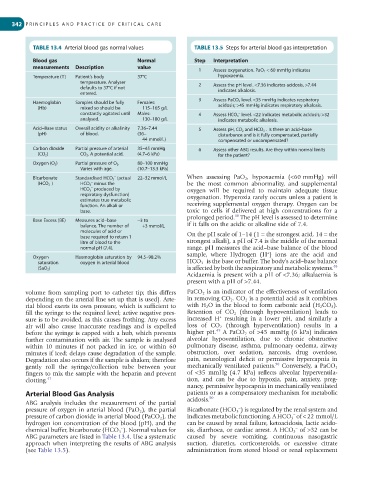
         ABG  analysis  includes  the  measurement  of  the  partial
                                                                               −
         pressure of oxygen in arterial blood (PaO 2 ), the partial   Bicarbonate (HCO 3 ) is regulated by the renal system and
                                                                                                 −
         pressure of carbon dioxide in arterial blood (PaCO 2 ), the   indicates metabolic functioning. A HCO 3  of < 22 mmol/L
         hydrogen ion concentration of the blood (pH), and the   can be caused by renal failure, ketoacidosis, lactic acido-
                                                                                                  −
                                         –
         chemical buffer, bicarbonate (HCO 3 ). Normal values for   sis, diarrhoea, or cardiac arrest. A HCO 3  of >32 can be
         ABG parameters are listed in Table 13.4. Use a systematic   caused  by  severe  vomiting,  continuous  nasogastric
         approach when interpreting the results of ABG analysis   suction,  diuretics,  corticosteroids,  or  excessive  citrate
         (see Table 13.5).                                    administration from stored blood or renal replacement

