


Page 376 - ACCCN's Critical Care Nursing
P. 376
Respiratory Alterations and Management  353

                                                                  ●  increased  metabolic  oxygen  requirements  may  be
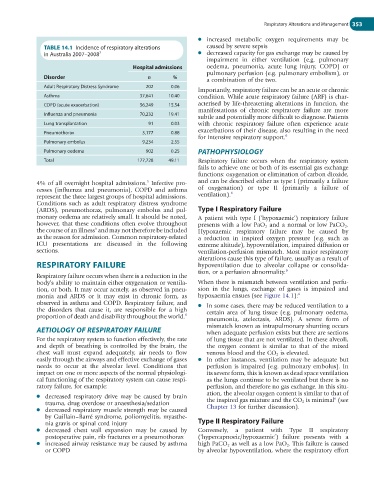
               TABLE 14.1  Incidence of respiratory alterations      caused by severe sepsis
               in Australia 2007–2008 7                           ●  decreased capacity for gas exchange may be caused by
                                                                     impairment  in  either  ventilation  (e.g.  pulmonary
                                             Hospital admissions     oedema,  pneumonia,  acute  lung  injury,  COPD)  or
                                                                     pulmonary perfusion (e.g. pulmonary embolism), or
               Disorder                          n        %          a combination of the two.
               Adult Respiratory Distress Syndrome  202  0.06
                                                                  Importantly, respiratory failure can be an acute or chronic
               Asthma                          37,641   10.40     condition. While acute respiratory failure (ARF) is char-
               COPD (acute exacerbation)       56,249   15.54     acterised by life-threatening alterations in function, the
                                                                  manifestations  of  chronic  respiratory  failure  are  more
               Influenza and pneumonia         70,232   19.41
                                                                  subtle and potentially more difficult to diagnose. Patients
               Lung transplantation               91     0.03     with  chronic  respiratory  failure  often  experience  acute
               Pneumothorax                     3,177    0.88     exacerbations of their disease, also resulting in the need
                                                                  for intensive respiratory support. 6
               Pulmonary embolus                9,234    2.55
               Pulmonary oedema                  902     0.25     PATHOPHYSIOLOGY
               Total                          177,728   49.11     Respiratory  failure  occurs  when  the  respiratory  system
                                                                  fails to achieve one or both of its essential gas exchange
                                                                  functions: oxygenation or elimination of carbon dioxide,
                                                 5
             4% of all overnight hospital admissions.  Infective pro-  and can be described either as type I (primarily a failure
             cesses  (influenza  and  pneumonia),  COPD  and  asthma   of  oxygenation)  or  type  II  (primarily  a  failure  of
                                                                             6
             represent the three largest groups of hospital admissions.   ventilation).
             Conditions  such  as  adult  respiratory  distress  syndrome
             (ARDS),  pneumothorax,  pulmonary  embolus  and  pul-  Type I Respiratory Failure
             monary oedema are relatively small. It should be noted,   A  patient  with  type  I  (‘hypoxaemic’)  respiratory  failure
             however, that these conditions often evolve throughout   presents with a low PaO 2  and a normal or low PaCO 2 .
             the course of an illness  and may not therefore be included   Hypoxaemic  respiratory  failure  may  be  caused  by
                                6
             as the reason for admission. Common respiratory-related   a  reduction  in  inspired  oxygen  pressure  (e.g.  such  as
             ICU  presentations  are  discussed  in  the  following   extreme altitude), hypoventilation, impaired diffusion or
             sections.                                            ventilation-perfusion mismatch. Most major respiratory
                                                                  alterations cause this type of failure, usually as a result of
             RESPIRATORY FAILURE                                  hypoventilation  due  to  alveolar  collapse  or  consolida-
                                                                  tion, or a perfusion abnormality. 6
             Respiratory failure occurs when there is a reduction in the
             body’s ability to maintain either oxygenation or ventila-  When there is mismatch between ventilation and perfu-
             tion, or both. It may occur acutely, as observed in pneu-  sion  in  the  lungs,  exchange  of  gases  is  impaired  and
             monia  and  ARDS  or  it  may  exist  in  chronic  form,  as   hypoxaemia ensues (see Figure 14.1): 6
             observed in asthma and COPD. Respiratory failure, and   ●  In some cases, there may be reduced ventilation to a
             the  disorders  that  cause  it,  are  responsible  for  a  high   certain  area  of  lung  tissue  (e.g.  pulmonary  oedema,
             proportion of death and disability throughout the world. 6
                                                                     pneumonia,  atelectasis,  ARDS).  A  severe  form  of
             AETIOLOGY OF RESPIRATORY FAILURE                        mismatch known as intrapulmonary shunting occurs
                                                                     when adequate perfusion exists but there are sections
             For the respiratory system to function effectively, the rate   of lung tissue that are not ventilated. In these alveoli,
             and  depth  of  breathing  is  controlled  by  the  brain,  the   the  oxygen  content  is  similar  to  that  of  the  mixed
             chest  wall  must  expand  adequately,  air  needs  to  flow   venous blood and the CO 2  is elevated.
             easily through the airways and effective exchange of gases   ●  In other instances, ventilation may be adequate but
             needs  to  occur  at  the  alveolar  level.  Conditions  that   perfusion  is  impaired  (e.g.  pulmonary  embolus).  In
             impact on one or more aspects of the normal physiologi-  its severe form, this is known as dead space ventilation
             cal functioning of the respiratory system can cause respi-  as the lungs continue to be ventilated but there is no
             ratory failure, for example:                            perfusion, and therefore no gas exchange. In this situ-
                                                                     ation, the alveolar oxygen content is similar to that of
             ●  decreased  respiratory  drive  may  be  caused  by  brain                                     6
                trauma, drug overdose or anaesthesia/sedation        the inspired gas mixture and the CO 2 is minimal  (see
             ●  decreased respiratory muscle strength may be caused   Chapter 13 for further discussion).
                by Guillain–Barré syndrome, poliomyelitis, myasthe-
                nia gravis or spinal cord injury                  Type II Respiratory Failure
             ●  decreased  chest  wall  expansion  may  be  caused  by   Conversely,  a  patient  with  Type  II  respiratory
                postoperative pain, rib fractures or a pneumothorax  (‘hypercapnoeic/hypoxaemic’)  failure  presents  with  a
             ●  increased airway resistance may be caused by asthma   high PaCO 2  as well as a low PaO 2 . This failure is caused
                or COPD                                           by alveolar hypoventilation, where the respiratory effort

