


Page 378 - ACCCN's Critical Care Nursing
P. 378
Respiratory Alterations and Management  355

             or  tidal  volume  to  maintain  a  specified  PaCO 2 .  One   method should be considered for all ventilated patients.
             concern that often arises, particularly with patients who   The  approach  may  result  in  tolerance  of  higher  PaCO 2
             require  high  concentrations  of  oxygen,  is  the  risk  of   than  normal  in  patients  presenting  with  acute  lung
             oxygen toxicity. The link between prolonged periods of   injury  or  ARDS  (see  Chapter  15  for  further
             oxygen  concentrations  approaching  100%  and  oxidant   discussion).
             injuries in airways and lung parenchyma has been estab-  Development of ventilator-associated respiratory muscle
             lished, although mostly from animal research. Although   weakness has been reported as a significant issue when
             it remains unclear how these data apply to human popu-  the  respiratory  muscles  are  rendered  inactive  through
             lations,  most  consensus  groups  have  argued  that  FiO 2    adjustment  of  ventilator  settings  and  administration  of
             values less than 0.4 are safe for prolonged periods of time   pharmacotherapy. While it is not yet possible to provide
             and that FiO 2  values of greater than 0.8 should be avoided   precise recommendations for interventions to avoid this,
                      6
             if  possible   (see  Chapter  15  for  further  discussion  of   clinicians  are  advised  to  select  ventilator  settings  that
             oxygenation).                                        provide for some respiratory muscle use. 11
             Ventilator-associated lung injury is also a concern when   Prevention or minimisation of complications associated
             managing patients with acute respiratory failure. A lung   with positive pressure mechanical ventilation remains a
             can  be  injured  when  it  is  stretched  excessively  as  a   major focus of nursing practice. These complications may
             result  of  tidal  volume  settings  that  generate  high  pres-  relate to the patient–ventilator interface (artificial airway
             sures,  often  referred  to  as  barotrauma  or  volutrauma.   and  ventilator  circuitry),  infectious  complications  such
             The  most  common  injury  is  that  of  alveolar  rupture   as  ventilator-associated  pneumonia  (VAP)  or  complica-
                                                          6
             and/or  air  in  the  pleural  space  (pneumothorax).   An   tions associated with sedation and/or immobility. Some
             approach  known  as  ‘lung  protective  ventilation’  aims   common  complications  and  the  appropriate  manage-
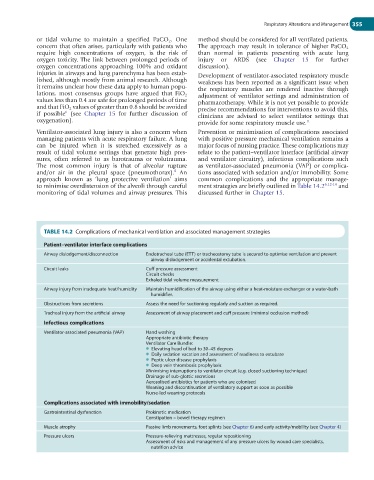
             to minimise overdistension of the alveoli through careful   ment strategies are briefly outlined in Table 14.2 6,12-14  and
             monitoring of tidal volumes and airway pressures. This   discussed further in Chapter 15.


               TABLE 14.2  Complications of mechanical ventilation and associated management strategies

               Patient–ventilator interface complications
               Airway dislodgement/disconnection  Endotracheal tube (ETT) or tracheostomy tube is secured to optimise ventilation and prevent
                                                  airway dislodgement or accidental extubation.
               Circuit leaks                     Cuff pressure assessment
                                                 Circuit checks
                                                 Exhaled tidal volume measurement
               Airway injury from inadequate heat/humidity  Maintain humidification of the airway using either a heat-moisture exchanger or a water-bath
                                                  humidifier.
               Obstructions from secretions      Assess the need for suctioning regularly and suction as required.
               Tracheal injury from the artificial airway  Assessment of airway placement and cuff pressure (minimal occlusion method)
               Infectious complications
               Ventilator-associated pneumonia (VAP)  Hand washing
                                                 Appropriate antibiotic therapy
                                                 Ventilator Care Bundle:
                                                 ●  Elevating head of bed to 30–45 degrees
                                                 ●  Daily sedation vacation and assessment of readiness to extubate
                                                 ●  Peptic ulcer disease prophylaxis
                                                 ●  Deep vein thrombosis prophylaxis
                                                 Minimising interruptions to ventilator circuit (e.g. closed suctioning technique)
                                                 Drainage of sub-glottic secretions
                                                 Aerosolised antibiotics for patients who are colonised
                                                 Weaning and discontinuation of ventilatory support as soon as possible
                                                 Nurse-led weaning protocols
               Complications associated with immobility/sedation
               Gastrointestinal dysfunction      Prokinetic medication
                                                 Constipation – bowel therapy regimen
               Muscle atrophy                    Passive limb movements, foot splints (see Chapter 6) and early activity/mobility (see Chapter 4)
               Pressure ulcers                   Pressure-relieving mattresses, regular repositioning
                                                 Assessment of risks and management of any pressure ulcers by wound care specialists,
                                                  nutrition advice

