


Page 377 - ACCCN's Critical Care Nursing
P. 377
354  P R I N C I P L E S   A N D   P R A C T I C E   O F   C R I T I C A L   C A R E

                                    Pure
                                    shunt
                                      V/Q = 0
                              52
                            Alveolar PCO 2  (mmHg)  Decreasing V/Q  Normal V/Q       space


                                                                                      Pure
                                                                                      dead

                                                                   Increasing V/Q
                                                                                        V/Q = ∞


                               0
                                     45                                               150
                                                      Alveolar PO 2  (mmHg)
                                          6
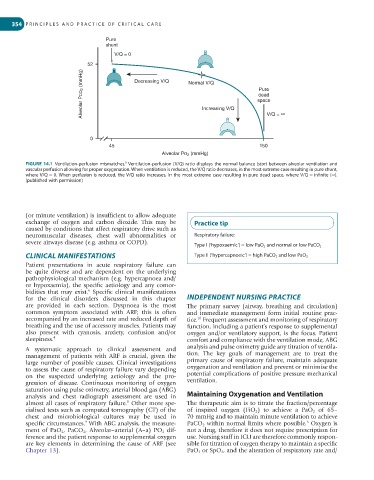
         FIGURE 14.1  Ventilation-perfusion mismatches.  Ventilation-perfusion (V/Q) ratio displays the normal balance (star) between alveolar ventilation and
         vascular perfusion allowing for proper oxygenation. When ventilation is reduced, the V/Q ratio decreases, in the most extreme case resulting in pure shunt,
         where V/Q = 0. When perfusion is reduced, the V/Q ratio increases, in the most extreme case resulting in pure dead space, where V/Q = infinite (∞).
         (published with permission)


         (or minute ventilation) is insufficient to allow adequate
         exchange  of  oxygen  and  carbon  dioxide.  This  may  be   Practice tip
         caused by conditions that affect respiratory drive such as
         neuromuscular  diseases,  chest  wall  abnormalities  or   Respiratory failure:
         severe airways disease (e.g. asthma or COPD).
                                                                 Type I (‘hypoxaemic’) = low PaO 2  and normal or low PaCO 2
         CLINICAL MANIFESTATIONS                                 Type II (‘hypercapnoeic’) = high PaCO 2  and low PaO 2
         Patient  presentations  in  acute  respiratory  failure  can
         be  quite  diverse  and  are  dependent  on  the  underlying
         pathophysiological mechanism (e.g. hypercapnoea and/
         or  hypoxaemia),  the  specific  aetiology  and  any  comor-
         bidities  that  may  exist.   Specific  clinical  manifestations
                              6
         for  the  clinical  disorders  discussed  in  this  chapter    INDEPENDENT NURSING PRACTICE
         are  provided  in  each  section.  Dyspnoea  is  the  most   The  primary  survey  (airway,  breathing  and  circulation)
         common  symptom  associated  with  ARF;  this  is  often   and  immediate  management  form  initial  routine  prac-
         accompanied by an increased rate and reduced depth of   tice.  Frequent assessment and monitoring of respiratory
                                                                  10
         breathing and the use of accessory muscles. Patients may   function, including a patient’s response to supplemental
         also  present  with  cyanosis,  anxiety,  confusion  and/or   oxygen and/or ventilatory support, is the focus. Patient
         sleepiness. 4                                        comfort and compliance with the ventilation mode, ABG
         A  systematic  approach  to  clinical  assessment  and     analysis and pulse oximetry guide any titration of ventila-
         management  of  patients  with  ARF  is  crucial,  given  the   tion.  The  key  goals  of  management  are  to  treat  the
         large number of possible causes. Clinical investigations   primary  cause  of  respiratory  failure,  maintain  adequate
         to assess the cause of respiratory failure vary depending   oxygenation and ventilation and prevent or minimise the
         on  the  suspected  underlying  aetiology  and  the  pro-  potential complications of positive pressure mechanical
         gression  of  disease.  Continuous  monitoring  of  oxygen   ventilation.
         saturation using pulse oximetry, arterial blood gas (ABG)
         analysis  and  chest  radiograph  assessment  are  used  in   Maintaining Oxygenation and Ventilation
                                           8
         almost all cases of respiratory failure.  Other more spe-  The therapeutic aim is to titrate the fraction/percentage
         cialised tests such as computed tomography (CT) of the   of  inspired  oxygen  (FiO 2 )  to  achieve  a  PaO 2   of  65–
         chest  and  microbiological  cultures  may  be  used  in     70 mmHg and to maintain minute ventilation to achieve
                                                                                                     6
                             9
         specific circumstances.  With ABG analysis, the measure-  PaCO 2  within normal limits where possible.  Oxygen is
         ment  of  PaO 2 ,  PaCO 2 ,  Alveolar–arterial  (A–a)  PO 2   dif-  not a drug, therefore it does not require prescription for
         ference and the patient response to supplemental oxygen   use. Nursing staff in ICU are therefore commonly respon-
         are  key  elements  in  determining  the  cause  of  ARF  (see   sible for titration of oxygen therapy to maintain a specific
         Chapter  13).                                        PaO 2  or SpO 2 , and the alteration of respiratory rate and/

