


Page 379 - ACCCN's Critical Care Nursing
P. 379
356  P R I N C I P L E S   A N D   P R A C T I C E   O F   C R I T I C A L   C A R E

         COLLABORATIVE PRACTICE                               of  medications  will  vary  depending  on  the  underlying
         A  patient  with  ARF  requires  extensive  multidisciplinary   cause  of  respiratory  failure,  these  are  discussed  in  each
         collaboration between nurses, physiotherapists, specialist   section respectively.
         medical staff, speech and occupational therapists, dieti-
         tians,  social  workers,  radiologists  and  radiographers.   SPECIAL CONSIDERATIONS
         Patients may require additional oxygen delivery through   Respiratory failure in patients who are pregnant, elderly
         an adequate haemoglobin level for oxygen transportation   or have comorbidities require specific attention to avoid
         and  a  cardiac  output  sufficient  to  supply  oxygenated   clinical  deterioration.  Respiratory  physiology  and  the
                            6
         blood  to  the  tissues.   At  times  this  may  require  blood   respiratory tract itself are altered during pregnancy; this
         transfusion and/or the use of vasoactive medications (see   may  result  in  exacerbation  of  preexisting  respiratory
         Chapters 11 and 20).                                 disease or increased susceptibility to disease (see Chapter
                                                              26).  Upper  airway  mucosal  oedema  may  increase  the
         Chest  physiotherapy  is  a  routine  activity  for  managing   likelihood of upper respiratory tract infection. Lung func-
         patients  with  ARF.  This  involves  positioning,  manual   tion and lung volume are also altered, compensated by
         hyperinflation, percussion and vibration and suctioning.   an increase in respiratory drive and minute ventilation.
         The evidence base for these techniques is limited, however,   The  impact  of  these  alterations  on  chronic  conditions
         with a systematic review not demonstrating an improve-  such  as  asthma/COPD  and  acute  illness  are  explored
                         12
         ment in mortality.  Guidelines for physiotherapy assess-  in  the  subsequent  sections.  The  impact  on  the  fetus  of
         ment have enabled identification of patient characteristics   infection,  hypoxia  and  drug  therapy  is  an  important
         for treatments to be prescribed and modified on an indi-  consideration. 6
                    13
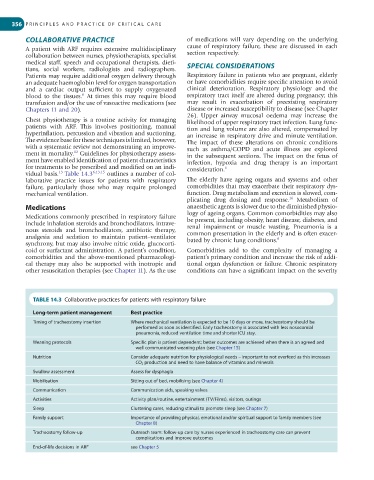
         vidual basis.  Table 14.3 6,13,15  outlines a number of col-
         laborative  practice  issues  for  patients  with  respiratory   The  elderly  have  ageing  organs  and  systems  and  other
         failure,  particularly  those  who  may  require  prolonged   comorbidities that may exacerbate their respiratory dys-
         mechanical ventilation.                              function. Drug metabolism and excretion is slowed, com-
                                                                                                16
                                                              plicating  drug  dosing  and  response.   Metabolism  of
         Medications                                          anaesthetic agents is slower due to the diminished physio-
                                                              logy of ageing organs. Common comorbidities may also
         Medications commonly prescribed in respiratory failure   be present, including obesity, heart disease, diabetes, and
         include inhalation steroids and bronchodilators, intrave-  renal  impairment  or  muscle  wasting.  Pneumonia  is  a
         nous  steroids  and  bronchodilators,  antibiotic  therapy,   common presentation in the elderly and is often exacer-
         analgesia  and  sedation  to  maintain  patient–ventilator   bated by chronic lung conditions. 6
         synchrony, but may also involve nitric oxide, glucocorti-
         coid or surfactant administration. A patient’s condition,   Comorbidities  add  to  the  complexity  of  managing  a
         comorbidities and the above-mentioned pharmacologi-  patient’s primary condition and increase the risk of addi-
         cal  therapy  may  also  be  supported  with  inotropic  and   tional organ dysfunction or failure. Chronic respiratory
         other resuscitation therapies (see Chapter 11). As the use   conditions can have a significant impact on the severity


            TABLE 14.3  Collaborative practices for patients with respiratory failure

            Long-term patient management    Best practice
            Timing of tracheostomy insertion  Where mechanical ventilation is expected to be 10 days or more, tracheostomy should be
                                             performed as soon as identified. Early tracheostomy is associated with less nosocomial
                                             pneumonia, reduced ventilation time and shorter ICU stay.
            Weaning protocols               Specific plan is patient dependent; better outcomes are achieved when there is an agreed and
                                             well communicated weaning plan (see Chapter 15)
            Nutrition                       Consider adequate nutrition for physiological needs – important to not overfeed as this increases
                                             CO 2  production and need to have balance of vitamins and minerals
            Swallow assessment              Assess for dysphagia
            Mobilisation                    Sitting out of bed, mobilising (see Chapter 4)
            Communication                   Communication aids, speaking valves
            Activities                      Activity plan/routine, entertainment (TV/Films), visitors, outings
            Sleep                           Clustering cares, reducing stimuli to promote sleep (see Chapter 7)
            Family support                  Importance of providing physical, emotional and/or spiritual support to family members (see
                                             Chapter 8)
            Tracheostomy follow-up          Outreach team: follow-up care by nurses experienced in tracheostomy care can prevent
                                             complications and improve outcomes
            End-of-life decisions in ARF    see Chapter 5

