


Page 384 - ACCCN's Critical Care Nursing
P. 384
Respiratory Alterations and Management  361


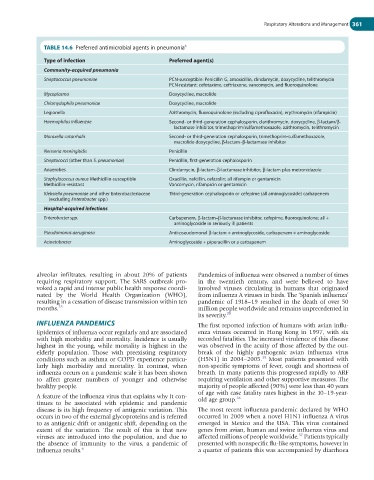
               TABLE 14.6  Preferred antimicrobial agents in pneumonia 6

               Type of infection                        Preferred agent(s)
               Community-acquired pneumonia
               Streptococcus pneumoniae                 PCN-susceptible: Penicillin G, amoxicillin, clindamycin, doxycycline, telithromycin
                                                        PCN-resistant: cefotaxime, ceftriaxone, vancomycin, and fluoroquinolone
               Mycoplasma                               Doxycycline, macrolide
               Chlamydophila pneumoniae                 Doxycycline, macrolide
               Legionella                               Azithromycin, fluoroquinolone (including ciprofloxacin), erythromycin (rifampicin)
               Haemophilus influenzae                   Second- or third-generation cephalosporin, clarithromycin, doxycycline, β-lactam/β-
                                                          lactamase inhibitor, trimethoprim/sulfamethoxazole, azithromycin, telithromycin
               Moraxella catarrhalis                    Second- or third-generation cephalosporin, trimethoprim-sulfamethoxazole,
                                                          macrolide doxycycline, β-lactam–β-lactamase inhibitor
               Neisseria meningitidis                   Penicillin
               Streptococci (other than S. pneumoniae)  Penicillin, first-generation cephalosporin
               Anaerobes                                Clindamycin, β-lactam–β-lactamase inhibitor, β-lactam plus metronidazole
               Staphylococcus aureus Methicillin-susceptible  Oxacillin, nafcillin, cefazolin; all rifampin or gentamicin
               Methicillin-resistant                    Vancomycin, rifampicin or gentamicin
               Klebsiella pneumoniae and other Enterobacteriaceae   Third-generation cephalosporin or cefepime (all aminoglycoside) carbapenem
                 (excluding Enterobacter spp.)
               Hospital-acquired infections
               Enterobacter spp.                        Carbapenem, β-lactam–β-lactamase inhibitor, cefepime, fluoroquinolone; all +
                                                          aminoglycoside in seriously ill patients
               Pseudomonas aeruginosa                   Anti-pseudomonal β-lactam + aminoglycoside, carbapenem + aminoglycoside
               Acinetobacter                            Aminoglycoside + piperacillin or a carbapenem


             alveolar  infiltrates,  resulting  in  about  20%  of  patients   Pandemics of influenza were observed a number of times
             requiring  respiratory  support.  The  SARS  outbreak  pro-  in  the  twentieth  century,  and  were  believed  to  have
             voked a rapid and intense public health response coordi-  involved  viruses  circulating  in  humans  that  originated
             nated  by  the  World  Health  Organization  (WHO),   from influenza A viruses in birds. The ‘Spanish influenza’
             resulting in a cessation of disease transmission within ten   pandemic  of  1918–19  resulted  in  the  death  of  over  50
             months. 35                                           million people worldwide and remains unprecedented in
                                                                  its severity. 35
             INFLUENZA PANDEMICS                                  The first reported infection of humans with avian influ-
             Epidemics of influenza occur regularly and are associated   enza  viruses  occurred  in  Hong  Kong  in  1997,  with  six
             with high morbidity and mortality. Incidence is usually   recorded fatalities. The increased virulence of this disease
             highest  in  the  young,  while  mortality  is  highest  in  the   was observed in the acuity of those affected by the out-
             elderly  population.  Those  with  preexisting  respiratory   break  of  the  highly  pathogenic  avian  influenza  virus
             conditions such as asthma or COPD experience particu-  (H5N1)  in  2004–2005.   Most  patients  presented  with
                                                                                       35
             larly  high  morbidity  and  mortality.  In  contrast,  when   non-specific symptoms of fever, cough and shortness of
             influenza occurs on a pandemic scale it has been shown   breath. In many patients this progressed rapidly to ARF
             to  affect  greater  numbers  of  younger  and  otherwise   requiring ventilation and other supportive measures. The
             healthy people.                                      majority of people affected (90%) were less than 40 years
                                                                  of age with case fatality rates highest in the 10–19-year-
             A feature of the influenza virus that explains why it con-  old age group. 36
             tinues  to  be  associated  with  epidemic  and  pandemic
             disease is its high frequency of antigenic variation. This   The most recent influenza pandemic declared by WHO
             occurs in two of the external glycoproteins and is referred   occurred in 2009 when a novel H1N1 influenza A virus
             to as antigenic drift or antigenic shift, depending on the   emerged  in  Mexico  and  the  USA.  This  virus  contained
             extent  of  the  variation.  The  result  of  this  is  that  new   genes from avian, human and swine influenza virus and
                                                                                                   37
             viruses are introduced into the population, and due to   affected millions of people worldwide.  Patients typically
             the  absence  of  immunity  to  the  virus,  a  pandemic  of   presented with nonspecific flu-like symptoms, however in
             influenza results. 6                                 a quarter of patients this was accompanied by diarrhoea

