


Page 386 - ACCCN's Critical Care Nursing
P. 386
Respiratory Alterations and Management  363

             AETIOLOGY
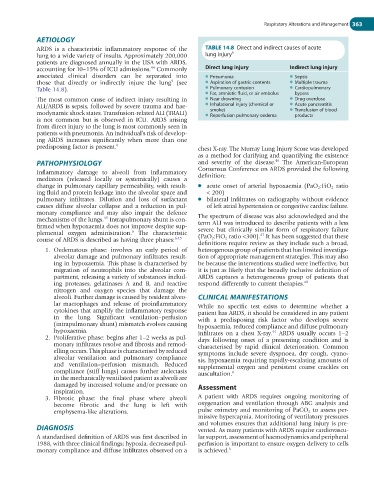
             ARDS  is  a  characteristic  inflammatory  response  of  the   TABLE 14.8  Direct and indirect causes of acute
             lung to a wide variety of insults. Approximately 200,000   lung injury 9
             patients are diagnosed annually in the USA with ARDS,
                                                  44
             accounting for 10–15% of ICU admissions.  Commonly     Direct lung injury          Indirect lung injury
             associated  clinical  disorders  can  be  separated  into     ●  Pneumonia         ●  Sepsis
                                                         9
             those  that  directly  or  indirectly  injure  the  lung   (see   ●  Aspiration of gastric contents  ●  Multiple trauma
             Table 14.8).                                           ●  Pulmonary contusion      ●  Cardiopulmonary
                                                                    ●  Fat, amniotic fluid, or air embolus  bypass
             The most common cause of indirect injury resulting in   ●  Near drowning           ●  Drug overdose
             ALI/ARDS is sepsis, followed by severe trauma and hae-  ●  Inhalational injury (chemical or   ●  Acute pancreatitis
                                                                      smoke)
             modynamic shock states. Transfusion-related ALI (TRALI)   ●  Reperfusion pulmonary oedema  ●  Transfusion of blood
                                                                                                 products
             is  not  common  but  is  observed  in  ICU.  ARDS  arising
             from direct injury to the lung is most commonly seen in
             patients with pneumonia. An individual’s risk of develop-
             ing  ARDS  increases  significantly  when  more  than  one
             predisposing factor is present. 6                    chest X-ray. The Murray Lung Injury Score was developed
                                                                  as a method for clarifying and quantifying the existence
                                                                                           46
             PATHOPHYSIOLOGY                                      and  severity  of  the  disease.   The  American-European
             Inflammatory  damage  to  alveoli  from  inflammatory   Consensus Conference on ARDS provided the following
             mediators  (released  locally  or  systemically)  causes  a   definition:
             change in pulmonary capillary permeability, with result-  ●  acute  onset  of  arterial  hypoxaemia  (PaO 2 :FiO 2   ratio
             ing fluid and protein leakage into the alveolar space and   < 200)
             pulmonary  infiltrates.  Dilution  and  loss  of  surfactant   ●  bilateral infiltrates on radiography without evidence
             causes diffuse alveolar collapse and a reduction in pul-  of left atrial hypertension or congestive cardiac failure.
             monary  compliance  and  may  also  impair  the  defence
             mechanisms of the lungs.  Intrapulmonary shunt is con-  The spectrum of disease was also acknowledged and the
                                   45
             firmed when hypoxaemia does not improve despite sup-  term ALI was introduced to describe patients with a less
             plemental  oxygen  administration.   The  characteristic   severe  but  clinically  similar  form  of  respiratory  failure
                                            6
                                                                                      47
             course of ARDS is described as having three phases: 6,45  (PaO 2 :FiO 2  ratio <300).  It has been suggested that these
                                                                  definitions require review as they include such a broad,
                1.  Oedematous  phase:  involves  an  early  period  of   heterogenous group of patients that has limited investiga-
                   alveolar damage and pulmonary infiltrates result-  tion of appropriate management strategies. This may also
                   ing in hypoxaemia. This phase is characterised by   be because the interventions studied were ineffective, but
                   migration  of  neutrophils  into  the  alveolar  com-  it is just as likely that the broadly inclusive definition of
                   partment, releasing a variety of substances includ-  ARDS  captures  a  heterogeneous  group  of  patients  that
                   ing  proteases,  gelatinases  A  and  B,  and  reactive   respond differently to current therapies. 48
                   nitrogen  and  oxygen  species  that  damage  the
                   alveoli. Further damage is caused by resident alveo-  CLINICAL MANIFESTATIONS
                   lar  macrophages  and  release  of  proinflammatory   While  no  specific  test  exists  to  determine  whether  a
                   cytokines that amplify the inflammatory response   patient has ARDS, it should be considered in any patient
                   in  the  lung.  Significant  ventilation–perfusion   with  a  predisposing  risk  factor  who  develops  severe
                   (intrapulmonary shunt) mismatch evolves causing   hypoxaemia, reduced compliance and diffuse pulmonary
                   hypoxaemia.                                    infiltrates  on  a  chest  X-ray.   ARDS  usually  occurs  1–2
                                                                                          44
                2.  Proliferative phase: begins after 1–2 weeks as pul-  days  following  onset  of  a  presenting  condition  and  is
                   monary infiltrates resolve and fibrosis and remod-  characterised  by  rapid  clinical  deterioration.  Common
                   elling occurs. This phase is characterised by reduced   symptoms  include  severe  dyspnoea,  dry  cough,  cyano-
                   alveolar  ventilation  and  pulmonary  compliance   sis, hypoxaemia requiring rapidly-escalating amounts of
                   and  ventilation–perfusion  mismatch.  Reduced   supplemental  oxygen  and  persistent  coarse  crackles  on
                   compliance (stiff lungs) causes further atelectasis   auscultation. 6
                   in the mechanically ventilated patient as alveoli are
                   damaged by increased volume and/or pressure on   Assessment
                   inspiration.
                3.  Fibrotic  phase:  the  final  phase  where  alveoli   A  patient  with  ARDS  requires  ongoing  monitoring  of
                   become  fibrotic  and  the  lung  is  left  with   oxygenation  and  ventilation  through  ABG  analysis  and
                   emphysema-like alterations.                    pulse oximetry and monitoring of PaCO 2  to assess per-
                                                                  missive hypercapnia. Monitoring of ventilatory pressures
                                                                  and volumes ensures that additional lung injury is pre-
             DIAGNOSIS                                            vented. As many patients with ARDS require cardiovascu-
             A standardised definition of ARDS was first described in   lar support, assessment of haemodynamics and peripheral
             1988, with three clinical findings; hypoxia, decreased pul-  perfusion is important to ensure oxygen delivery to cells
             monary compliance and diffuse infiltrates observed on a   is achieved. 6

