


Page 388 - ACCCN's Critical Care Nursing
P. 388
Respiratory Alterations and Management  365

                                                                                                        70
                                                                  risk  factor  for  the  development  of  COPD.   Continued
                  Overlap of bronchitis, emphysema and asthma
                within chronic obstructive pulmonary disease      smoking accelerates the decline of respiratory function in
                (COPD)                                            susceptible  individuals. 71,72   However,  less  than  15%  of
                                                                  smokers actually develop clinically-significant COPD 68,73,74
                                                                  suggesting that other factors are also involved, including
                        Chronic                                   environmental and occupational pollutants, genetic pre-
                        bronchitis          Emphysema             disposition,  hyper-responsive  airways  and  respiratory
                                                                  infections. 68,75-79  Disease progression in susceptible indi-
                                                                  viduals is most likely to be dependent on the synergistic
                                                                  effects of these factors.
                                  COPD
                                                                  Ventilation  abnormalities  in  COPD  result  from  airway
                                                                  inflammation,  bronchoconstriction,  increased  mucus
               Airflow                                            secretion  and  oedema.  Perfusion  abnormalities  arise
                                                                  from  hypoxic-induced  vasoconstriction  of  the  capillary
               obstruction
                                                                  beds. Pulmonary ventilation/perfusion (V/Q) abnormali-
                                                                  ties, and  hyperinflation contribute to  increased pulmo-
                                                                  nary  vascular  resistance  (PVR),  and  respiratory  muscle
                                                                  fatigue.   Increased  PVR  and  hypoxaemia  require  the
                                                                        80
                                                                  heart’s right side heart to work harder, over time resulting
                                 Asthma                           in hypertrophy, remodelling and cor pulmonale. 81,82  The
                                                                  incidence of right ventricular hypertrophy approximates
                                                                  40% for patients with moderate levels of COPD (i.e. FEV 1
              This non-proportional Venn diagram shows the overlap of chronic  60
              bronchitis, emphysema and asthma within COPD. Chronic  <1000 mL).  The left ventricle may also be compromised
              bronchitis, airway narrowing and emphysema are independent  by  hyperinflation,  which  generates  an  increased  work
              effects of cigarette smoking, and may occur in various  of  afterload.   Heart  disease  is  therefore  a  frequent
                                                                             83
              combinations. Asthma is, by definition, associated with reversible  concomitant condition with COPD 84-86  (see Chapter 11
              airflow obstruction. Patients with asthma whose airflow obstruction
              is completely reversible do not have COPD. In many cases it is  for further discussion). Impaired ventilation and perfu-
              impossible to differentiate patients with asthma whose airflow  sion leads to hypoxaemia and mechanical dysfunctions,
              obstruction does not remit completely from persons with chronic  with the primary cause of adverse lung mechanics being
              bronchitis and emphysema who have partially reversible airflow  hyperinflation.
              obstruction with airway hyperreactivity.
                                                                                                                  83
                                                                  Hyperinflation has two components: static and dynamic.
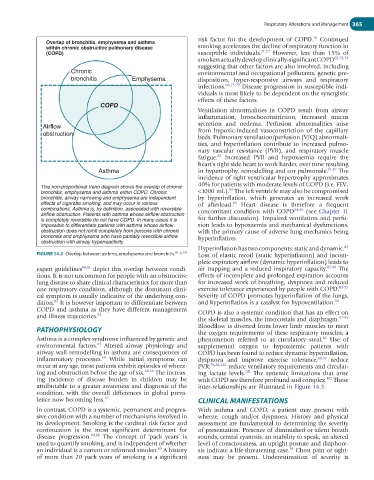
             FIGURE 14.2  Overlap between asthma, emphysema and bronchitis.       Loss of elastic recoil (static hyperinflation) and incom-
                                                          60, p. S10
                                                                  plete expiratory airflow (dynamic hyperinflation) leads to
             expert guidelines 60,61  depict this overlap between condi-  air trapping and a reduced inspiratory capacity. 87,88  The
             tions. It is not uncommon for people with an obstructive   effects of incomplete and prolonged expiration accounts
             lung disease to share clinical characteristics for more than   for increased work of breathing, dyspnoea and reduced
             one respiratory condition, although the dominant clini-  exercise tolerance experienced by people with COPD. 89-95
             cal symptom is usually indicative of the underlying con-  Severity of COPD promotes hyperinflation of the lungs,
                   62
             dition.  It is however important to differentiate between   and hyperinflation is a catalyst for hypoventilation. 96
             COPD  and  asthma  as  they  have  different  management   COPD is also a systemic condition that has an effect on
             and illness trajectories. 56
                                                                  the skeletal muscles, the intercostals and diaphragm. 97-99
             PATHOPHYSIOLOGY                                      Bloodflow is diverted from lower limb muscles to meet
                                                                  the oxygen requirements of these respiratory muscles; a
             Asthma is a complex syndrome influenced by genetic and   phenomenon  referred  to  as  circulatory  steal.   Use  of
                                                                                                           82
             environmental  factors.   Altered  airway  physiology  and   supplemental  oxygen  to  hypoxaemic  patients  with
                                 63
             airway wall remodelling in asthma are consequences of   COPD has been found to reduce dynamic hyperinflation,
             inflammatory  processes.   While  initial  symptoms  can   dyspnoea  and  improve  exercise  tolerance; 88,97   reduce
                                  64
             occur at any age, most patients exhibit episodes of wheez-  PVR; 76,86,100  reduce ventilatory requirements and circulat-
             ing and obstruction before the age of six. 65,66  The increas-  ing  lactate  levels.   The  systemic  limitations  that  arise
                                                                                 101
             ing  incidence  of  disease  burden  in  children  may  be   with COPD are therefore profound and complex.  These
                                                                                                            102
             attributable to a greater awareness and diagnosis of the   inter-relationships are illustrated in Figure 14.3.
             condition,  with  the  overall  differences  in  global  preva-
             lence now becoming less. 67                          CLINICAL MANIFESTATIONS
             In contrast, COPD is a systemic, permanent and progres-  With  asthma  and  COPD,  a  patient  may  present  with
             sive condition with a number of mechanisms involved in   wheeze,  cough  and/or  dyspnoea.  History  and  physical
             its development. Smoking is the cardinal risk factor and   assessment are fundamental to determining the severity
             continuation  is  the  most  significant  determinant  for   of presentation. Presence of diminished or silent breath
             disease  progression. 60,68   The  concept  of  ‘pack  years’  is   sounds, central cyanosis, an inability to speak, an altered
             used to quantify smoking, and is independent of whether   level of consciousness, an upright posture and diaphore-
                                                     69
                                                                                                58
             an individual is a current or reformed smoker.  A history   sis indicate a life-threatening case.  Chest pain or tight-
             of more than 20 pack years of smoking is a significant   ness  may  be  present.  Underestimation  of  severity  is

