


Page 389 - ACCCN's Critical Care Nursing
P. 389
366  P R I N C I P L E S   A N D   P R A C T I C E   O F   C R I T I C A L   C A R E

                                                                                 Ventilatory Limitation
                                                                             Increased Ventitatory Requirement
                                                                               Increased Work of Breathing
                              Deconditioning
                                           LV Dysfunction          Reduced
                                                                  Pulmonary
                                                                 Conductance
                                 O 2
                                                                                        CO 2
              •                                                                                           •
              QO 2
                                                      CO 2           O 2                                  VCO 2
                               MUSCLE              SYSTEMIC      PULMONARY             LUNGS
                            (Lactic Acidosis)     CIRCULATION    CIRCULATION
              •                                       O 2            CO 2
             QCO 2                  CO 2                                                                  •
                                                                                                          VO 2
                                                                                         O 2
                                                          RV Dysfunction
                                                                          Loss of
                                                                      Gas Exchanging
                                                                        Surface Area
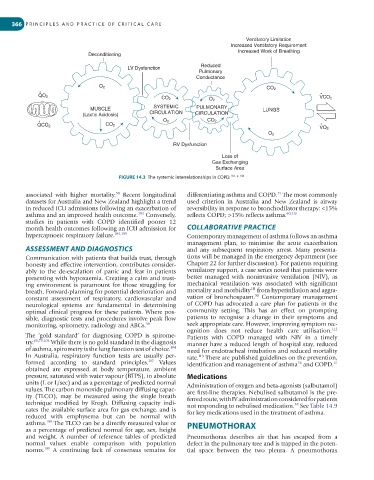
                                        FIGURE 14.3  The systemic interrelationships in COPD. 102, p. 148

                                       58
                                                                                            71
         associated  with  higher  mortality.   Recent  longitudinal   differentiating asthma and COPD.  The most commonly
         datasets for Australia and New Zealand highlight a trend   used  criterion  in  Australia  and  New  Zealand  is  airway
         in reduced ICU admissions following an exacerbation of   reversibility in response to bronchodilator therapy: <15%
         asthma and an improved health outcome.  Conversely,   reflects COPD; >15% reflects asthma. 60,110
                                              103
         studies  in  patients  with  COPD  identified  poorer  12
         month health outcomes following an ICU admission for   COLLABORATIVE PRACTICE
         hypercapnoeic respiratory failure. 104,105           Contemporary management of asthma follows an asthma
                                                              management  plan,  to  minimise  the  acute  exacerbation
         ASSESSMENT AND DIAGNOSTICS                           and  any  subsequent  respiratory  arrest.  Many  presenta-
         Communication with patients that builds trust, through   tions will be managed in the emergency department (see
         honesty and effective intervention, contributes consider-  Chapter 22 for further discussion). For patients requiring
         ably  to  the  de-escalation  of  panic  and  fear  in  patients   ventilatory support, a case series noted that patients were
         presenting with hypoxaemia. Creating a calm and trust-  better  managed  with  noninvasive  ventilation  (NIV),  as
         ing  environment  is  paramount  for  those  struggling  for   mechanical  ventilation  was  associated  with  significant
                                                                                   111
         breath. Forward-planning for potential deterioration and   mortality and morbidity  from hyperinflation and aggra-
                                                                                    58
         constant  assessment  of  respiratory,  cardiovascular  and   vation  of  bronchospasm.   Contemporary  management
         neurological  systems  are  fundamental  in  determining   of COPD has advocated a care plan for patients in the
         optimal clinical progress for these patients. Where pos-  community  setting.  This  has  an  effect  on  prompting
         sible, diagnostic tests and procedures involve peak flow   patients  to  recognise  a  change  in  their  symptoms  and
         monitoring, spirometry, radiology and ABGs. 58       seek appropriate care. However, improving symptom rec-
                                                                                                              112
                                                              ognition  does  not  reduce  health  care  utilisation.
         The  ‘gold  standard’  for  diagnosing  COPD  is  spirome-  Patients  with  COPD  managed  with  NIV  in  a  timely
         try. 60,75,106  While there is no gold standard in the diagnosis   manner have a reduced length of hospital stay, reduced
         of asthma, spirometry is the lung function test of choice.    need for endotracheal intubation and reduced mortality
                                                         104
         In  Australia,  respiratory  function  tests  are  usually  per-  rate.  There are published guidelines on the prevention,
                                                                  113
         formed  according  to  standard  principles.   Values   identification and management of asthma  and COPD. 61
                                                  107
                                                                                                  56
         obtained  are  expressed  at  body  temperature,  ambient
         pressure, saturated with water vapour (BTPS), in absolute   Medications
         units (L or L/sec) and as a percentage of predicted normal   Administration of oxygen and beta-agonists (salbutamol)
         values. The carbon monoxide pulmonary diffusing capac-  are first-line therapies. Nebulised salbutamol is the pre-
         ity  (TLCO),  may  be  measured  using  the  single  breath   ferred route, with IV administration considered for patients
         technique  modified  by  Krogh.  Diffusing  capacity  indi-  not responding to nebulised medication.  See Table 14.9
                                                                                                 58
         cates the available surface area for gas exchange, and is   for key medications used in the treatment of asthma.
         reduced  with  emphysema  but  can  be  normal  with
                108
         asthma.  The TLCO can be a directly measured value or   PNEUMOTHORAX
         as a percentage of predicted normal for age, sex, height
         and  weight.  A  number  of  reference  tables  of  predicted   Pneumothorax  describes  air  that  has  escaped  from  a
         normal  values  enable  comparison  with  population   defect in the pulmonary tree and is trapped in the poten-
               109
         norms.   A  continuing  lack  of  consensus  remains  for   tial  space  between  the  two  pleura.  A  pneumothorax

