


Page 418 - ACCCN's Critical Care Nursing
P. 418
Ventilation and Oxygenation Management 395


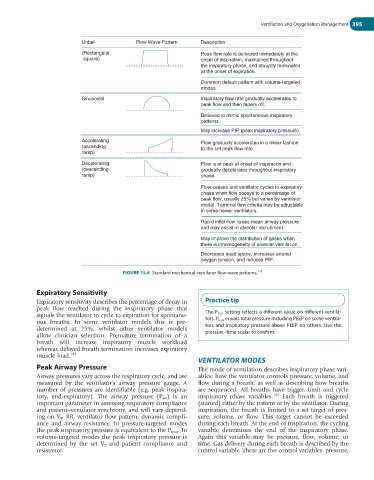
                            Unbel             Flow Wave Pattern    Description
                            (Rectangular,                          Peak flow rate is delivered immedately at the
                             square)                               onset of inspiration, maintained throughout
                                                                   the inspiratory phase, and abruptly terminated
                                                                   at the onset of expiration.
                                                                   Common default pattern with volume-targeted
                                                                   modes.

                            Sinusoidal                             Inspiratory flow rate gradually accelerates to
                                                                   peak flow and then tapers off.
                                                                   Believed to mimic spontaneous inspiratory
                                                                   patterns.
                                                                   May increase PIP (peak inspiratory pressure).
                            Accelerating                           Flow gradually accelerates in a linear fashion
                            (ascending                             to the set peak flow rate.
                            ramp)

                            Decelerating                           Flow is at peak at onset of inspiration and
                            (descending                            gradually decelerates throughout inspiratory
                            ramp)                                  phase.

                                                                   Flow ceases and ventilator cycles to expiratory
                                                                   phase when flow decays to a percentage of
                                                                   peak flow, usually 25% but varies by ventilator
                                                                   model. Terminal flow criteria may be adjustable
                                                                   in some newer ventilators.

                                                                   Rapid intial flow raises mean airway pressure
                                                                   and may assist in alveolar recruitment.
                                                                   May improve the distribution of gases when
                                                                   there is inhomogeneity of alveolar ventilation.
                                                                   Decreases dead space, increases arterial
                                                                   oxygen tension, and reduces PIP.

                                         FIGURE 15.4  Standard mechanical ventilator flow-wave patterns.
                                                                                     129

             Expiratory Sensitivity
             Expiratory sensitivity describes the percentage of decay in   Practice tip
             peak  flow  reached  during  the  inspiratory  phase  that
             signals the ventilator to cycle to expiration for spontane-  The P insp  setting reflects a different value on different ventila-
             ous  breaths.  In  some  ventilator  models  this  is  pre-  tors. P insp  equals total pressure including PEEP on some ventila-
             determined  at  25%,  whilst  other  ventilator  models     tors  and  inspiratory  pressure  above  PEEP  on  others.  Use  the
             allow  clinician  selection.  Premature  termination  of  a   pressure–time scalar to confirm.
             breath  will  increase  inspiratory  muscle  workload
             whereas delayed breath termination increases expiratory
             muscle load. 143
                                                                  VENTILATOR MODES
             Peak Airway Pressure                                 The mode of ventilation describes inspiratory phase vari-
             Airway pressures vary across the respiratory cycle, and are   ables; how the ventilator controls pressure, volume, and
             measured  by  the  ventilator’s  airway  pressure  gauge.  A   flow during a breath; as well as describing how breaths
             number  of  pressures  are  identifiable  (e.g.  peak  inspira-  are  sequenced.  All  breaths  have  trigger,  limit  and  cycle
             tory,  end-expiratory).  The  airway  pressure  (P aw )  is  an   inspiratory  phase  variables. 144   Each  breath  is  triggered
             important parameter in assessing respiratory compliance   (started) either by the patient or by the ventilator. During
             and patient–ventilator synchrony, and will vary depend-  inspiration, the breath is limited to a set target of pres-
             ing on V T , RR, ventilator flow pattern, dynamic compli-  sure,  volume,  or  flow.  This  target  cannot  be  exceeded
             ance  and  airway  resistance.  In  pressure-targeted  modes   during each breath. At the end of inspiration, the cycling
             the peak inspiratory pressure is equivalent to the P insp . In   variable  determines  the  end  of  the  inspiratory  phase.
             volume-targeted modes the peak inspiratory pressure is   Again  this  variable  may  be  pressure,  flow,  volume,  or
             determined  by  the  set  V T  and  patient  compliance  and   time. Gas delivery during each breath is described by the
             resistance.                                          control variable. There are five control variables: pressure,

