


Page 417 - ACCCN's Critical Care Nursing
P. 417
394  P R I N C I P L E S   A N D   P R A C T I C E   O F   C R I T I C A L   C A R E


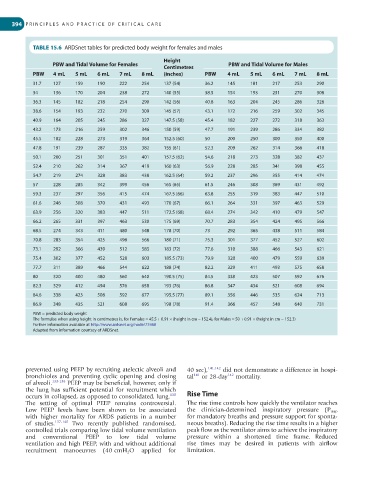
            TABLE 15.6  ARDSnet tables for predicted body weight for females and males

                                                       Height
                  PBW and Tidal Volume for Females                          PBW and Tidal Volume for Males
                                                       Centimetres
            PBW   4 mL    5 mL   6 mL   7 mL   8 mL    (inches)     PBW    4 mL    5 mL   6 mL   7 mL    8 mL
            31.7  127     159    190    222    254     137 (54)     36.2   145     181    217    253     290
            34    136     170    204    238    272     140 (55)     38.5   154     193    231    270     308
            36.3  145     182    218    254    290     142 (56)     40.8   163     204    245    286     326
            38.6  154     193    232    270    309     145 (57)     43.1   172     216    259    302     345
            40.9  164     205    245    286    327     147.5 (58)   45.4   182     227    272    318     363
            43.2  173     216    259    302    346     150 (59)     47.7   191     239    286    334     382
            45.5  182     228    273    319    364     152.5 (60)   50     200     250    300    350     400
            47.8  191     239    287    335    382     155 (61)     52.3   209     262    314    366     418
            50.1  200     251    301    351    401     157.5 (62)   54.6   218     273    328    382     437
            52.4  210     262    314    367    419     160 (63)     56.9   228     285    341    398     455
            54.7  219     274    328    383    438     162.5 (64)   59.2   237     296    355    414     474
            57    228     285    342    399    456     165 (65)     61.5   246     308    369    431     492
            59.3  237     297    356    415    474     167.5 (66)   63.8   255     319    383    447     510
            61.6  246     308    370    431    493     170 (67)     66.1   264     331    397    463     529
            63.9  256     320    383    447    511     172.5 (68)   68.4   274     342    410    479     547
            66.2  265     331    397    463    530     175 (69)     70.7   283     354    424    495     566
            68.5  274     343    411    480    548     178 (70)     73     292     365    438    511     584
            70.8  283     354    425    496    566     180 (71)     75.3   301     377    452    527     602
            73.1  292     366    439    512    585     183 (72)     77.6   310     388    466    543     621
            75.4  302     377    452    528    603     185.5 (73)   79.9   320     400    479    559     639
            77.7  311     389    466    544    622     188 (74)     82.2   329     411    493    575     658
            80    320     400    480    560    640     190.5 (75)   84.5   338     423    507    592     676
            82.3  329     412    494    576    658     193 (76)     86.8   347     434    521    608     694
            84.6  338     423    508    592    677     195.5 (77)   89.1   356     446    535    624     713
            86.9  348     435    521    608    695     198 (78)     91.4   366     457    548    640     731
            PBW = predicted body weight
            The formulae when using height in centimetres is, for Females = 45.5 + 0.91 × (height in cm − 152.4), for Males = 50 + 0.91 × (height in cm − 152.3)
            Further information available at http://www.ardsnet.org/node/77460
            Adapted from information courtesy of ARDSnet.


         prevented using PEEP by recruiting atelectic alveoli and   40 sec), 141,142  did not demonstrate a difference in hospi-
         bronchioles  and  preventing  cyclic  opening  and  closing   tal  or 28-day 142  mortality.
                                                                141
         of alveoli. 133-136  PEEP may be beneficial, however, only if
         the  lung  has  sufficient  potential  for  recruitment  which
                                                         130
         occurs in collapsed, as opposed to consolidated, lung.    Rise Time
         The  setting  of  optimal  PEEP  remains  controversial.    The rise time controls how quickly the ventilator reaches
         Low  PEEP  levels  have  been  shown  to  be  associated     the  clinician-determined  inspiratory  pressure  (P insp
         with  higher  mortality  for  ARDS  patients  in  a  number     for mandatory breaths and pressure support for sponta-
         of  studies. 137-140   Two  recently  published  randomised,   neous breaths). Reducing the rise time results in a higher
         controlled trials comparing low tidal volume ventilation   peak flow as the ventilator aims to achieve the inspiratory
         and  conventional  PEEP  to  low  tidal  volume      pressure  within  a  shortened  time  frame.  Reduced
         ventilation and high PEEP, with and without additional   rise  times  may  be  desired  in  patients  with  airflow
         recruitment  man oeuvres  (40 cmH 2 O  applied  for   limitation.

