


Page 422 - ACCCN's Critical Care Nursing
P. 422
Ventilation and Oxygenation Management 399

                             Pressure
                              (kPa)
                                              C                 Peak pressure

                                                                                                            .
                                                                                                           .
                                                                                       ‘Resistance pressure’ (R  V)
                                                 D
                                                           E    Plateau pressure
                                   B
                                           Gradient
                                           .
                  Resistance               V/C                                         ‘Compliance pressure’ (V /C)
                                                                                                           T
                  Pressure
                     .
                      .
                  (R  V)         A     Flow-      Pause                        F
                                       phase      phase
                                                                                         ‘PEEP’
                                                                                        Time (s)
                                       Inspiration time          Expiration time
                                                                                      (V  insp  = const.)
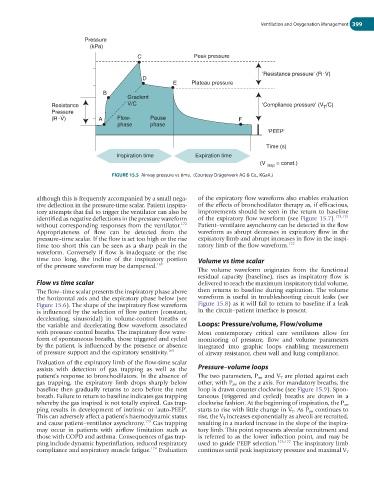
                                      FIGURE 15.5  Airway pressure vs time.  (Courtesy Drägerwerk AG & Co., KGaA.)


             although this is frequently accompanied by a small nega-  of the expiratory flow waveform also enables evaluation
             tive deflection in the pressure-time scalar. Patient inspira-  of the effects of bronchodilator therapy as, if efficacious,
             tory attempts that fail to trigger the ventilator can also be   improvements should be seen in the return to baseline
             identified as negative deflections in the pressure waveform   of the expiratory flow waveform (see Figure 15.7). 173,175
             without corresponding responses from the ventilator. 172    Patient–ventilator asynchrony can be detected in the flow
             Appropriateness  of  flow  can  be  detected  from  the   waveform as abrupt decreases in expiratory flow in the
             pressure–time scalar. If the flow is set too high or the rise   expiratory limb and abrupt increases in flow in the inspi-
             time too short this can be seen as a sharp peak in the   ratory limb of the flow waveform. 172
             waveform.  Conversely  if  flow  is  inadequate  or  the  rise
             time  too  long,  the  incline  of  the  inspiratory  portion    Volume vs time scalar
             of the pressure waveform may be dampened. 169
                                                                  The  volume  waveform  originates  from  the  functional
                                                                  residual  capacity  (baseline),  rises  as  inspiratory  flow  is
             Flow vs time scalar                                  delivered to reach the maximum inspiratory tidal volume,
             The flow–time scalar presents the inspiratory phase above   then returns to baseline during expiration. The volume
             the horizontal axis and the expiratory phase below (see   waveform is useful in troubleshooting circuit leaks (see
             Figure 15.6). The shape of the inspiratory flow waveform   Figure 15.8) as it will fail to return to baseline if a leak
             is influenced by the selection of flow pattern (constant,   in the circuit–patient interface is present.
             decelerating,  sinusoidal)  in  volume-control  breaths  or
             the  variable  and  decelerating  flow  waveform  associated   Loops: Pressure/volume, Flow/volume
             with pressure-control breaths. The inspiratory flow wave-  Most  contemporary  critical  care  ventilators  allow  for
             form of spontaneous breaths, those triggered and cycled   monitoring  of  pressure,  flow  and  volume  parameters
             by the patient, is influenced by the presence or absence   integrated  into  graphic  loops  enabling  measurement
             of pressure support and the expiratory sensitivity. 169  of airway resistance, chest wall and lung compliance.
             Evaluation of the expiratory limb of the flow-time scalar
             assists  with  detection  of  gas  trapping  as  well  as  the   Pressure–volume loops
             patient’s response to bronchodilators. In the absence of   The two parameters, P aw  and V T  are plotted against each
             gas  trapping,  the  expiratory  limb  drops  sharply  below   other, with P aw  on the x axis. For mandatory breaths, the
             baseline  then  gradually  returns  to  zero  before  the  next   loop is drawn counter clockwise (see Figure 15.9). Spon-
             breath. Failure to return to baseline indicates gas trapping   taneous  (triggered  and  cycled)  breaths  are  drawn  in  a
             whereby the gas inspired is not totally expired. Gas trap-  clockwise fashion. At the beginning of inspiration, the P aw
             ping  results  in  development  of  intrinsic  or  ‘auto-PEEP’.   starts to rise with little change in V T . As P aw  continues to
             This can adversely affect a patient’s haemodynamic status   rise, the V T  increases exponentially as alveoli are recruited,
             and cause patient–ventilator asynchrony. 173  Gas trapping   resulting in a marked increase in the slope of the inspira-
             may  occur  in  patients  with  airflow  limitation  such  as   tory limb. This point represents alveolar recruitment and
             those with COPD and asthma. Consequences of gas trap-  is referred to as the lower inflection point, and may be
             ping include dynamic hyperinflation, reduced respiratory   used to guide PEEP selection. 176,177  The inspiratory limb
             compliance and respiratory muscle fatigue. 174  Evaluation   continues until peak inspiratory pressure and maximal V T

